Minerals and Energy Resources
CBSE · Class 10 · Social Science
Quick revision notes for Minerals and Energy Resources — CBSE Class 10 Social Science. Key concepts, formulas, and definitions for last-minute revision.
Interactive on Super Tutor
Studying Minerals and Energy Resources? Get the full interactive chapter.
Quizzes, flashcards, AI doubt-solver and a step-by-step study plan — built for revision notes and more.
1,000+ Class 10 students started this chapter today
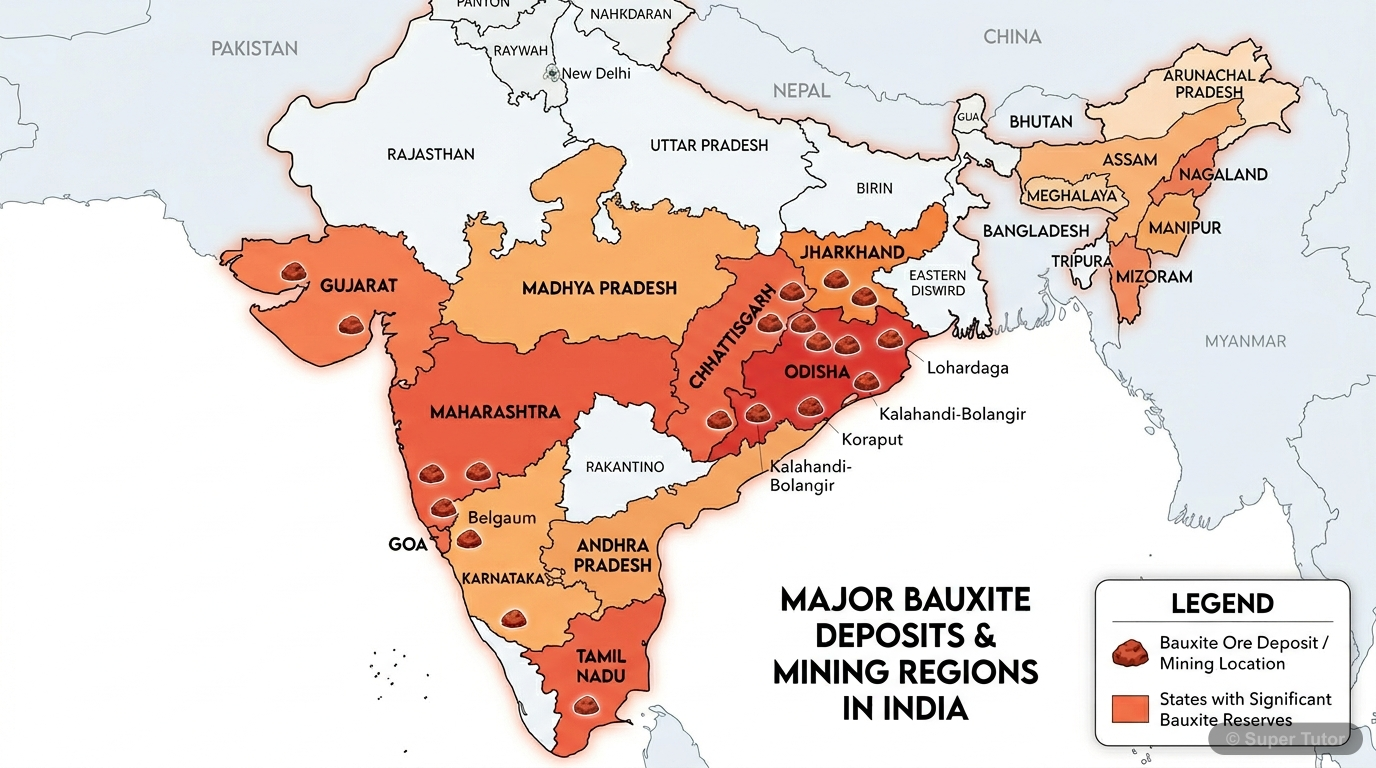
Learn better with visuals Super Tutor has hundreds of illustrations like this across every chapter — all free to try.
Get startedKey Topics to Revise
Introduction to Minerals
- Minerals are homogeneous, naturally occurring substances with definable internal structure
- Over 2000 minerals identified, but only a few are abundantly found in rocks
- Minerals are essential for all life processes and industrial activities
Mode of Occurrence of Minerals
- Igneous and metamorphic rocks: Minerals occur in veins and lodes (tin, copper, zinc, lead)
- Sedimentary rocks: Minerals occur in beds/layers (coal, iron ore, gypsum, potash salt)
- Weathering and decomposition: Residual mass formation (bauxite)
Ferrous Minerals
- Account for 3/4th of total metallic mineral production value in India
- Iron ore is backbone of industrial development with two main types:
- Magnetite: Finest quality (70% iron content), excellent magnetic properties
Non-Ferrous Minerals
- India's reserves and production not very satisfactory
- Include copper, bauxite, lead, zinc, and gold
- Copper: Critically deficient, malleable, ductile, good conductor
Get complete notes with diagrams and examples
Full NotesKey Concepts
Frequently Asked Questions
What are the important topics in Minerals and Energy Resources for CBSE Class 10 Social Science?
How to score full marks in Minerals and Energy Resources — CBSE Class 10 Social Science?
Sources & Official References
- NCERT Official — ncert.nic.in
- CBSE Academic — cbseacademic.nic.in
- CBSE Official — cbse.gov.in
- National Education Policy 2020 — education.gov.in
Content is aligned to the official syllabus. Refer to the board website for the latest curriculum.
More resources for Minerals and Energy Resources
Important Questions
Practice with board exam-style questions
Syllabus
What topics to cover
Study Plan
Step-by-step plan to ace this chapter
Flashcards
Quick-fire cards for active recall
Formula Sheet
All formulas in one place
Chapter Summary
Understand the chapter at a glance
Practice Quiz
Test yourself with a quick quiz
Concept Maps
See how topics connect visually
For serious students
Get the full Minerals and Energy Resources chapter — for free.
Quizzes, flashcards, AI doubt-solver and a step-by-step study plan for CBSE Class 10 Social Science.