Dissolution of Partnership Firm
CBSE · Class 12 · Accountancy
Quick revision notes for Dissolution of Partnership Firm — CBSE Class 12 Accountancy. Key concepts, formulas, and definitions for last-minute revision.
Interactive on Super Tutor
Studying Dissolution of Partnership Firm? Get the full interactive chapter.
Quizzes, flashcards, AI doubt-solver and a step-by-step study plan — built for revision notes and more.
1,000+ Class 12 students started this chapter today
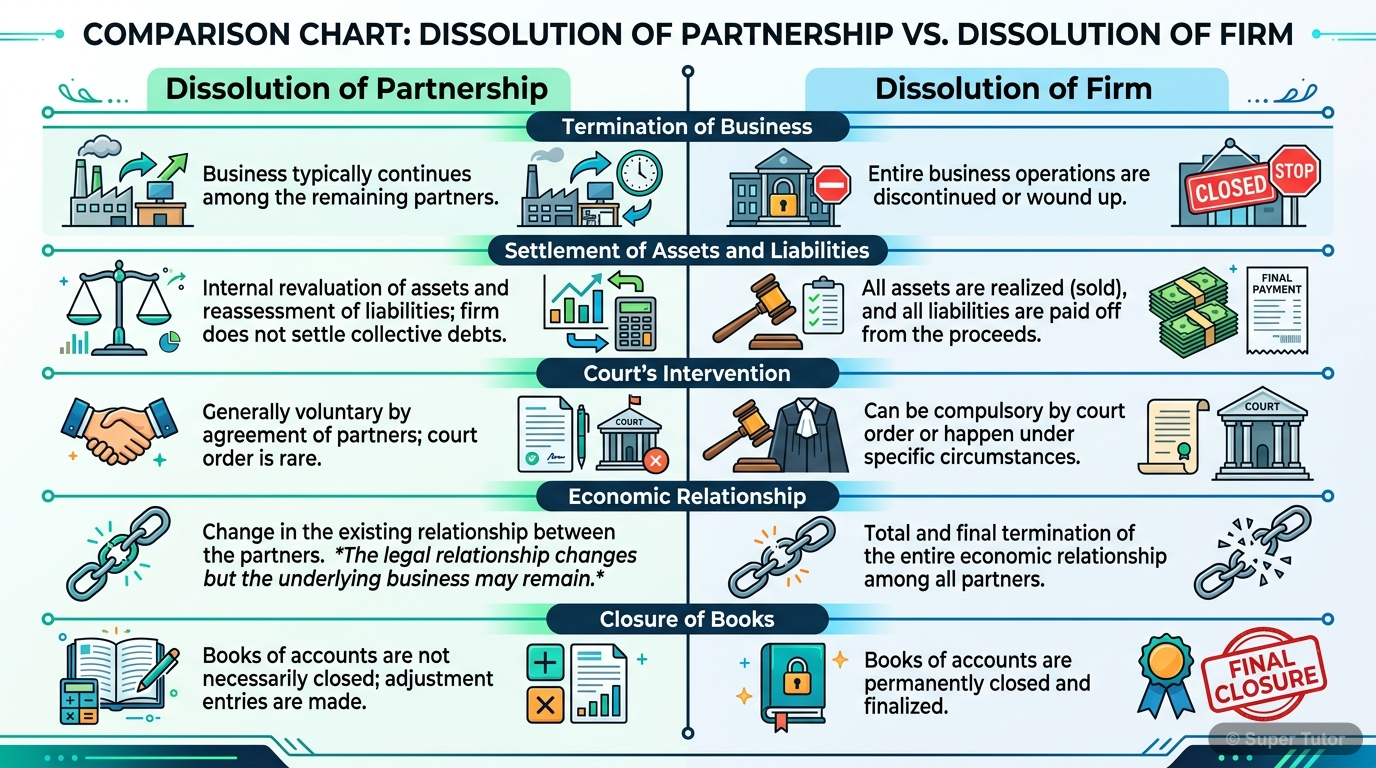
Learn better with visuals Super Tutor has hundreds of illustrations like this across every chapter — all free to try.
Get startedKey Topics to Revise
Basic Concepts and Distinctions
- Dissolution of Partnership vs Dissolution of Firm - Partnership dissolution changes relationship but firm may continue; Firm dissolution terminates business completely
- Section 39 of Partnership Act 1932 defines dissolution of firm as breaking of relationship between ALL partners
- After firm dissolution, only winding up activities are allowed - no regular business transactions
Modes of Dissolution
- Dissolution by Agreement - With consent of all partners or as per partnership contract
- Compulsory Dissolution - When all partners become insolvent, business becomes illegal, or partners become alien enemies
- Dissolution on Contingencies - Expiry of fixed term, completion of venture, death of partner, insolvency of partner
Settlement of Accounts (Section 48)
- Treatment of Losses - First from profits, then from capital, finally by partners in PSR
- Application of Assets - External debts first, then partner's loans proportionately, then capital proportionately, surplus in PSR
- Private debts and firm debts are separate - firm property for firm debts first
Realisation Account - Format and Rules
- Debit side - All assets except cash/bank and fictitious assets, payment of liabilities, realisation expenses
- Credit side - All external liabilities, sale proceeds of assets, assets taken by partners
- Cash and Bank accounts are not transferred to Realisation Account
Get complete notes with diagrams and examples
Full NotesKey Concepts
Frequently Asked Questions
What are the important topics in Dissolution of Partnership Firm for CBSE Class 12 Accountancy?
How to score full marks in Dissolution of Partnership Firm — CBSE Class 12 Accountancy?
Sources & Official References
- NCERT Official — ncert.nic.in
- CBSE Academic — cbseacademic.nic.in
- CBSE Official — cbse.gov.in
- National Education Policy 2020 — education.gov.in
Content is aligned to the official syllabus. Refer to the board website for the latest curriculum.
More resources for Dissolution of Partnership Firm
Important Questions
Practice with board exam-style questions
Syllabus
What topics to cover
Study Plan
Step-by-step plan to ace this chapter
Flashcards
Quick-fire cards for active recall
Formula Sheet
All formulas in one place
Chapter Summary
Understand the chapter at a glance
Practice Quiz
Test yourself with a quick quiz
Concept Maps
See how topics connect visually
For serious students
Get the full Dissolution of Partnership Firm chapter — for free.
Quizzes, flashcards, AI doubt-solver and a step-by-step study plan for CBSE Class 12 Accountancy.