Organisms and Populations
CBSE · Class 12 · Biology
Summary of Organisms and Populations for CBSE Class 12 Biology. Key concepts, important points, and chapter overview.
Interactive on Super Tutor
Studying Organisms and Populations? Get the full interactive chapter.
Quizzes, flashcards, AI doubt-solver and a step-by-step study plan — built for chapter summary and more.
1,000+ Class 12 students started this chapter today
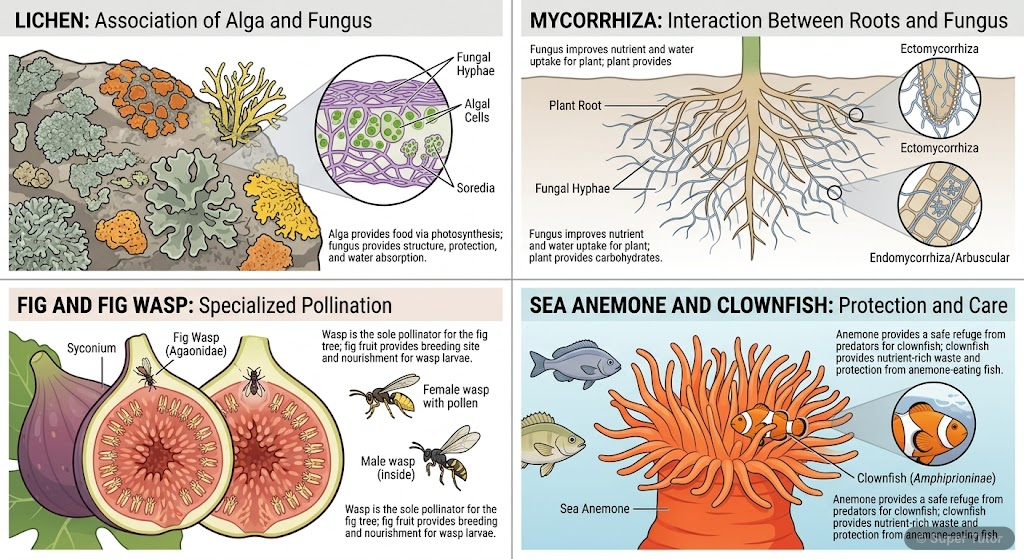
Learn better with visuals Super Tutor has hundreds of illustrations like this across every chapter — all free to try.
Get startedOverview
This chapter explores ecology at the population level, focusing on how groups of organisms interact with each other and their environment. Ecology studies interactions at four levels: organisms, populations, communities, and biomes. Understanding population ecology is crucial as it links ecology to
Key Concepts
A population is a group
A population is a group of individuals of the same species living in a defined geographical area, sharing resources and potentially interbreeding. Unl
Age pyramids graphically represent the age
Age pyramids graphically represent the age distribution of males and females in a population. The shape indicates population status: expanding (triang
Population density (N) measures the number
Population density (N) measures the number of individuals per unit area or volume. It can be expressed as total numbers, biomass, or percentage cover
When resources are unlimited
When resources are unlimited, populations grow exponentially following the equation dN/dt = rN, where r is the intrinsic rate of natural increase. Thi
In nature
In nature, resources are limited, leading to logistic growth described by dN/dt = rN(K-N)/K, where K is the carrying capacity. This creates an S-shape
Learning Objectives
- Understand population attributes and characteristics that distinguish populations from individual organisms
- Analyze population growth patterns including exponential and logistic growth models
- Explain the concept of carrying capacity and intrinsic rate of natural increase
- Identify and describe different types of population interactions in ecosystems
- Evaluate the ecological significance of predation, competition, parasitism, commensalism, and mutualism
Frequently Asked Questions
What are the important topics in Organisms and Populations for CBSE Class 12 Biology?
How to score full marks in Organisms and Populations — CBSE Class 12 Biology?
Sources & Official References
- NCERT Official — ncert.nic.in
- CBSE Academic — cbseacademic.nic.in
- CBSE Official — cbse.gov.in
- National Education Policy 2020 — education.gov.in
Content is aligned to the official syllabus. Refer to the board website for the latest curriculum.
More resources for Organisms and Populations
Important Questions
Practice with board exam-style questions
Syllabus
What topics to cover
Revision Notes
Key points for last-minute revision
Study Plan
Step-by-step plan to ace this chapter
Flashcards
Quick-fire cards for active recall
Formula Sheet
All formulas in one place
Practice Quiz
Test yourself with a quick quiz
Concept Maps
See how topics connect visually
For serious students
Get the full Organisms and Populations chapter — for free.
Quizzes, flashcards, AI doubt-solver and a step-by-step study plan for CBSE Class 12 Biology.