Planning and Sustainable Development in Indian Context
CBSE · Class 12 · Geography
Quick revision notes for Planning and Sustainable Development in Indian Context — CBSE Class 12 Geography. Key concepts, formulas, and definitions for last-minute revision.
Interactive on Super Tutor
Studying Planning and Sustainable Development in Indian Context? Get the full interactive chapter.
Quizzes, flashcards, AI doubt-solver and a step-by-step study plan — built for revision notes and more.
1,000+ Class 12 students started this chapter today
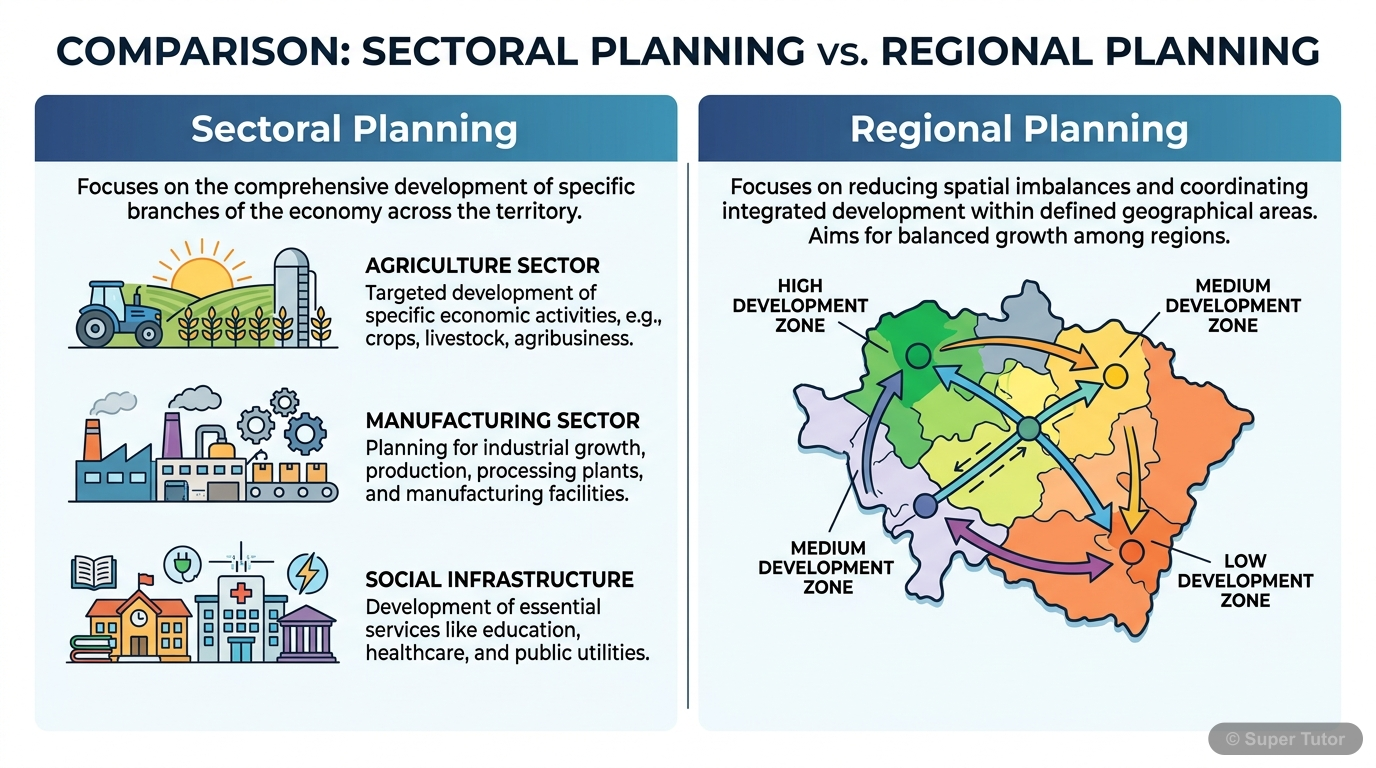
Learn better with visuals Super Tutor has hundreds of illustrations like this across every chapter — all free to try.
Get startedKey Topics to Revise
Planning in India: Evolution and Approaches
- Planning involves thinking, formulation of schemes/programmes and implementation to achieve specific goals
- India adopted centralized planning after Independence through Five Year Plans
- Planning Commission was replaced by NITI Aayog on 1st January 2015
Target Area and Target Group Approaches
- Introduced to arrest regional and social disparities
- Target Area Programmes: Command Area Development, Drought Prone Area Development, Desert Development, Hill Area Development
- Target Group Programmes: Small Farmers Development Agency (SFDA), Marginal Farmers Development Agency (MFDA)
Hill Area Development Programme
- Initiated during Fifth Five Year Plan covering 15 districts
- Covered hilly districts of UP (now Uttarakhand), Mikir Hill and North Cachar hills of Assam, Darjeeling (West Bengal), Nilgiri (Tamil Nadu)
- National Committee (1981) recommended areas above 600m height as backward hill areas
Drought Prone Area Development Programme
- Initiated during Fourth Five Year Plan
- Objectives: providing employment and creating productive assets
- Initially focused on labour-intensive civil works, later on irrigation, land development, afforestation, grassland development
Get complete notes with diagrams and examples
Full NotesKey Concepts
Frequently Asked Questions
What are the important topics in Planning and Sustainable Development in Indian Context for CBSE Class 12 Geography?
How to score full marks in Planning and Sustainable Development in Indian Context — CBSE Class 12 Geography?
Sources & Official References
- NCERT Official — ncert.nic.in
- CBSE Academic — cbseacademic.nic.in
- CBSE Official — cbse.gov.in
- National Education Policy 2020 — education.gov.in
Content is aligned to the official syllabus. Refer to the board website for the latest curriculum.
More resources for Planning and Sustainable Development in Indian Context
Important Questions
Practice with board exam-style questions
Syllabus
What topics to cover
Study Plan
Step-by-step plan to ace this chapter
Flashcards
Quick-fire cards for active recall
Formula Sheet
All formulas in one place
Chapter Summary
Understand the chapter at a glance
Practice Quiz
Test yourself with a quick quiz
Concept Maps
See how topics connect visually
For serious students
Get the full Planning and Sustainable Development in Indian Context chapter — for free.
Quizzes, flashcards, AI doubt-solver and a step-by-step study plan for CBSE Class 12 Geography.