Social Influence and Group Processes
CBSE · Class 12 · Psychology
Summary of Social Influence and Group Processes for CBSE Class 12 Psychology. Key concepts, important points, and chapter overview.
Interactive on Super Tutor
Studying Social Influence and Group Processes? Get the full interactive chapter.
Quizzes, flashcards, AI doubt-solver and a step-by-step study plan — built for chapter summary and more.
1,000+ Class 12 students started this chapter today
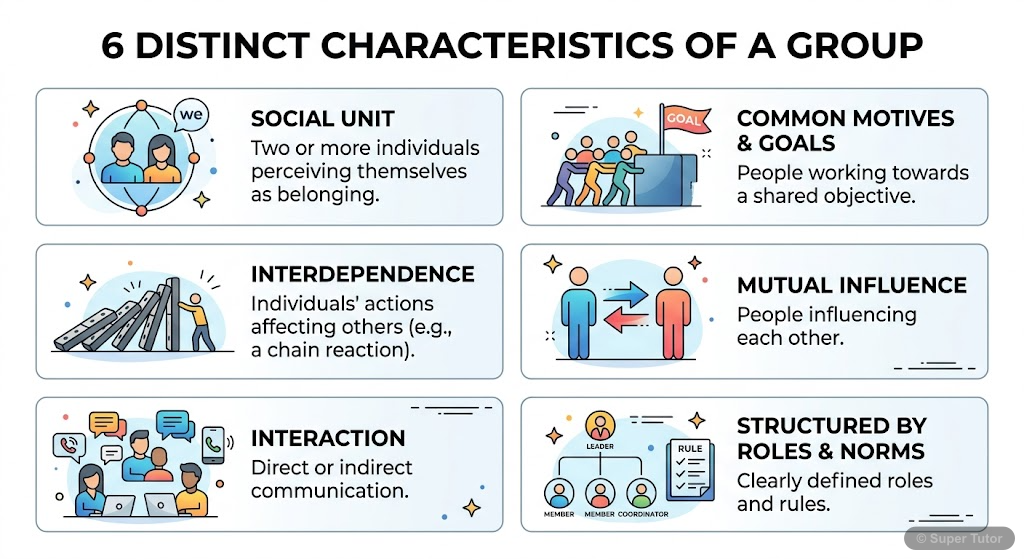
This is just one of 9+ visuals inside Super Tutor's Social Influence and Group Processes chapter
Explore the full setOverview
This chapter explores how groups shape our daily lives and influence our behavior. From morning interactions with family to school discussions with classmates and playing with friends, we are constantly part of various groups. Groups provide essential support, comfort, and facilitate personal growth
Key Concepts
A group is an organized system
A group is an organized system of two or more individuals who interact and are interdependent, have common motives, defined roles, status relationship
Tuckman's five stages
Tuckman's five stages: Forming (uncertainty and getting to know each other), Storming (conflict over goals and leadership), Norming (developing rules
Four key elements
Four key elements: Roles (expected behaviors), Norms (unspoken rules), Status (relative social position), and Cohesiveness (togetherness and mutual at
The tendency for individuals to exert
The tendency for individuals to exert less effort when working in a group compared to working alone, especially when individual contributions cannot b
Groups tend to make more extreme
Groups tend to make more extreme decisions than individuals would make alone. Initial group positions become stronger after discussion, leading to eit
Learning Objectives
- Understand the nature and characteristics of groups and how they differ from other collections of people
- Learn about the process of group formation and the stages groups go through
- Examine different types of groups including primary-secondary, formal-informal, and ingroup-outgroup distinctions
- Analyze how groups influence individual behavior through phenomena like social facilitation and social loafing
- Understand group polarization and groupthink as important group processes
Frequently Asked Questions
What are the important topics in Social Influence and Group Processes for CBSE Class 12 Psychology?
How to score full marks in Social Influence and Group Processes — CBSE Class 12 Psychology?
Sources & Official References
- NCERT Official — ncert.nic.in
- CBSE Academic — cbseacademic.nic.in
- CBSE Official — cbse.gov.in
- National Education Policy 2020 — education.gov.in
Content is aligned to the official syllabus. Refer to the board website for the latest curriculum.
More resources for Social Influence and Group Processes
Important Questions
Practice with board exam-style questions
Syllabus
What topics to cover
Revision Notes
Key points for last-minute revision
Study Plan
Step-by-step plan to ace this chapter
Flashcards
Quick-fire cards for active recall
Formula Sheet
All formulas in one place
Practice Quiz
Test yourself with a quick quiz
Concept Maps
See how topics connect visually
For serious students
Get the full Social Influence and Group Processes chapter — for free.
Quizzes, flashcards, AI doubt-solver and a step-by-step study plan for CBSE Class 12 Psychology.