Meeting Life Challenges
CBSE · Class 12 · Psychology
Quick revision notes for Meeting Life Challenges — CBSE Class 12 Psychology. Key concepts, formulas, and definitions for last-minute revision.
Interactive on Super Tutor
Studying Meeting Life Challenges? Get the full interactive chapter.
Quizzes, flashcards, AI doubt-solver and a step-by-step study plan — built for revision notes and more.
1,000+ Class 12 students started this chapter today
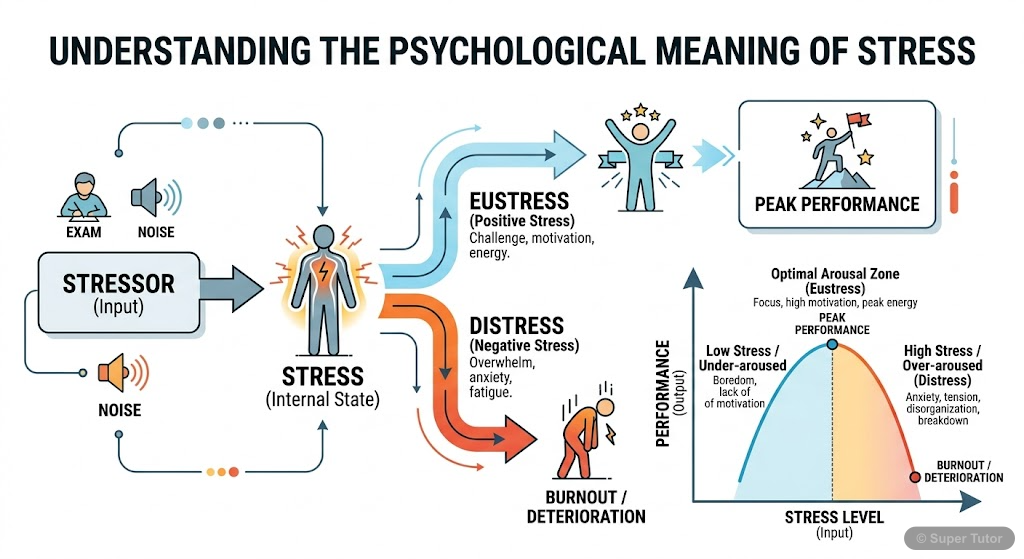
Super Tutor has 10+ illustrations like this for Meeting Life Challenges alone — flashcards, concept maps, and step-by-step visuals.
See them allKey Topics to Revise
Nature, Types and Sources of Stress
- Stress is a dynamic mental/cognitive state involving disruption in homeostasis that requires resolution
- Stress is not inherently bad - 'Eustress' is positive stress that enhances performance, while 'Distress' causes harm
- Stress involves transaction between individual and environment, not just a stimulus or response
Effects of Stress on Psychological Functioning and Health
- Four major effects: Emotional, Physiological, Cognitive, and Behavioral
- Emotional effects: mood swings, anxiety, depression, erratic behavior
- Physiological effects: increased adrenaline/cortisol, changes in heart rate, blood pressure, metabolism
General Adaptation Syndrome and Immune System
- Selye's General Adaptation Syndrome (GAS) has three stages:
- 1. Alarm Reaction: activation of adrenal-pituitary-cortex system, fight-or-flight response
- 2. Resistance: parasympathetic system manages resources, organism copes with threat
Coping with Stress
- Coping is dynamic, situation-specific reaction to stress involving concrete responses to resolve problems
- Three coping strategies by Endler and Parker:
- 1. Task-oriented: obtaining information, deciding priorities, direct action
Get complete notes with diagrams and examples
Full NotesKey Concepts
Frequently Asked Questions
What are the important topics in Meeting Life Challenges for CBSE Class 12 Psychology?
How to score full marks in Meeting Life Challenges — CBSE Class 12 Psychology?
Sources & Official References
- NCERT Official — ncert.nic.in
- CBSE Academic — cbseacademic.nic.in
- CBSE Official — cbse.gov.in
- National Education Policy 2020 — education.gov.in
Content is aligned to the official syllabus. Refer to the board website for the latest curriculum.
More resources for Meeting Life Challenges
Important Questions
Practice with board exam-style questions
Syllabus
What topics to cover
Study Plan
Step-by-step plan to ace this chapter
Flashcards
Quick-fire cards for active recall
Formula Sheet
All formulas in one place
Chapter Summary
Understand the chapter at a glance
Practice Quiz
Test yourself with a quick quiz
Concept Maps
See how topics connect visually
For serious students
Get the full Meeting Life Challenges chapter — for free.
Quizzes, flashcards, AI doubt-solver and a step-by-step study plan for CBSE Class 12 Psychology.