Introducing Indian Society
CBSE · Class 12 · Sociology
Summary of Introducing Indian Society for CBSE Class 12 Sociology. Key concepts, important points, and chapter overview.
Interactive on Super Tutor
Studying Introducing Indian Society? Get the full interactive chapter.
Quizzes, flashcards, AI doubt-solver and a step-by-step study plan — built for chapter summary and more.
1,000+ Class 12 students started this chapter today
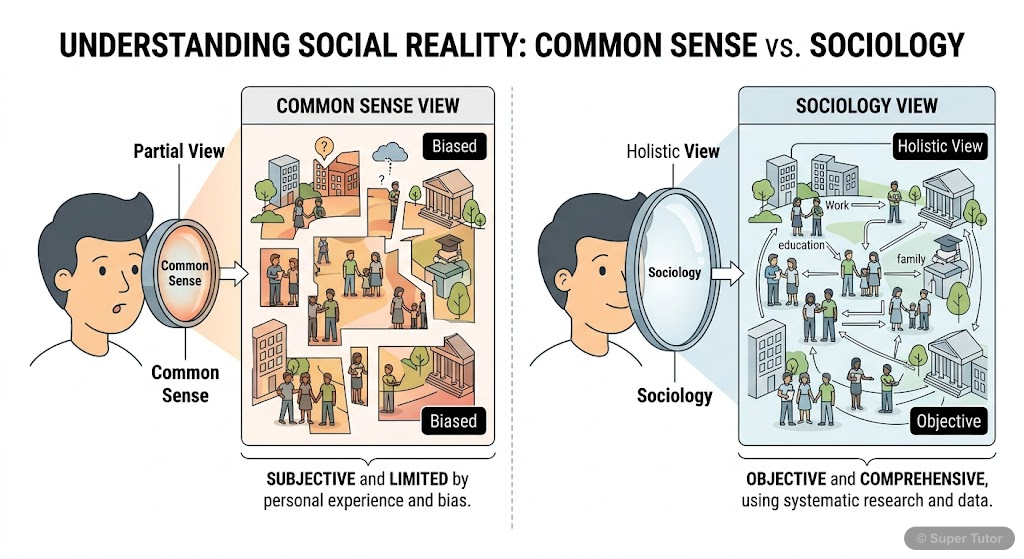
Super Tutor has 5+ illustrations like this for Introducing Indian Society alone — flashcards, concept maps, and step-by-step visuals.
See them allOverview
This chapter introduces the unique nature of studying sociology and Indian society. Unlike other subjects where students start from zero, everyone already has some knowledge about society gained through daily experiences. However, this prior knowledge based on common sense can be both helpful and li
Key Concepts
The initial stage of learning sociology
The initial stage of learning sociology requires 'unlearning' our common sense knowledge about society. This is necessary because our prior knowledge
The ability to reflect upon yourself
The ability to reflect upon yourself and examine yourself 'from the outside' - turning your gaze inward to understand your own position in society. Th
A conceptual tool that shows where
A conceptual tool that shows where individuals are located in society based on various identities like age group, regional/linguistic community, econo
Personal troubles are individual worries
Personal troubles are individual worries, problems, or concerns affecting one person (like family relationships, career worries). Social issues are pr
The composition and characteristics of India's
The composition and characteristics of India's population, including age distribution, regional diversity, and population growth patterns. India is th
Learning Objectives
- Understand the difference between common sense knowledge and sociological understanding of society
- Develop self-reflexivity - the ability to examine oneself from an outside perspective
- Learn to distinguish between personal troubles and social issues
- Gain awareness of one's position in the social structure of Indian society
- Understand the major institutions and processes that shape Indian society
Frequently Asked Questions
What are the important topics in Introducing Indian Society for CBSE Class 12 Sociology?
How to score full marks in Introducing Indian Society — CBSE Class 12 Sociology?
Sources & Official References
- NCERT Official — ncert.nic.in
- CBSE Academic — cbseacademic.nic.in
- CBSE Official — cbse.gov.in
- National Education Policy 2020 — education.gov.in
Content is aligned to the official syllabus. Refer to the board website for the latest curriculum.
More resources for Introducing Indian Society
Important Questions
Practice with board exam-style questions
Syllabus
What topics to cover
Revision Notes
Key points for last-minute revision
Study Plan
Step-by-step plan to ace this chapter
Flashcards
Quick-fire cards for active recall
Formula Sheet
All formulas in one place
Practice Quiz
Test yourself with a quick quiz
Concept Maps
See how topics connect visually
For serious students
Get the full Introducing Indian Society chapter — for free.
Quizzes, flashcards, AI doubt-solver and a step-by-step study plan for CBSE Class 12 Sociology.