The Constitution and Social Change
CBSE · Class 12 · Sociology
Summary of The Constitution and Social Change for CBSE Class 12 Sociology. Key concepts, important points, and chapter overview.
Interactive on Super Tutor
Studying The Constitution and Social Change? Get the full interactive chapter.
Quizzes, flashcards, AI doubt-solver and a step-by-step study plan — built for chapter summary and more.
1,000+ Class 12 students started this chapter today
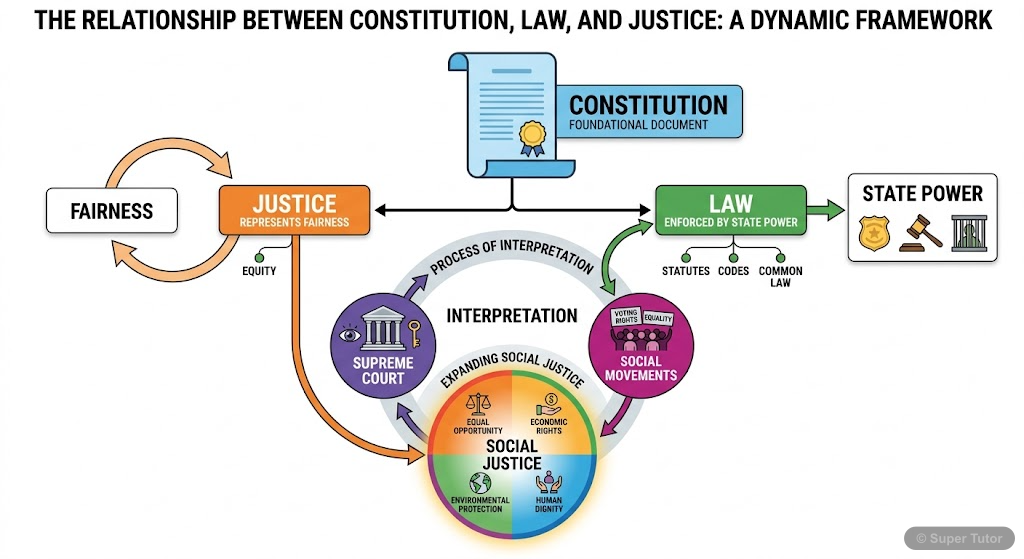
This is just one of 11+ visuals inside Super Tutor's The Constitution and Social Change chapter
Explore the full setOverview
This chapter explores how the Indian Constitution serves as a living document that not only establishes the framework of governance but also acts as a catalyst for social change. It examines the relationship between constitutional provisions and social justice, particularly focusing on how the Const
Key Concepts
The Constitution is not merely
The Constitution is not merely a static document but has the capacity to help people achieve social justice. It contains provisions that can be interp
Law derives its essence from force
Law derives its essence from force and the power of the state to coerce obedience, while justice is based on fairness. The Constitution serves as the
The Supreme Court has expanded
The Supreme Court has expanded the meaning of Fundamental Rights through interpretation. Article 21 (Right to Life and Liberty) has been interpreted t
A three
A three-tier system of local self-governance consisting of Gram Sabha (village level), Panchayat Samiti (block level), and Zilla Panchayat (district l
The 73rd and 74th Amendments reserved
The 73rd and 74th Amendments reserved one-third of seats for women in local bodies, bringing 800,000 women into political processes in the 1993-94 ele
Learning Objectives
- Understand the Constitution's role as an agent of social change and justice
- Analyze the difference between law and justice in the constitutional framework
- Examine the evolution and implementation of Panchayati Raj institutions
- Evaluate the impact of constitutional amendments on democratic participation
- Assess the challenges and opportunities in grassroots democracy
Frequently Asked Questions
What are the important topics in The Constitution and Social Change for CBSE Class 12 Sociology?
How to score full marks in The Constitution and Social Change — CBSE Class 12 Sociology?
Sources & Official References
- NCERT Official — ncert.nic.in
- CBSE Academic — cbseacademic.nic.in
- CBSE Official — cbse.gov.in
- National Education Policy 2020 — education.gov.in
Content is aligned to the official syllabus. Refer to the board website for the latest curriculum.
More resources for The Constitution and Social Change
Important Questions
Practice with board exam-style questions
Syllabus
What topics to cover
Revision Notes
Key points for last-minute revision
Study Plan
Step-by-step plan to ace this chapter
Flashcards
Quick-fire cards for active recall
Formula Sheet
All formulas in one place
Practice Quiz
Test yourself with a quick quiz
Concept Maps
See how topics connect visually
For serious students
Get the full The Constitution and Social Change chapter — for free.
Quizzes, flashcards, AI doubt-solver and a step-by-step study plan for CBSE Class 12 Sociology.