Working of Institutions
CBSE · Class 9 · Social Science
Summary of Working of Institutions for CBSE Class 9 Social Science. Key concepts, important points, and chapter overview.
Interactive on Super Tutor
Studying Working of Institutions? Get the full interactive chapter.
Quizzes, flashcards, AI doubt-solver and a step-by-step study plan — built for chapter summary and more.
1,000+ Class 9 students started this chapter today
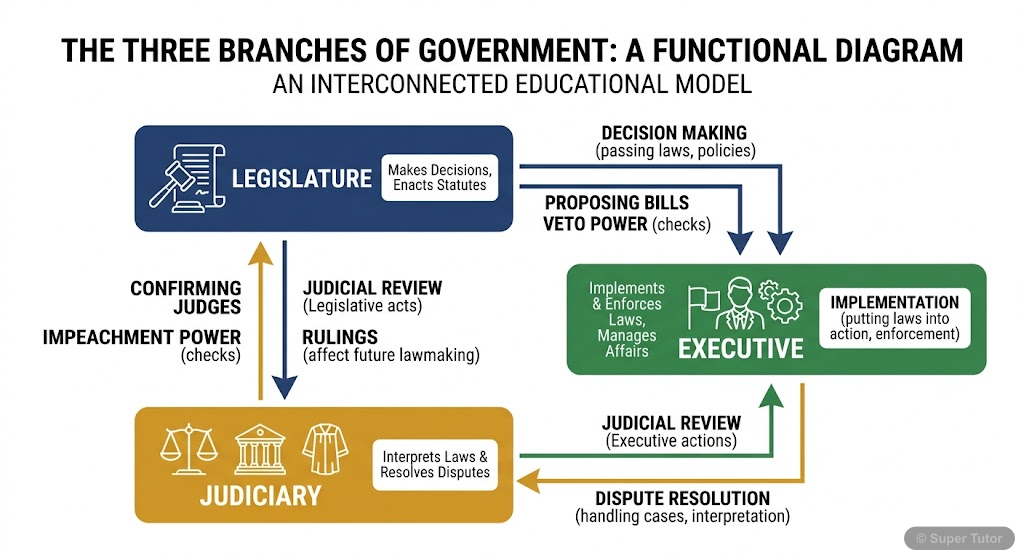
This is just one of 13+ visuals inside Super Tutor's Working of Institutions chapter
Explore the full setOverview
Democracy is not just about electing leaders; it requires rulers to work within institutions following specific rules and procedures. This chapter explores how major decisions are made and implemented in India through three key institutions: legislature (Parliament), executive (Prime Minister and Co
Key Concepts
Organized arrangements like Parliament
Organized arrangements like Parliament, Executive, and Judiciary that perform specific functions in governance. They involve rules, procedures, and re
The supreme law
The supreme law-making body consisting of Lok Sabha (House of People) and Rajya Sabha (Council of States), with the President as part of Parliament. I
The branch responsible for implementing government
The branch responsible for implementing government policies, divided into Political Executive (elected ministers led by Prime Minister) and Permanent
Independent courts system including Supreme Court
Independent courts system including Supreme Court, High Courts, and lower courts that interpret laws, resolve disputes, and protect constitutional rig
Different institutions have distinct roles
Different institutions have distinct roles - Parliament makes laws, Executive implements them, and Judiciary interprets them. Each institution checks
Learning Objectives
- Understand how major policy decisions are taken in India through institutional processes
- Learn about the roles and functions of Parliament, Executive, and Judiciary
- Analyze the relationship between different democratic institutions
- Evaluate what makes institutional functioning more or less democratic
- Examine real examples of institutional decision-making in Indian democracy
Frequently Asked Questions
What are the important topics in Working of Institutions for CBSE Class 9 Social Science?
How to score full marks in Working of Institutions — CBSE Class 9 Social Science?
Sources & Official References
- NCERT Official — ncert.nic.in
- CBSE Academic — cbseacademic.nic.in
- CBSE Official — cbse.gov.in
- National Education Policy 2020 — education.gov.in
Content is aligned to the official syllabus. Refer to the board website for the latest curriculum.
More resources for Working of Institutions
Important Questions
Practice with board exam-style questions
Syllabus
What topics to cover
Revision Notes
Key points for last-minute revision
Study Plan
Step-by-step plan to ace this chapter
Flashcards
Quick-fire cards for active recall
Formula Sheet
All formulas in one place
Practice Quiz
Test yourself with a quick quiz
Concept Maps
See how topics connect visually
For serious students
Get the full Working of Institutions chapter — for free.
Quizzes, flashcards, AI doubt-solver and a step-by-step study plan for CBSE Class 9 Social Science.