Working of Institutions
CBSE · Class 9 · Social Science
Quick revision notes for Working of Institutions — CBSE Class 9 Social Science. Key concepts, formulas, and definitions for last-minute revision.
Interactive on Super Tutor
Studying Working of Institutions? Get the full interactive chapter.
Quizzes, flashcards, AI doubt-solver and a step-by-step study plan — built for revision notes and more.
1,000+ Class 9 students started this chapter today
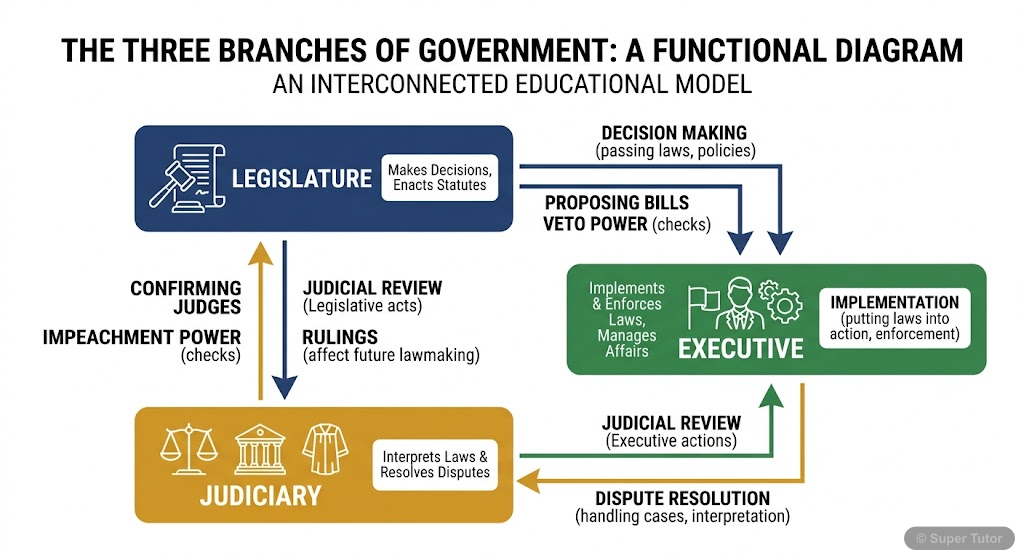
This is just one of 13+ visuals inside Super Tutor's Working of Institutions chapter
Explore the full setKey Topics to Revise
Major Policy Decision Making Process
- Government decisions are made through a systematic process involving multiple institutions
- The Mandal Commission case (1990) serves as a perfect example of institutional functioning
- Office Memorandum (O.M. No. 36012/31/90-Est) reserved 27% government jobs for SEBC (Socially and Educationally Backward Classes)
Parliament - The Legislature
- Parliament is the final authority for making laws in India
- Consists of two Houses: Lok Sabha (House of People) and Rajya Sabha (Council of States)
- President is part of Parliament but not member of either House
Political Executive - The Government
- Executive implements policies and runs day-to-day administration
- Two types: Political Executive (elected, temporary) and Permanent Executive (appointed, permanent)
- Political executive has more power because it represents people's will
The President - Head of State
- President is head of state while PM is head of government
- Elected indirectly by MPs and MLAs
- Exercises nominal/ceremonial powers
Get complete notes with diagrams and examples
Full NotesKey Concepts
Frequently Asked Questions
What are the important topics in Working of Institutions for CBSE Class 9 Social Science?
How to score full marks in Working of Institutions — CBSE Class 9 Social Science?
Sources & Official References
- NCERT Official — ncert.nic.in
- CBSE Academic — cbseacademic.nic.in
- CBSE Official — cbse.gov.in
- National Education Policy 2020 — education.gov.in
Content is aligned to the official syllabus. Refer to the board website for the latest curriculum.
More resources for Working of Institutions
Important Questions
Practice with board exam-style questions
Syllabus
What topics to cover
Study Plan
Step-by-step plan to ace this chapter
Flashcards
Quick-fire cards for active recall
Formula Sheet
All formulas in one place
Chapter Summary
Understand the chapter at a glance
Practice Quiz
Test yourself with a quick quiz
Concept Maps
See how topics connect visually
For serious students
Get the full Working of Institutions chapter — for free.
Quizzes, flashcards, AI doubt-solver and a step-by-step study plan for CBSE Class 9 Social Science.