Electoral Politics
CBSE · Class 9 · Social Science
Complete topic list for Electoral Politics in CBSE Class 9 Social Science. Key concepts, sub-topics, and what to focus on for board exams.
Interactive on Super Tutor
Studying Electoral Politics? Get the full interactive chapter.
Quizzes, flashcards, AI doubt-solver and a step-by-step study plan — built for syllabus and more.
1,000+ Class 9 students started this chapter today
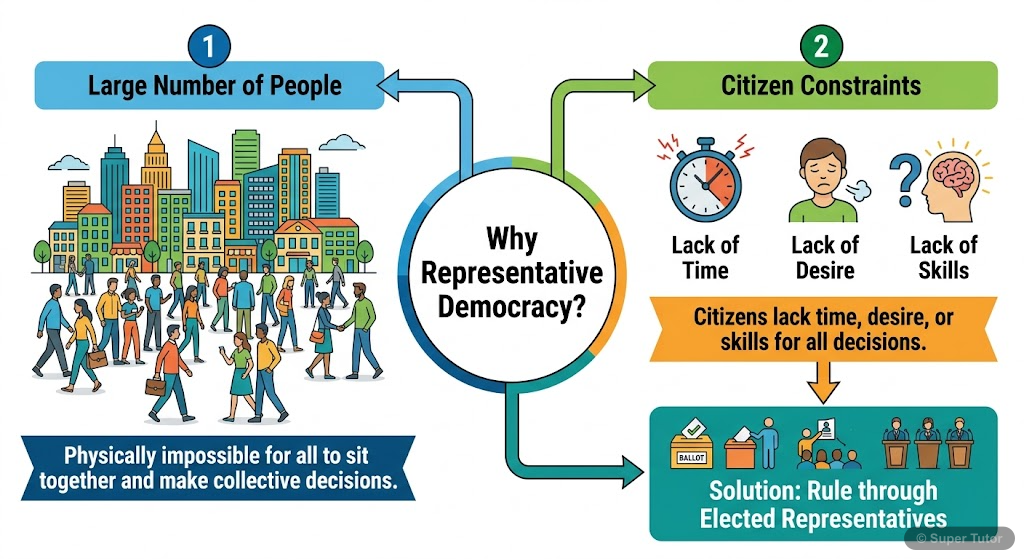
Learn better with visuals Super Tutor has hundreds of illustrations like this across every chapter — all free to try.
Get startedTopics in Electoral Politics
Why Elections are Necessary
- Elections are essential because direct democracy is impossible in large communities - people cannot sit together daily to make decisions
- Representatives are needed to govern on behalf of the people, and elections provide a democratic way to select them
- Elections allow people to choose who makes laws, forms government, and guides policy decisions
Conditions for Democratic Elections
- Everyone should be able to choose (universal adult franchise with equal voting rights)
- There should be real choices available (multiple parties and candidates can contest freely)
- Elections must be held at regular intervals (every 5 years for Lok Sabha and State Assemblies)
Indian Electoral System
- India follows an area-based system of representation with electoral constituencies
- Lok Sabha has 543 constituencies, each electing one MP; States divided into Assembly constituencies electing MLAs
- Each constituency should have roughly equal population to ensure equal value of votes
Electoral Process in India
- Voters' List (Electoral Roll) prepared well in advance with all eligible citizens aged 18+
- EPIC (Election Photo Identity Card) introduced for voter identification
- Any citizen can contest elections (minimum age 25 for candidates vs 18 for voters)
Key Concepts
Frequently Asked Questions
What are the important topics in Electoral Politics for CBSE Class 9 Social Science?
How to score full marks in Electoral Politics — CBSE Class 9 Social Science?
Sources & Official References
- NCERT Official — ncert.nic.in
- CBSE Academic — cbseacademic.nic.in
- CBSE Official — cbse.gov.in
- National Education Policy 2020 — education.gov.in
Content is aligned to the official syllabus. Refer to the board website for the latest curriculum.
More resources for Electoral Politics
Important Questions
Practice with board exam-style questions
Revision Notes
Key points for last-minute revision
Study Plan
Step-by-step plan to ace this chapter
Flashcards
Quick-fire cards for active recall
Formula Sheet
All formulas in one place
Chapter Summary
Understand the chapter at a glance
Practice Quiz
Test yourself with a quick quiz
Concept Maps
See how topics connect visually
For serious students
Get the full Electoral Politics chapter — for free.
Quizzes, flashcards, AI doubt-solver and a step-by-step study plan for CBSE Class 9 Social Science.