Chapter 19 of 32
Syllabus
Cell Cycle and Cell Division — Syllabus
AP EAPCET · Biology
Topics covered in Cell Cycle and Cell Division for AP EAPCET Biology. Understand the syllabus structure and key areas to focus on.
Interactive on Super Tutor
Studying Cell Cycle and Cell Division? Get the full chapter — free.
Practice questions, revision notes, formula sheet and AI doubt-solver — built for AP EAPCET Biology.
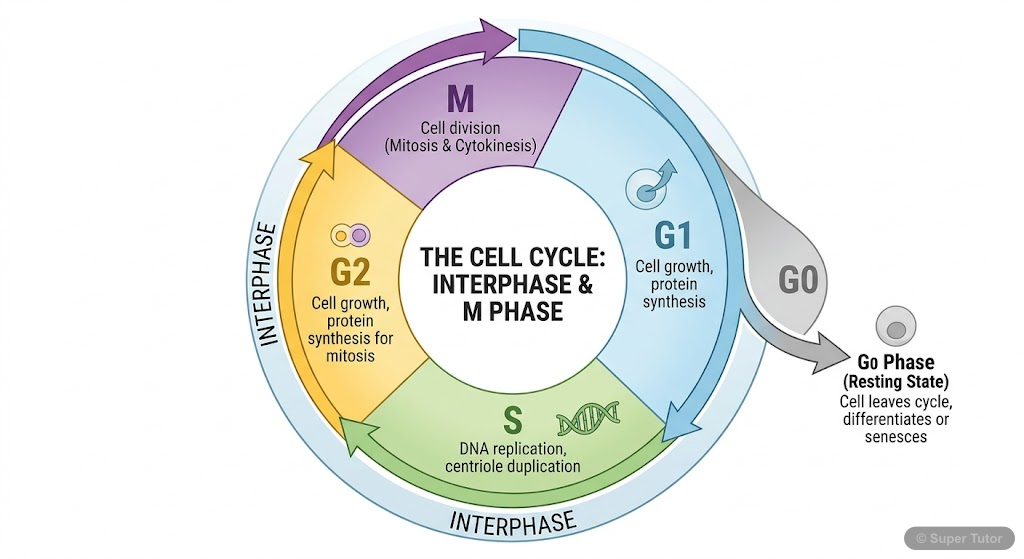
Super Tutor
Super Tutor has 11+ illustrations like this for Cell Cycle and Cell Division alone — flashcards, concept maps, and step-by-step visuals.
See them allCell Cycle and Cell Division — Syllabus & Topics
Topics covered in Cell Cycle and Cell Division for AP EAPCET Biology.
Topics in Cell Cycle and Cell Division
1
10.1 Cell Cycle - Overview and Phases
- Cell cycle is the sequence of events by which a cell duplicates its genome, synthesizes cellular components, and divides into two daughter cells
- Human cells complete one cell cycle in approximately 24 hours, while yeast cells can complete it in 90 minutes
- Cell cycle has two main phases: Interphase (95% duration) and M-phase (5% duration)
2
10.2 M Phase - Mitosis Detailed
- Mitosis is equational division - chromosome number remains same in daughter cells (2n→2n)
- Four stages: Prophase, Metaphase, Anaphase, Telophase (PMAT sequence)
- Prophase: Chromosome condensation, nuclear envelope breakdown, centriole movement to opposite poles, spindle formation
3
10.3 Significance of Mitosis
- Growth and development: Increases cell number in multicellular organisms
- Tissue repair and regeneration: Replaces damaged or worn-out cells
- Maintenance of chromosome number: All body cells have identical genetic material
4
10.4 Meiosis - Reductional Division
- Meiosis is reductional division: diploid (2n) → haploid (n) gametes
- Two consecutive divisions: Meiosis I (reductional) and Meiosis II (equational)
- One round of DNA replication followed by two divisions
Key Concepts
The cell cycle is the sequenceMitosis is the equational division consistingMeiosis is the reductional division involvingCytokinesis is the physical divisionCrossing over occurs during prophase I
Frequently Asked Questions
What topics are covered in Cell Cycle and Cell Division for AP EAPCET?
Cell Cycle and Cell Division is an important chapter in AP EAPCET Biology. It covers key concepts and formulas that are frequently tested in the exam. Key topics include: 10.1 Cell Cycle - Overview and Phases, 10.2 M Phase - Mitosis Detailed, 10.3 Significance of Mitosis, 10.4 Meiosis - Reductional Division.
How important is Cell Cycle and Cell Division for AP EAPCET?
Cell Cycle and Cell Division is a frequently tested chapter in AP EAPCET Biology. Questions from this chapter appear regularly in previous year papers. There are 64 practice questions available for this chapter.
How to prepare Cell Cycle and Cell Division for AP EAPCET?
Start by understanding the core concepts, then solve practice questions. Focus on formulas and their applications. Use revision notes for quick review before the exam.
More resources for Cell Cycle and Cell Division
For AP EAPCET aspirants
Get the full Cell Cycle and Cell Division chapter — for free.
Practice questions, revision notes, formula sheet and AI doubt-solver for AP EAPCET Biology.