Chapter 4 of 32
Revision Notes
Human Reproduction — Revision Notes
BCECE · Biology
Quick revision notes for Human Reproduction — key concepts, formulas, and definitions for BCECE Biology preparation.
Interactive on Super Tutor
Studying Human Reproduction? Get the full chapter — free.
Practice questions, revision notes, formula sheet and AI doubt-solver — built for BCECE Biology.
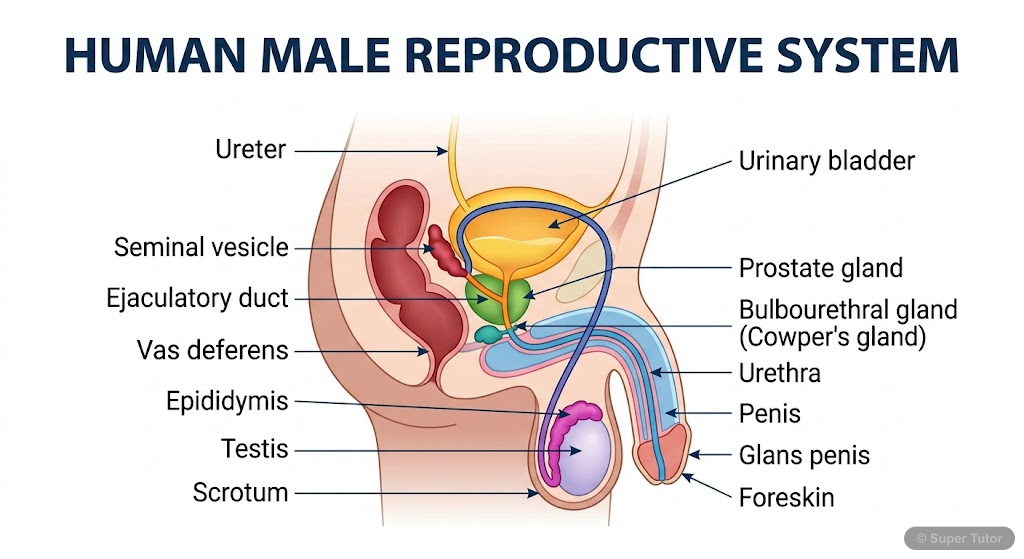
Super Tutor
Learn better with visuals Super Tutor has hundreds of illustrations like this across every chapter — all free to try.
Get startedRevision Notes — Human Reproduction
Key concepts, formulas, and definitions from Human Reproduction for BCECE Biology preparation.
Key Topics to Revise
1
Male Reproductive System
- Primary organs: Paired testes located in scrotum outside abdominal cavity
- Scrotum maintains temperature 2-2.5°C lower than body temperature (34°C) for optimal sperm production
- Each testis contains 250 testicular lobules with 1-3 seminiferous tubules per lobule
2
Female Reproductive System
- Primary organs: Paired almond-shaped ovaries (2-4cm length, 1.5cm width, 1cm thickness)
- Ovary structure: Germinal epithelium → Tunica albuginea → Cortex (contains follicles) → Medulla (blood vessels)
- Fallopian tubes (10-12cm): Infundibulum (fimbriae) → Ampulla (fertilization site) → Isthmus → Uterus
3
Gametogenesis
- Spermatogenesis phases: (1) Multiplication - mitotic divisions of spermatogonia, (2) Growth - formation of primary spermatocytes, (3) Maturation - meiotic divisions
- One primary spermatocyte (46 chromosomes) → 4 functional sperms (23 chromosomes each)
- Sperm structure: Head (nucleus + acrosome), Neck, Middle piece (mitochondria), Tail (9+2 arrangement)
4
Menstrual Cycle
- Average cycle: 28 days, divided into 4 phases
- Menstrual phase (Days 1-5): Shedding of endometrium due to estrogen/progesterone withdrawal
- Follicular/Proliferative phase (Days 6-13): FSH stimulates follicle development, estrogen causes endometrial proliferation
Get complete revision notes with diagrams and examples — continue in Super Tutor
Key Concepts
Consists of testes (primary sex organs)Comprises ovaries (primary sex organs)Process of sperm formation occurringFormation of female gametes beginning during28
Frequently Asked Questions
What topics are covered in Human Reproduction for BCECE?
Human Reproduction is an important chapter in BCECE Biology. It covers key concepts and formulas that are frequently tested in the exam. Key topics include: Male Reproductive System, Female Reproductive System, Gametogenesis, Menstrual Cycle.
How important is Human Reproduction for BCECE?
Human Reproduction is a frequently tested chapter in BCECE Biology. Questions from this chapter appear regularly in previous year papers. There are 101 practice questions available for this chapter.
How to prepare Human Reproduction for BCECE?
Start by understanding the core concepts, then solve practice questions. Focus on formulas and their applications. Use revision notes for quick review before the exam.
More resources for Human Reproduction
For BCECE aspirants
Get the full Human Reproduction chapter — for free.
Practice questions, revision notes, formula sheet and AI doubt-solver for BCECE Biology.