Chapter 22 of 32
Revision Notes
Organisms and Populations — Revision Notes
CUET (UG) · Biology
Quick revision notes for Organisms and Populations — key concepts, formulas, and definitions for CUET (UG) Biology preparation.
Interactive on Super Tutor
Studying Organisms and Populations? Get the full chapter — free.
Practice questions, revision notes, formula sheet and AI doubt-solver — built for CUET (UG) Biology.
Super Tutor
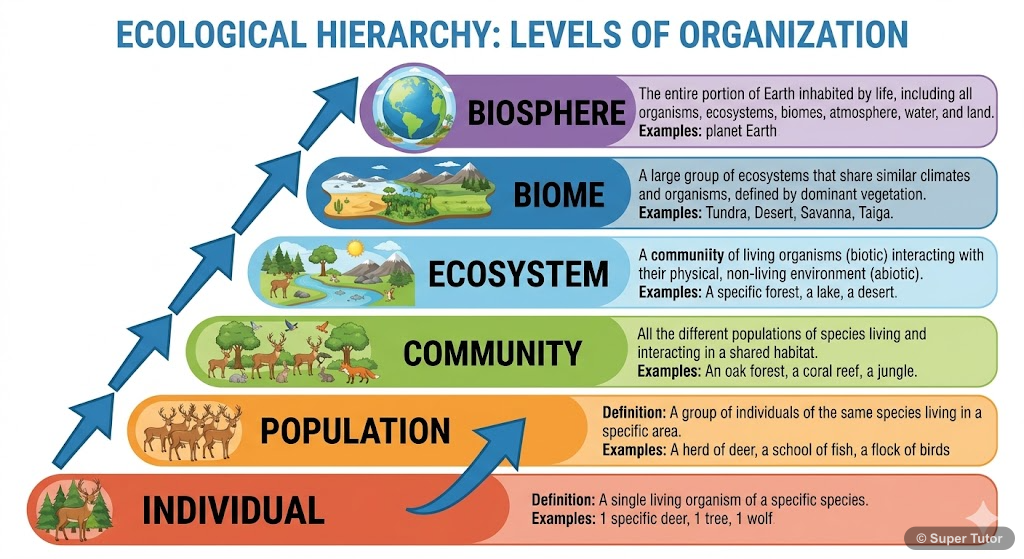
Learn better with visuals Super Tutor has hundreds of illustrations like this across every chapter — all free to try.
Get startedRevision Notes — Organisms and Populations
Key concepts, formulas, and definitions from Organisms and Populations for CUET (UG) Biology preparation.
Key Topics to Revise
1
Organism and Environment
- Ecology is the study of interactions between organisms and their environment, coined by Ernst Haeckel in 1866
- Ramdeo Misra is known as the Father of Ecology in India
- Ecological hierarchy: Individual → Population → Community → Ecosystem → Biome
2
Major Abiotic Factors
- Temperature ranges from subzero in polar regions to >50°C in deserts, affecting enzyme kinetics and metabolism
- Eurythermal organisms tolerate wide temperature ranges (mammals, birds); stenothermal need constant temperature (polar bears, amphibians)
- Homoiothermal animals maintain constant body temperature; poikilothermal animals have variable body temperature
3
Responses to Abiotic Factors
- Four main responses to environmental stress: Regulate, Conform, Migrate, Suspend
- Regulators maintain constant internal conditions despite external changes (birds, mammals)
- Conformers cannot maintain homeostasis and change with environment (99% of animals, all plants)
4
Adaptations
- Adaptation is any morphological, physiological, or behavioral trait that enhances survival and reproduction
- Plant adaptations: Sun plants (heliophytes) vs shade plants (sciophytes)
- Xerophyte types: Ephemerals (drought escapers), Succulents (water storers), Non-succulent perennials (drought endurers)
Get complete revision notes with diagrams and examples — continue in Super Tutor
Key Concepts
The biological organization levels include macromoleculesHabitat is the physical place whereMajor environmental factors include Temperature (affectingExponential growth (JSix main types
Frequently Asked Questions
What topics are covered in Organisms and Populations for CUET (UG)?
Organisms and Populations is an important chapter in CUET (UG) Biology. It covers key concepts and formulas that are frequently tested in the exam. Key topics include: Organism and Environment, Major Abiotic Factors, Responses to Abiotic Factors, Adaptations.
How important is Organisms and Populations for CUET (UG)?
Organisms and Populations is a frequently tested chapter in CUET (UG) Biology. Questions from this chapter appear regularly in previous year papers. There are 80 practice questions available for this chapter.
How to prepare Organisms and Populations for CUET (UG)?
Start by understanding the core concepts, then solve practice questions. Focus on formulas and their applications. Use revision notes for quick review before the exam.
More resources for Organisms and Populations
For CUET (UG) aspirants
Get the full Organisms and Populations chapter — for free.
Practice questions, revision notes, formula sheet and AI doubt-solver for CUET (UG) Biology.