Principles of Inheritance and variation — Revision Notes
CUET (UG) · Biology
Quick revision notes for Principles of Inheritance and variation — key concepts, formulas, and definitions for CUET (UG) Biology preparation.
Interactive on Super Tutor
Studying Principles of Inheritance and variation? Get the full chapter — free.
Practice questions, revision notes, formula sheet and AI doubt-solver — built for CUET (UG) Biology.
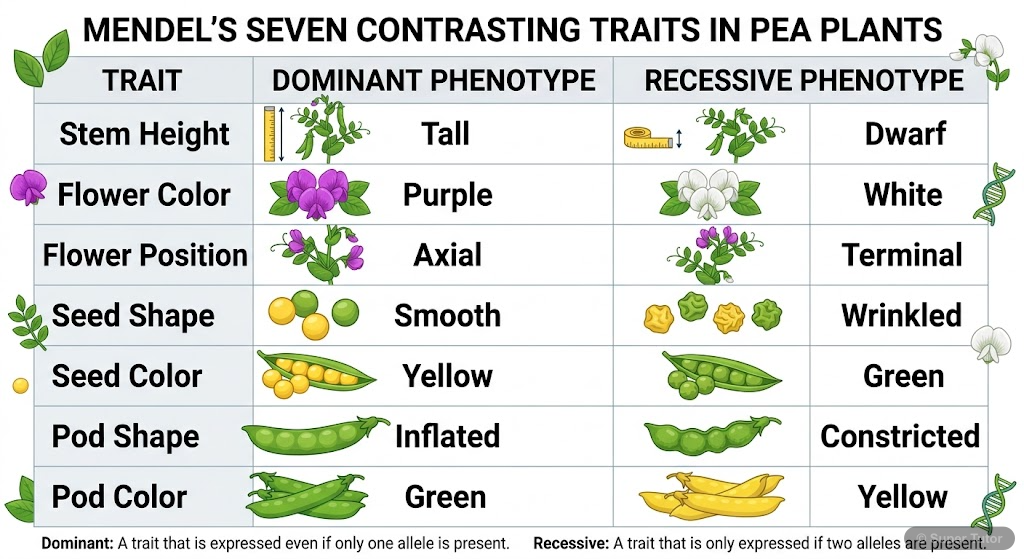
Learn better with visuals Super Tutor has hundreds of illustrations like this across every chapter — all free to try.
Get startedRevision Notes — Principles of Inheritance and variation
Key concepts, formulas, and definitions from Principles of Inheritance and variation for CUET (UG) Biology preparation.
Key Topics to Revise
4.1 Mendel's Laws of Inheritance
- Gregor Mendel (1822-1884) is called the 'Father of Genetics' who worked on garden pea (Pisum sativum) from 1856-1863
- Mendel chose pea plants because: annual plant with short life cycle, many contrasting traits, natural self-pollination, successful artificial cross-pollination possible, easy cultivation, produces lar
- True-breeding lines: Plants showing stable trait inheritance for several generations through continuous self-pollination
4.2 Law of Dominance and Law of Segregation
- Law of Dominance: Characters are controlled by discrete units (factors/genes) that occur in pairs; in dissimilar pairs, one dominates over the other
- Law of Segregation (Law of Purity of Gametes): Allele pairs separate during gamete formation so each gamete receives only one allele of each gene
- Incomplete Dominance: Neither allele is completely dominant; F₁ shows intermediate phenotype (e.g., red × white = pink in snapdragon)
4.3 Inheritance of Two Genes - Dihybrid Cross
- Law of Independent Assortment: When two pairs of contrasting traits are combined in a hybrid, segregation of one pair is independent of the other pair
- Dihybrid cross involves two pairs of contrasting traits studied simultaneously
- F₁ dihybrid produces four types of gametes in equal proportions (1:1:1:1)
4.4 Polygenic Inheritance and 4.5 Pleiotropy
- Polygenic Inheritance: Multiple genes control a single trait; each gene contributes additively to the phenotype
- Examples include human skin color (controlled by 3 gene pairs A, B, C), height, and wheat kernel color
- Shows continuous variation rather than discrete categories
Get complete revision notes with diagrams and examples — continue in Super Tutor
Key Concepts
Frequently Asked Questions
What topics are covered in Principles of Inheritance and variation for CUET (UG)?
How important is Principles of Inheritance and variation for CUET (UG)?
How to prepare Principles of Inheritance and variation for CUET (UG)?
More resources for Principles of Inheritance and variation
Syllabus
Principles of Inheritance and variation — syllabus
Important Topics
Principles of Inheritance and variation — important topics
Practice Questions
Principles of Inheritance and variation — practice questions
Study Plan
Principles of Inheritance and variation — study plan
Formula Sheet
Principles of Inheritance and variation — formula sheet
For CUET (UG) aspirants
Get the full Principles of Inheritance and variation chapter — for free.
Practice questions, revision notes, formula sheet and AI doubt-solver for CUET (UG) Biology.