Locomotion and Movement — Study Plan
CUET (UG) · Biology
Step-by-step study plan for Locomotion and Movement — structured approach to mastering this chapter for CUET (UG) Biology.
Interactive on Super Tutor
Studying Locomotion and Movement? Get the full chapter — free.
Practice questions, revision notes, formula sheet and AI doubt-solver — built for CUET (UG) Biology.
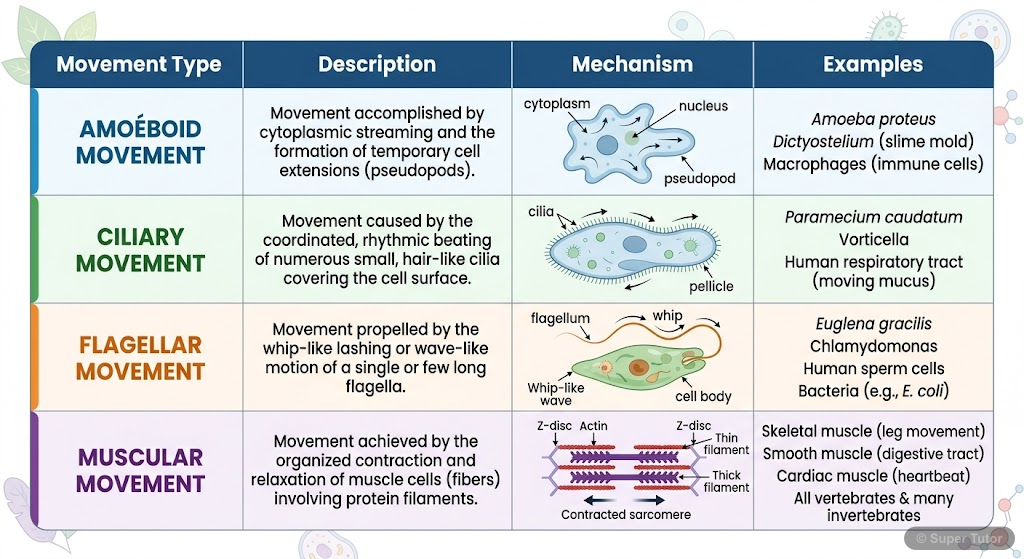
Super Tutor has 22+ illustrations like this for Locomotion and Movement alone — flashcards, concept maps, and step-by-step visuals.
See them allHow to Study Locomotion and Movement
A structured approach to studying Locomotion and Movement for CUET (UG) Biology.
Study Plan for Locomotion and Movement
Day 1–2: Learn the Theory
Study the chapter thoroughly. Note down definitions, formulas, and key concepts.
Day 3: Practice Problems
Solve practice questions and previous year CUET (UG) problems. There are 59 questions available for this chapter.
Day 4: Revise & Test
Revise key formulas and concepts without looking at notes. Take a practice quiz to test your understanding.
What to Focus On
- All locomotions are movements, but all movements are not locomotions
- Amoeboid movement involves pseudopodia and cytoskeletal elements like microfilaments
- Ciliary movement helps in transport of materials in tubular organs
- Skeletal muscles are voluntary and striated, found in limbs and body wall
- Cardiac muscles have intercalated discs and are involuntary
- Smooth muscles are spindle-shaped and control visceral functions
- Sarcolemma is the muscle fiber membrane, sarcoplasm is the cytoplasm
- Myofibrils contain alternating A-bands (dark) and I-bands (light)
- Sarcomere is the functional unit between two Z-lines
Common Mistakes to Avoid
During muscle contraction, both actin and myosin filaments shorten
Cardiac muscles are voluntary because we can control our heartbeat through breathing
Rigor mortis occurs because muscles continue contracting after death
Want a personalised study plan?
Super Tutor creates a day-by-day plan for CUET (UG) Biology that adapts to your exam date and pace.
Create My Study Plan — FreeFrequently Asked Questions
What topics are covered in Locomotion and Movement for CUET (UG)?
How important is Locomotion and Movement for CUET (UG)?
How to prepare Locomotion and Movement for CUET (UG)?
More resources for Locomotion and Movement
For CUET (UG) aspirants
Get the full Locomotion and Movement chapter — for free.
Practice questions, revision notes, formula sheet and AI doubt-solver for CUET (UG) Biology.