Structural Organisation in Animals — Syllabus
CUET (UG) · Biology
Topics covered in Structural Organisation in Animals for CUET (UG) Biology. Understand the syllabus structure and key areas to focus on.
Interactive on Super Tutor
Studying Structural Organisation in Animals? Get the full chapter — free.
Practice questions, revision notes, formula sheet and AI doubt-solver — built for CUET (UG) Biology.
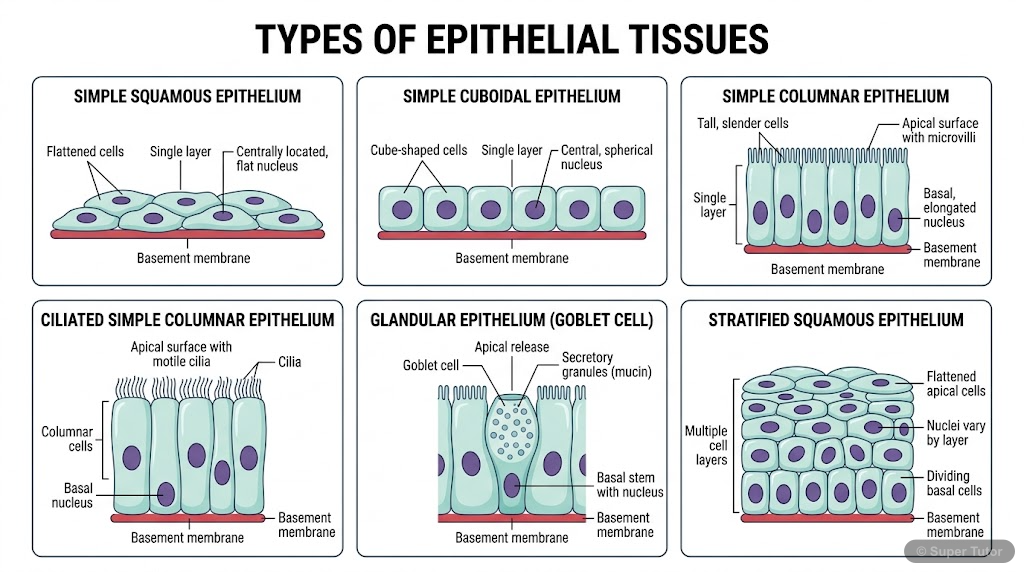
Learn better with visuals Super Tutor has hundreds of illustrations like this across every chapter — all free to try.
Get startedStructural Organisation in Animals — Syllabus & Topics
Topics covered in Structural Organisation in Animals for CUET (UG) Biology.
Topics in Structural Organisation in Animals
Basic Concepts and Tissue Types
- In unicellular organisms, all functions are performed by a single cell, while in multicellular organisms, specialized groups of cells perform specific functions
- A tissue is a group of similar cells with intercellular substances having similar origin and performing a specific function
- All complex animals have only four basic tissue types: Epithelial, Connective, Muscular, and Neural
Epithelial Tissue
- Epithelial tissue has a free surface facing body fluid or external environment
- Cells are compactly packed with little intercellular matrix
- Simple epithelium: single layer - Squamous (diffusion), Cuboidal (secretion/absorption), Columnar (protection/secretion)
Connective Tissue
- Most abundant and widely distributed tissue; connects and supports other tissues
- Contains cells, fibers (collagen/elastin), and matrix between cells and fibers
- Loose connective tissue: cells and fibers loosely arranged in semi-fluid ground substance
Muscular and Neural Tissue
- Muscular tissue contains contractile fibers (myofibrils) in cytoplasm (sarcoplasm)
- Skeletal muscle: striated, voluntary, attached to bones, bundles in connective tissue sheath
- Smooth muscle: non-striated, involuntary, spindle-shaped, found in internal organs
Key Concepts
Frequently Asked Questions
What topics are covered in Structural Organisation in Animals for CUET (UG)?
How important is Structural Organisation in Animals for CUET (UG)?
How to prepare Structural Organisation in Animals for CUET (UG)?
More resources for Structural Organisation in Animals
Revision Notes
Structural Organisation in Animals — revision notes
Important Topics
Structural Organisation in Animals — important topics
Practice Questions
Structural Organisation in Animals — practice questions
Study Plan
Structural Organisation in Animals — study plan
Formula Sheet
Structural Organisation in Animals — formula sheet
For CUET (UG) aspirants
Get the full Structural Organisation in Animals chapter — for free.
Practice questions, revision notes, formula sheet and AI doubt-solver for CUET (UG) Biology.