Mechanical Properties of Solids — Study Plan
IISER Aptitude Test · Physics
Step-by-step study plan for Mechanical Properties of Solids — structured approach to mastering this chapter for IISER Aptitude Test Physics.
Interactive on Super Tutor
Studying Mechanical Properties of Solids? Get the full chapter — free.
Practice questions, revision notes, formula sheet and AI doubt-solver — built for IISER Aptitude Test Physics.
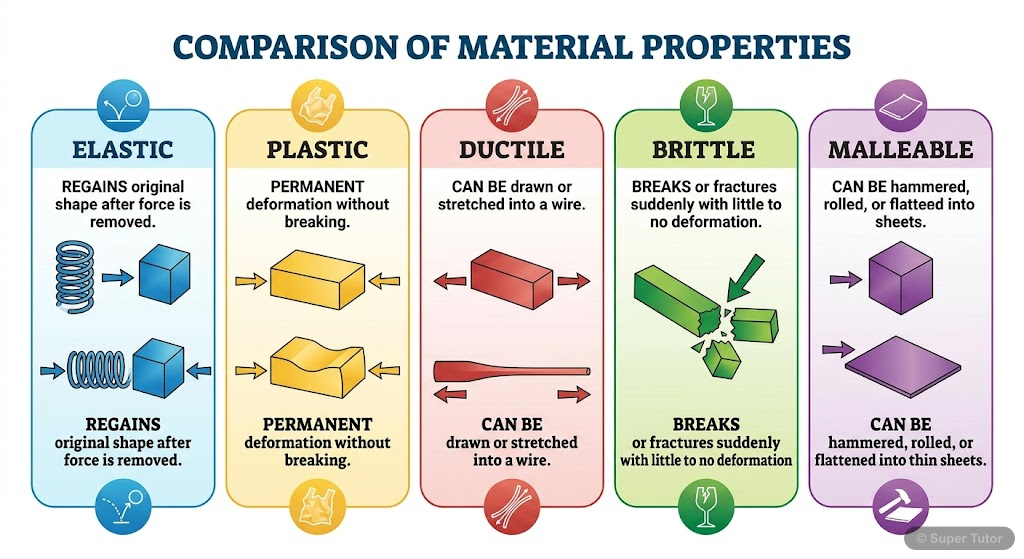
Learn better with visuals Super Tutor has hundreds of illustrations like this across every chapter — all free to try.
Get startedHow to Study Mechanical Properties of Solids
A structured approach to studying Mechanical Properties of Solids for IISER Aptitude Test Physics.
Study Plan for Mechanical Properties of Solids
Day 1–2: Learn the Theory
Study the chapter thoroughly. Note down definitions, formulas, and key concepts.
Day 3: Practice Problems
Solve practice questions and previous year IISER Aptitude Test problems. There are 138 questions available for this chapter.
Day 4: Revise & Test
Revise key formulas and concepts without looking at notes. Take a practice quiz to test your understanding.
What to Focus On
- Elasticity is the ability to regain original shape and size after removing deforming force
- Elastic substances return completely to original form; plastic substances retain permanent deformation
- Spring-ball model explains atomic basis of elasticity
- Stress = Force/Area, measured in N m⁻² or Pascal
- Strain = Relative change in dimension, dimensionless
- Tensile stress stretches, compressive stress compresses
- Stress is directly proportional to strain for small deformations
- The proportionality constant is called modulus of elasticity
- Valid only within elastic limit of the material
Common Mistakes to Avoid
Stress equals force and strain equals extension - they are the same as F and ΔL
Higher Young's modulus means the material is weaker and less elastic
Poisson's ratio can have any positive value between 0 and 1
Want a personalised study plan?
Super Tutor creates a day-by-day plan for IISER Aptitude Test Physics that adapts to your exam date and pace.
Create My Study Plan — FreeFrequently Asked Questions
What topics are covered in Mechanical Properties of Solids for IISER Aptitude Test?
How important is Mechanical Properties of Solids for IISER Aptitude Test?
How to prepare Mechanical Properties of Solids for IISER Aptitude Test?
More resources for Mechanical Properties of Solids
Syllabus
Mechanical Properties of Solids — syllabus
Revision Notes
Mechanical Properties of Solids — revision notes
Important Topics
Mechanical Properties of Solids — important topics
Practice Questions
Mechanical Properties of Solids — practice questions
Formula Sheet
Mechanical Properties of Solids — formula sheet
For IISER Aptitude Test aspirants
Get the full Mechanical Properties of Solids chapter — for free.
Practice questions, revision notes, formula sheet and AI doubt-solver for IISER Aptitude Test Physics.