Chapter 39 of 46
Revision Notes
d- and f-Block Elements — Revision Notes
JEE Mains · Chemistry
Quick revision notes for d- and f-Block Elements — key concepts, formulas, and definitions for JEE Mains Chemistry preparation.
Interactive on Super Tutor
Studying d- and f-Block Elements? Get the full chapter — free.
Practice questions, revision notes, formula sheet and AI doubt-solver — built for JEE Mains Chemistry.
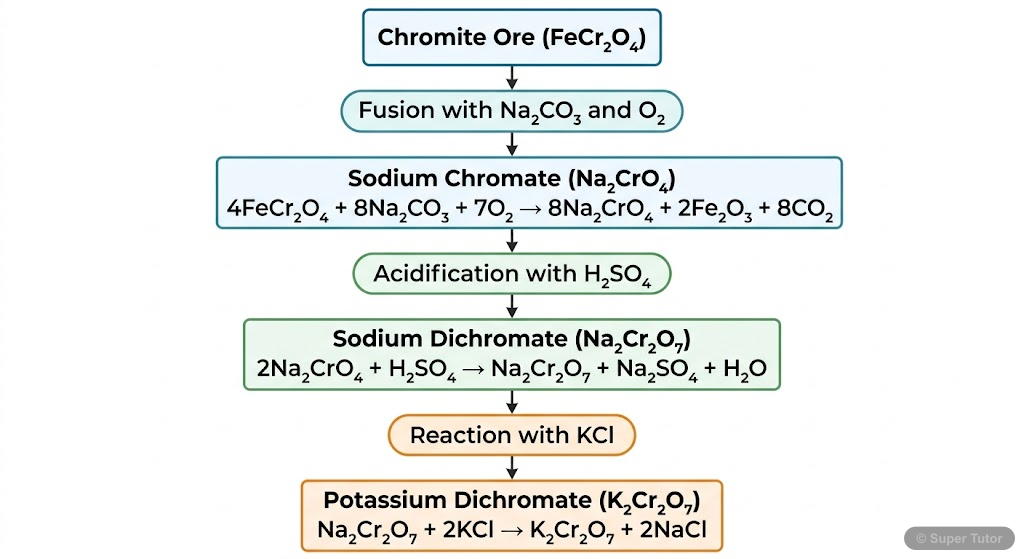
Super Tutor
Super Tutor has 24+ illustrations like this for d- and f-Block Elements alone — flashcards, concept maps, and step-by-step visuals.
See them allRevision Notes — d- and f-Block Elements
Key concepts, formulas, and definitions from d- and f-Block Elements for JEE Mains Chemistry preparation.
Key Topics to Revise
1
Introduction and Electronic Configuration
- d-block elements: General electronic configuration (n-1)d¹⁻¹⁰ ns¹⁻²
- Transition elements have incompletely filled d-orbitals in ground state or stable oxidation states
- Zn, Cd, Hg are non-typical transition elements (completely filled d-orbitals)
2
Physical Properties
- Metallic character: High tensile strength, thermal/electrical conductivity, metallic luster
- High melting and boiling points due to strong metallic bonding involving d-electrons
- Atomic radii trend: Generally decrease across period, then remain constant, slight increase at end
3
Variable Oxidation States
- Multiple oxidation states due to small energy difference between (n-1)d and ns orbitals
- Common oxidation states differ by unity (+2, +3, +4, +5, etc.)
- Maximum oxidation state = Group number (up to Mn), then decreases
4
Ionization Energies and Electrode Potentials
- Ionization energies generally increase across series with some irregularities
- IE₁ values lie between s-block (lower) and p-block (higher) elements
- High IE₂ for Cr and Cu due to stable d⁵ and d¹⁰ configurations respectively
Get complete revision notes with diagrams and examples — continue in Super Tutor
Key Concepts
Transition elements have general electronic configurationTransition elements show multiple oxidation statesTransition metal compounds are paramagnetic dueMost transition metal compounds are coloredTransition metals and their compounds show
Frequently Asked Questions
What topics are covered in d- and f-Block Elements for JEE Mains?
d- and f-Block Elements is an important chapter in JEE Mains Chemistry. It covers key concepts and formulas that are frequently tested in the exam. Key topics include: Introduction and Electronic Configuration, Physical Properties, Variable Oxidation States, Ionization Energies and Electrode Potentials.
How important is d- and f-Block Elements for JEE Mains?
d- and f-Block Elements is a frequently tested chapter in JEE Mains Chemistry. Questions from this chapter appear regularly in previous year papers. There are 90 practice questions available for this chapter.
How to prepare d- and f-Block Elements for JEE Mains?
Start by understanding the core concepts, then solve practice questions. Focus on formulas and their applications. Use revision notes for quick review before the exam.
More resources for d- and f-Block Elements
For JEE Mains aspirants
Get the full d- and f-Block Elements chapter — for free.
Practice questions, revision notes, formula sheet and AI doubt-solver for JEE Mains Chemistry.