Chapter 33 of 36
Syllabus
Laws of Motion — Syllabus
JEE Mains · Physics
Topics covered in Laws of Motion for JEE Mains Physics. Understand the syllabus structure and key areas to focus on.
Interactive on Super Tutor
Studying Laws of Motion? Get the full chapter — free.
Practice questions, revision notes, formula sheet and AI doubt-solver — built for JEE Mains Physics.
Super Tutor
Learn better with visuals Super Tutor has hundreds of illustrations like this across every chapter — all free to try.
Get startedLaws of Motion — Syllabus & Topics
Topics covered in Laws of Motion for JEE Mains Physics.
Topics in Laws of Motion
1
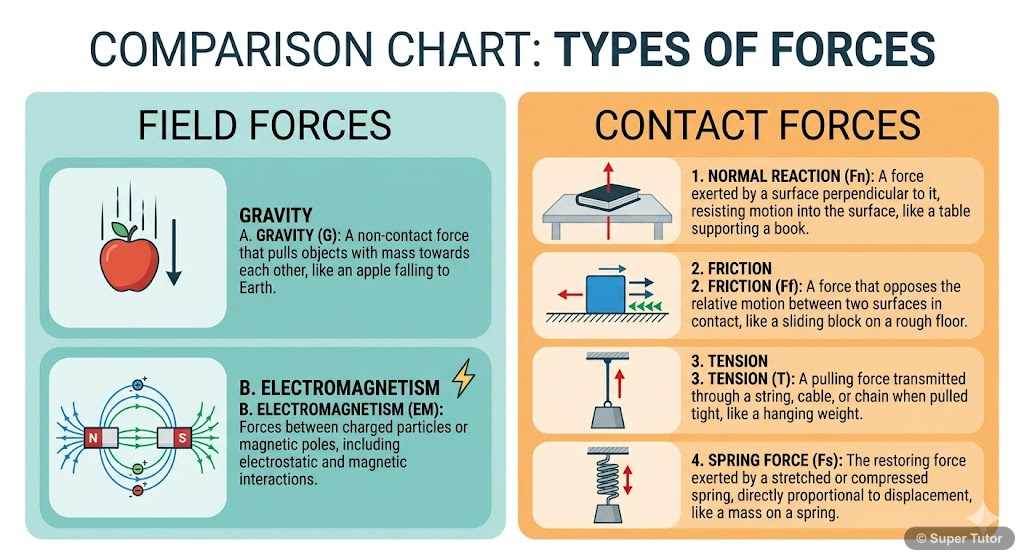
Types of Forces
- Field forces act without physical contact (gravitational, electrostatic)
- Contact forces require physical contact between objects
- Contact force F = √(N² + f²) where N is normal reaction and f is friction
2
Free Body Diagrams and Equilibrium
- Free body diagram shows all forces acting on a single isolated body
- For equilibrium: ΣFₓ = 0, ΣFᵧ = 0, Στ = 0
- Resolution of forces into rectangular components simplifies analysis
3
Newton's Laws of Motion
- First Law: Object continues in uniform motion unless acted by unbalanced force
- Second Law: F = ma, acceleration is proportional to net force
- Third Law: Every action has equal and opposite reaction
4
Constraint Equations
- Constraint equations relate accelerations of different parts of a system
- String constraint: total length remains constant
- For simple pulley: a₁ + a₂ = 0 (accelerations are opposite)
Key Concepts
Forces are classified into three mainA systematic representation showing all forcesFor static equilibrium of coplanar forcesLaw I (Inertia)Mathematical relationships connecting accelerations of di...
Frequently Asked Questions
What topics are covered in Laws of Motion for JEE Mains?
Laws of Motion is an important chapter in JEE Mains Physics. It covers key concepts and formulas that are frequently tested in the exam. Key topics include: Types of Forces, Free Body Diagrams and Equilibrium, Newton's Laws of Motion, Constraint Equations.
How important is Laws of Motion for JEE Mains?
Laws of Motion is a frequently tested chapter in JEE Mains Physics. Questions from this chapter appear regularly in previous year papers. There are 82 practice questions available for this chapter.
How to prepare Laws of Motion for JEE Mains?
Start by understanding the core concepts, then solve practice questions. Focus on formulas and their applications. Use revision notes for quick review before the exam.
More resources for Laws of Motion
For JEE Mains aspirants
Get the full Laws of Motion chapter — for free.
Practice questions, revision notes, formula sheet and AI doubt-solver for JEE Mains Physics.