Chapter 2 of 19
Formula Sheet
Solutions — Formula Sheet
MET · Chemistry
All important formulas from Solutions for MET Chemistry. Quick reference for revision and problem solving.
Interactive on Super Tutor
Studying Solutions? Get the full chapter — free.
Practice questions, revision notes, formula sheet and AI doubt-solver — built for MET Chemistry.
Super Tutor
Super Tutor has 19+ illustrations like this for Solutions alone — flashcards, concept maps, and step-by-step visuals.
See them allFormula Sheet — Solutions
Important formulas and equations from Solutions for MET Chemistry.
Formulas — Solutions
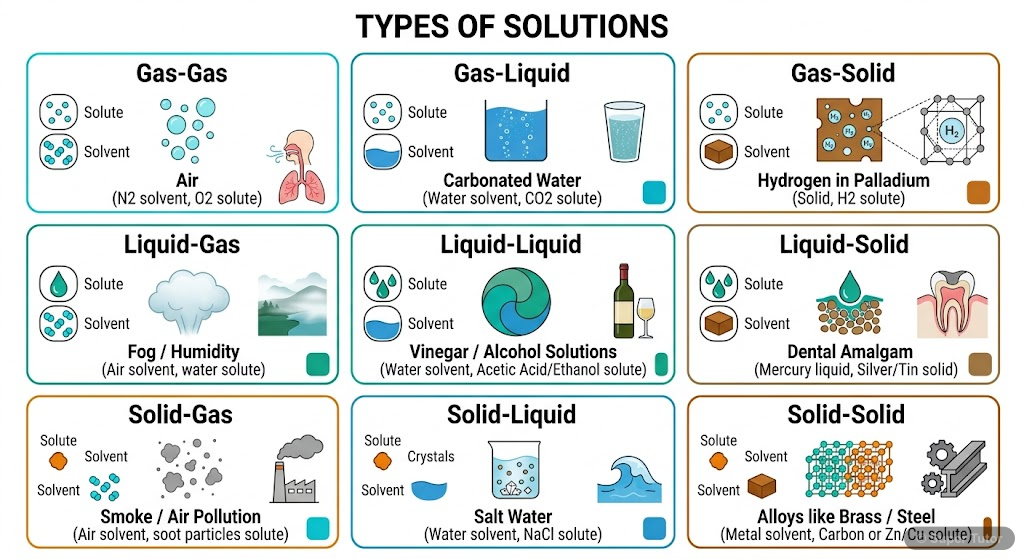
Types of Solutions & Concentration
Mass percentage = (Mass of solute/Total mass of solution) × 100Molarity (M) = Moles of solute/Volume of solution in LMolality (m) = Moles of solute/Mass of solvent in kgMole fraction (x) = n₁/(n₁ + n₂)Henry's Law & Gas Solubility
p = K_H × xRaoult's Law & Vapor Pressure
p₁ = p₁° × x₁p_total = p₁ + p₂ = x₁p₁° + x₂p₂°Relative lowering = (p° - p_s)/p° = x₂Non-ideal Solutions & Azeotropes
Get the complete formula sheet with derivations — continue in Super Tutor
Frequently Asked Questions
What topics are covered in Solutions for MET?
Solutions is an important chapter in MET Chemistry. It covers key concepts and formulas that are frequently tested in the exam. Key topics include: Types of Solutions and Basic Concepts, Concentration of Solutions, Solubility and Henry's Law, Raoult's Law and Vapor Pressure.
How important is Solutions for MET?
Solutions is a frequently tested chapter in MET Chemistry. Questions from this chapter appear regularly in previous year papers. There are 532 practice questions available for this chapter.
How to prepare Solutions for MET?
Start by understanding the core concepts, then solve practice questions. Focus on formulas and their applications. Use revision notes for quick review before the exam.
More resources for Solutions
For MET aspirants
Get the full Solutions chapter — for free.
Practice questions, revision notes, formula sheet and AI doubt-solver for MET Chemistry.