Electron, Photon, Photo-electric Effect and X-Rays — Revision Notes
NEET-UG · Physics
Quick revision notes for Electron, Photon, Photo-electric Effect and X-Rays — key concepts, formulas, and definitions for NEET-UG Physics preparation.
Interactive on Super Tutor
Studying Electron, Photon, Photo-electric Effect and X-Rays? Get the full chapter — free.
Practice questions, revision notes, formula sheet and AI doubt-solver — built for NEET-UG Physics.
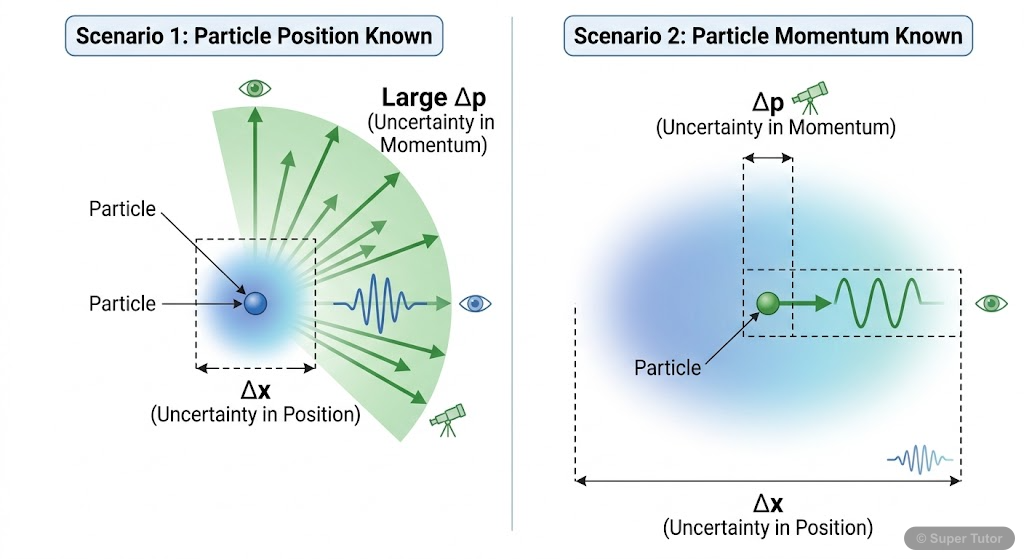
This is just one of 17+ visuals inside Super Tutor's Electron, Photon, Photo-electric Effect and X-Rays chapter
Explore the full setRevision Notes — Electron, Photon, Photo-electric Effect and X-Rays
Key concepts, formulas, and definitions from Electron, Photon, Photo-electric Effect and X-Rays for NEET-UG Physics preparation.
Key Topics to Revise
Electric Discharge Through Gases and Cathode Rays
- At normal pressure, gases are poor conductors of electricity
- As pressure decreases in discharge tube, different phenomena occur: sparks → dark discharge → positive column → negative glow → striations → cathode rays
- Cathode rays are discovered at pressure ~10⁻² mm of Hg
Positive Rays and Mass Spectrography
- Positive rays (canal rays) discovered by Goldstein - consist of positive ions
- Properties: slower than cathode rays, deflected by electric and magnetic fields but less than cathode rays
- q/m ratio depends on nature of gas (unlike cathode rays where e/m is constant)
Matter Waves (de Broglie Waves)
- de Broglie proposed wave-particle duality - moving particles have wave properties
- Matter waves are probability waves, not electromagnetic waves
- Wavelength is inversely proportional to momentum: λ = h/p
Heisenberg's Uncertainty Principle
- Impossible to simultaneously measure exact position and momentum of microscopic particles
- Mathematical form: Δx·Δp ≥ h/4π
- If position is known exactly (Δx = 0), momentum is completely uncertain (Δp = ∞)
Get complete revision notes with diagrams and examples — continue in Super Tutor
Key Concepts
Frequently Asked Questions
What topics are covered in Electron, Photon, Photo-electric Effect and X-Rays for NEET-UG?
How important is Electron, Photon, Photo-electric Effect and X-Rays for NEET-UG?
How to prepare Electron, Photon, Photo-electric Effect and X-Rays for NEET-UG?
More resources for Electron, Photon, Photo-electric Effect and X-Rays
Syllabus
Electron, Photon, Photo-electric Effect and X-Rays — syllabus
Important Topics
Electron, Photon, Photo-electric Effect and X-Rays — important topics
Practice Questions
Electron, Photon, Photo-electric Effect and X-Rays — practice questions
Study Plan
Electron, Photon, Photo-electric Effect and X-Rays — study plan
Formula Sheet
Electron, Photon, Photo-electric Effect and X-Rays — formula sheet
For NEET-UG aspirants
Get the full Electron, Photon, Photo-electric Effect and X-Rays chapter — for free.
Practice questions, revision notes, formula sheet and AI doubt-solver for NEET-UG Physics.