Chapter 17 of 19
Revision Notes
Hydrocarbons — Revision Notes
SRMJEE · Chemistry
Quick revision notes for Hydrocarbons — key concepts, formulas, and definitions for SRMJEE Chemistry preparation.
Interactive on Super Tutor
Studying Hydrocarbons? Get the full chapter — free.
Practice questions, revision notes, formula sheet and AI doubt-solver — built for SRMJEE Chemistry.
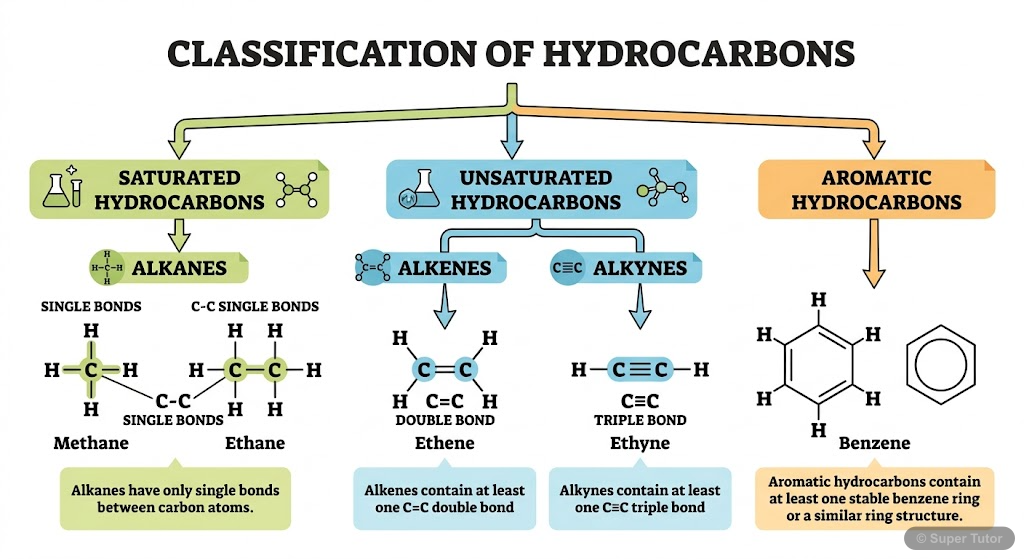
Super Tutor
This is just one of 28+ visuals inside Super Tutor's Hydrocarbons chapter
Explore the full setRevision Notes — Hydrocarbons
Key concepts, formulas, and definitions from Hydrocarbons for SRMJEE Chemistry preparation.
Key Topics to Revise
1
9.1 Classification of Hydrocarbons
- Hydrocarbons are classified into three main categories: Saturated (alkanes and cycloalkanes), Unsaturated (alkenes and alkynes), and Aromatic (benzene derivatives)
- Saturated hydrocarbons contain only single C-C bonds and follow the formula CnH2n+2 for alkanes and CnH2n for cycloalkanes
- Unsaturated hydrocarbons contain double or triple bonds: alkenes (C=C) have formula CnH2n, alkynes (C≡C) have formula CnH2n-2
2
9.2 Alkanes - Structure and Properties
- Alkanes have sp³ hybridized carbon atoms with tetrahedral geometry (bond angle 109°28')
- All C-C bonds are 1.54 Å long and C-H bonds are 1.09 Å long
- Alkanes exhibit chain isomerism starting from C₄H₁₀ (butane has 2 isomers, pentane has 3, hexane has 5)
3
9.2 Alkane Preparation Methods
- Hydrogenation of alkenes/alkynes: R-CH=CH-R' + H₂ → R-CH₂-CH₂-R' (Pt/Pd/Ni catalyst)
- Reduction of alkyl halides: R-X + H₂ → R-H + HX (Zn/HCl)
- Wurtz reaction: 2R-X + 2Na → R-R + 2NaX (dry ether, gives even-carbon alkanes)
4
9.2 Alkane Chemical Reactions
- Halogenation follows free radical mechanism: Initiation (Cl₂ → 2Cl•), Propagation (CH₄ + Cl• → CH₃• + HCl), Termination (Cl• + Cl• → Cl₂)
- Halogenation reactivity order: F₂ > Cl₂ > Br₂ > I₂ (fluorination too violent, iodination needs oxidizing agent)
- Hydrogen replacement order: 3° > 2° > 1° (tertiary hydrogen most easily replaced)
Get complete revision notes with diagrams and examples — continue in Super Tutor
Key Concepts
Hydrocarbons are classified into three mainAlkanes have general formula CₙH₂ₙ₊₂Alkenes have general formula CₙH₂ₙMarkovnikov's rule states that inAlkynes with general formula CₙH₂ₙ₋₂ have
Frequently Asked Questions
What topics are covered in Hydrocarbons for SRMJEE?
Hydrocarbons is an important chapter in SRMJEE Chemistry. It covers key concepts and formulas that are frequently tested in the exam. Key topics include: 9.1 Classification of Hydrocarbons, 9.2 Alkanes - Structure and Properties, 9.2 Alkane Preparation Methods, 9.2 Alkane Chemical Reactions.
How important is Hydrocarbons for SRMJEE?
Hydrocarbons is a frequently tested chapter in SRMJEE Chemistry. Questions from this chapter appear regularly in previous year papers. There are 267 practice questions available for this chapter.
How to prepare Hydrocarbons for SRMJEE?
Start by understanding the core concepts, then solve practice questions. Focus on formulas and their applications. Use revision notes for quick review before the exam.
More resources for Hydrocarbons
For SRMJEE aspirants
Get the full Hydrocarbons chapter — for free.
Practice questions, revision notes, formula sheet and AI doubt-solver for SRMJEE Chemistry.