Plant Kingdom — Study Plan
SRMJEE · Biology
Step-by-step study plan for Plant Kingdom — structured approach to mastering this chapter for SRMJEE Biology.
Interactive on Super Tutor
Studying Plant Kingdom? Get the full chapter — free.
Practice questions, revision notes, formula sheet and AI doubt-solver — built for SRMJEE Biology.
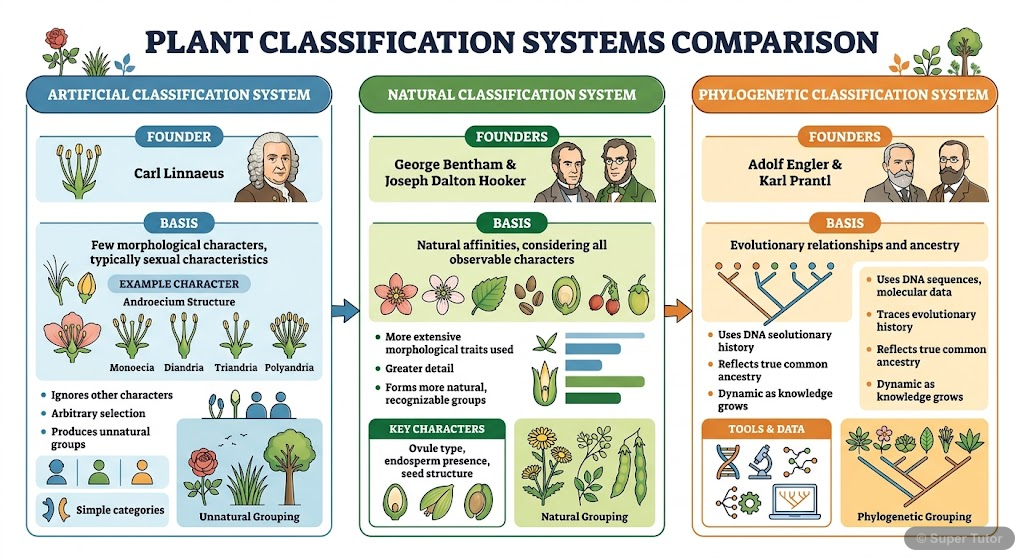
Learn better with visuals Super Tutor has hundreds of illustrations like this across every chapter — all free to try.
Get startedHow to Study Plant Kingdom
A structured approach to studying Plant Kingdom for SRMJEE Biology.
Study Plan for Plant Kingdom
Day 1–2: Learn the Theory
Study the chapter thoroughly. Note down definitions, formulas, and key concepts.
Day 3: Practice Problems
Solve practice questions and previous year SRMJEE problems. There are 84 questions available for this chapter.
Day 4: Revise & Test
Revise key formulas and concepts without looking at notes. Take a practice quiz to test your understanding.
What to Focus On
- Artificial systems used limited characteristics and separated closely related species
- Natural systems consider multiple internal and external features
- Phylogenetic systems are based on evolutionary relationships and common ancestry
- Algae are simple, autotrophic, primarily aquatic organisms with thalloid body structure
- They inhabit diverse environments and may form symbiotic associations
- Size ranges from microscopic unicells to massive marine kelps over 100m long
- Chlorophyceae: Green algae with chlorophyll a and b, store starch, diverse forms
- Phaeophyceae: Brown algae with fucoxanthin, mostly marine, complex body structure
- Rhodophyceae: Red algae with phycoerythrin, marine, survive at great depths
Common Mistakes to Avoid
All algae are primitive plants that lack cell walls and organized structures
Bryophytes are called 'amphibians of plant kingdom' because they can survive both in water and on land like frogs
In bryophytes, sporophyte is the dominant phase because it produces spores
Want a personalised study plan?
Super Tutor creates a day-by-day plan for SRMJEE Biology that adapts to your exam date and pace.
Create My Study Plan — FreeFrequently Asked Questions
What topics are covered in Plant Kingdom for SRMJEE?
How important is Plant Kingdom for SRMJEE?
How to prepare Plant Kingdom for SRMJEE?
More resources for Plant Kingdom
For SRMJEE aspirants
Get the full Plant Kingdom chapter — for free.
Practice questions, revision notes, formula sheet and AI doubt-solver for SRMJEE Biology.