Biotechnology Principles and Processes — Revision Notes
TG EAPCET · Biology
Quick revision notes for Biotechnology Principles and Processes — key concepts, formulas, and definitions for TG EAPCET Biology preparation.
Interactive on Super Tutor
Studying Biotechnology Principles and Processes? Get the full chapter — free.
Practice questions, revision notes, formula sheet and AI doubt-solver — built for TG EAPCET Biology.
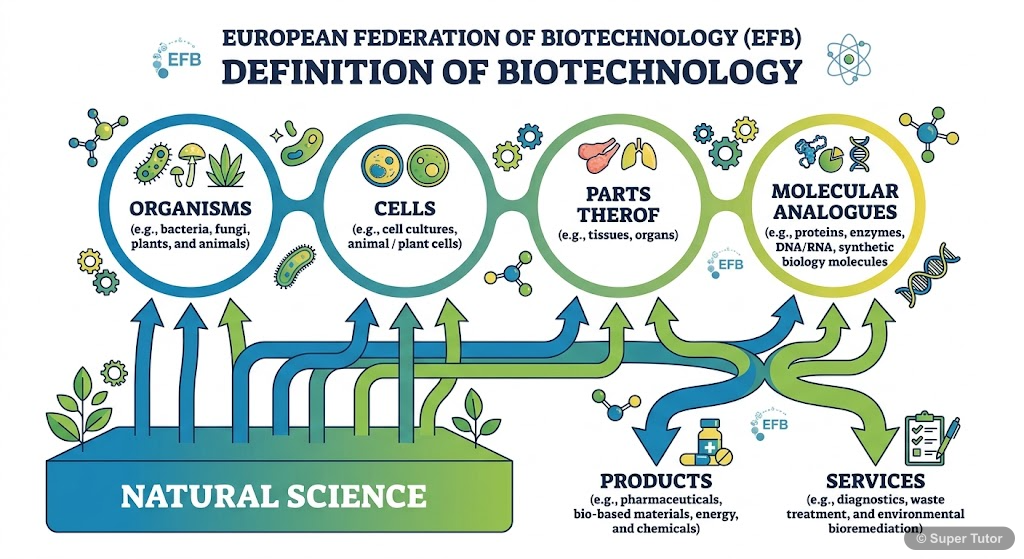
Learn better with visuals Super Tutor has hundreds of illustrations like this across every chapter — all free to try.
Get startedRevision Notes — Biotechnology Principles and Processes
Key concepts, formulas, and definitions from Biotechnology Principles and Processes for TG EAPCET Biology preparation.
Key Topics to Revise
Introduction to Biotechnology
- Biotechnology involves two main techniques: Traditional biotechnology (using living organisms directly) and Modern biotechnology (genetic engineering)
- Chemical engineering maintains sterile conditions for growing desired microorganisms to produce biotechnological products like antibiotics, vaccines, and enzymes
- Genetic engineering techniques include recombinant DNA creation, gene cloning, and gene transfer
Tools of Recombinant DNA Technology
- Three main biological tools: Restriction enzymes, Cloning vectors, and Competent hosts
- Restriction enzymes were first discovered by W. Arber (1963), later awarded Nobel Prize with Smith and Nathan
- Hind II was the first restriction endonuclease isolated from Haemophilus influenzae Rd
Cloning Vectors
- Vectors are DNA molecules that carry foreign DNA and replicate in host cells
- Common vectors include plasmids, bacteriophages, cosmids, YACs, BACs, and transposons
- Essential vector features: Origin of replication, selectable marker, and cloning sites
Competent Host and Transformation
- Competent hosts are essential for DNA uptake as DNA cannot naturally pass through cell membranes
- Bacterial competency achieved using divalent cations like calcium ions
- Transformation process involves ice treatment, heat shock, and return to ice
Get complete revision notes with diagrams and examples — continue in Super Tutor
Key Concepts
Frequently Asked Questions
What topics are covered in Biotechnology Principles and Processes for TG EAPCET?
How important is Biotechnology Principles and Processes for TG EAPCET?
How to prepare Biotechnology Principles and Processes for TG EAPCET?
More resources for Biotechnology Principles and Processes
Syllabus
Biotechnology Principles and Processes — syllabus
Important Topics
Biotechnology Principles and Processes — important topics
Practice Questions
Biotechnology Principles and Processes — practice questions
Study Plan
Biotechnology Principles and Processes — study plan
Formula Sheet
Biotechnology Principles and Processes — formula sheet
For TG EAPCET aspirants
Get the full Biotechnology Principles and Processes chapter — for free.
Practice questions, revision notes, formula sheet and AI doubt-solver for TG EAPCET Biology.