Chapter 3 of 32
Important Topics
Biological Classification — Important Topics
VITEEE · Biology
Most important topics from Biological Classification for VITEEE Biology. Focus on these high-weightage areas for maximum score.
Interactive on Super Tutor
Studying Biological Classification? Get the full chapter — free.
Practice questions, revision notes, formula sheet and AI doubt-solver — built for VITEEE Biology.
Super Tutor
This is just one of 19+ visuals inside Super Tutor's Biological Classification chapter
Explore the full setBiological Classification — Syllabus & Topics
Topics covered in Biological Classification for VITEEE Biology.
Topics in Biological Classification
1
History and Evolution of Classification Systems
- Aristotle (384-322 BCE) was the first to attempt scientific classification, dividing plants into trees, shrubs, and herbs, and animals into those with red blood (enaima) and without red blood (anaima)
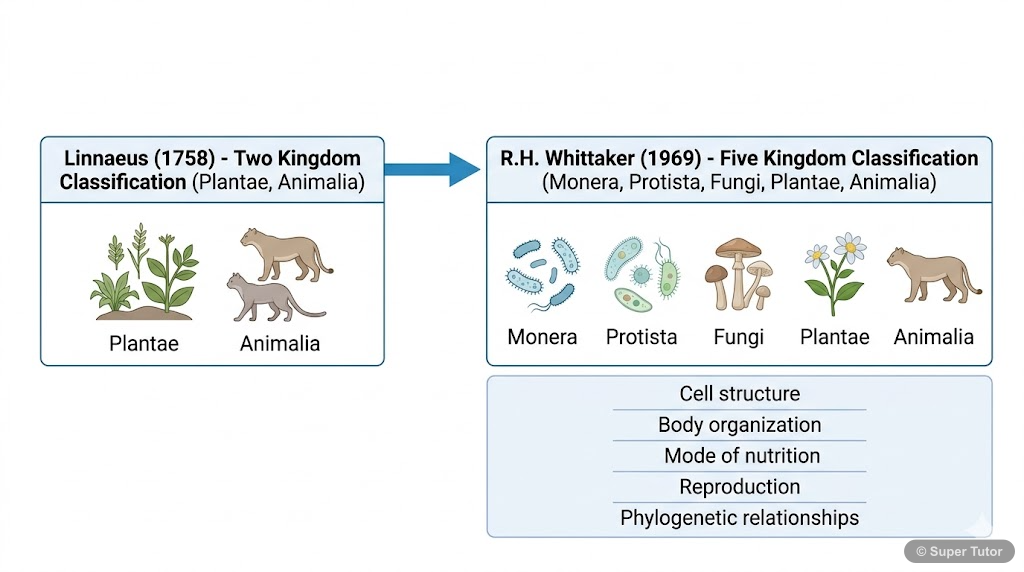
- Linnaeus proposed the Two Kingdom System (Plantae and Animalia) which was widely used but had limitations as it didn't distinguish between prokaryotes-eukaryotes, unicellular-multicellular, and photos
- Haeckel introduced the Three Kingdom System adding Kingdom Protista to separate primitive organisms
2
Whittaker's Five Kingdom System - Overview
- Kingdom Monera: Prokaryotic organisms (bacteria and archaea)
- Kingdom Protista: Unicellular eukaryotic organisms
- Kingdom Fungi: Heterotrophic eukaryotes with chitin cell walls
3
Kingdom Monera - Prokaryotic Diversity
- Includes all prokaryotic organisms - bacteria are the sole members
- Found everywhere: soil, extreme environments (hot springs, deserts, deep oceans), as parasites
- Four basic shapes: Coccus (spherical), Bacillus (rod-shaped), Vibrio (comma-shaped), Spirillum (spiral)
4
Kingdom Protista - Unicellular Eukaryotes
- All single-celled eukaryotes with well-defined nucleus and membrane-bound organelles
- Primarily aquatic organisms serving as connecting link between other kingdoms
- Includes both photosynthetic (phytoplankton) and non-photosynthetic (zooplankton) forms
Key Concepts
Whittaker's classification divides all living organismsIncludes all prokaryotic organisms with cellsContains all singleMulticellular (except yeast) heterotrophic organismsViruses are non
Frequently Asked Questions
What topics are covered in Biological Classification for VITEEE?
Biological Classification is an important chapter in VITEEE Biology. It covers key concepts and formulas that are frequently tested in the exam. Key topics include: History and Evolution of Classification Systems, Whittaker's Five Kingdom System - Overview, Kingdom Monera - Prokaryotic Diversity, Kingdom Protista - Unicellular Eukaryotes.
How important is Biological Classification for VITEEE?
Biological Classification is a frequently tested chapter in VITEEE Biology. Questions from this chapter appear regularly in previous year papers. There are 179 practice questions available for this chapter.
How to prepare Biological Classification for VITEEE?
Start by understanding the core concepts, then solve practice questions. Focus on formulas and their applications. Use revision notes for quick review before the exam.
More resources for Biological Classification
For VITEEE aspirants
Get the full Biological Classification chapter — for free.
Practice questions, revision notes, formula sheet and AI doubt-solver for VITEEE Biology.