Chapter 7 of 28
Revision Notes
Laws of Motion — Revision Notes
WBJEE · Physics
Quick revision notes for Laws of Motion — key concepts, formulas, and definitions for WBJEE Physics preparation.
Interactive on Super Tutor
Studying Laws of Motion? Get the full chapter — free.
Practice questions, revision notes, formula sheet and AI doubt-solver — built for WBJEE Physics.
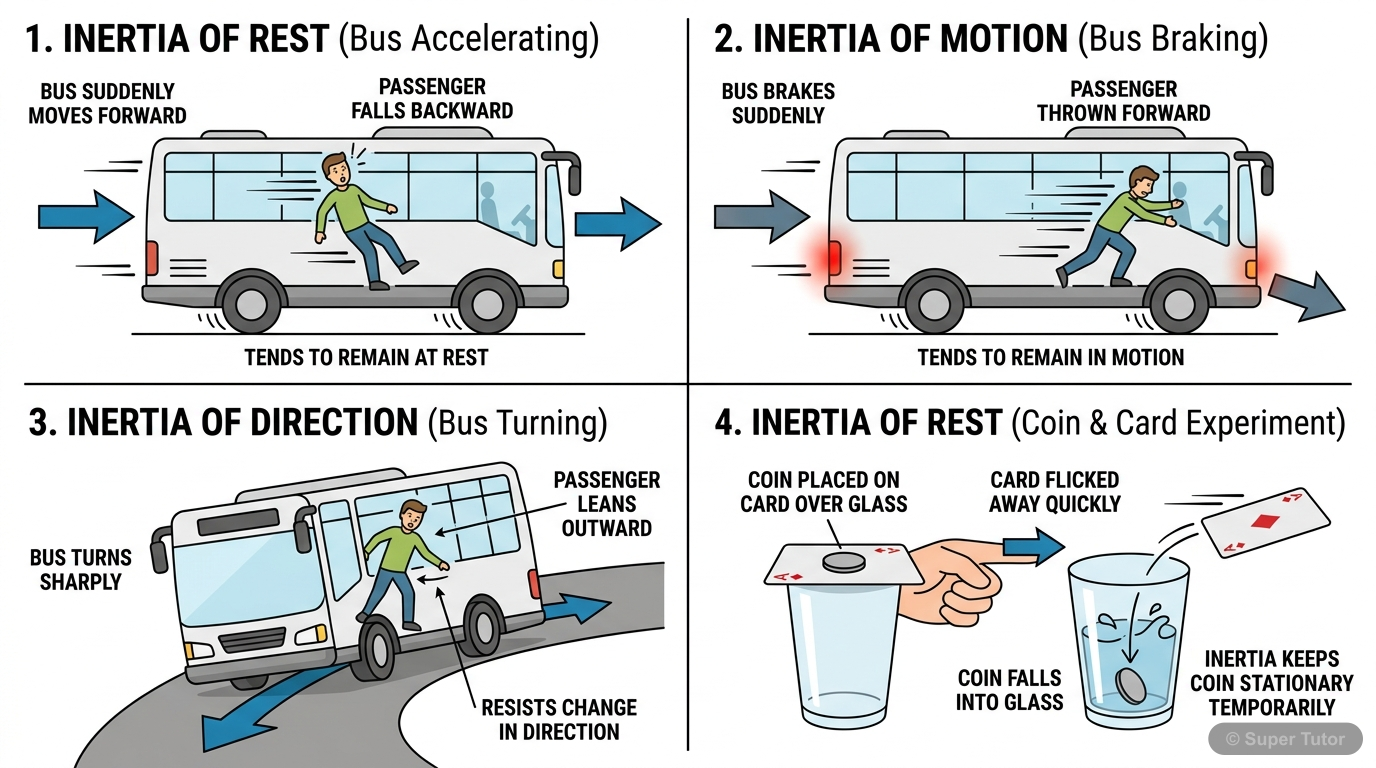
Super Tutor
Super Tutor has 13+ illustrations like this for Laws of Motion alone — flashcards, concept maps, and step-by-step visuals.
See them allRevision Notes — Laws of Motion
Key concepts, formulas, and definitions from Laws of Motion for WBJEE Physics preparation.
Key Topics to Revise
1
Introduction and Galileo's Contributions
- External force is needed to start or stop motion, but not to maintain uniform motion
- Aristotle's fallacy: believed external force was required to keep a body in motion
- Galileo's experiments with inclined planes proved objects on frictionless surfaces move with constant velocity
2
Newton's First Law of Motion
- A body at rest remains at rest, and a body in uniform motion continues in uniform motion unless acted upon by net external force
- Also known as the Law of Inertia
- Inertia is directly proportional to mass of the body
3
Momentum and Newton's Second Law
- Momentum is the product of mass and velocity: p = mv
- Rate of change of momentum equals applied force: F = dp/dt
- For constant mass: F = ma (most common form)
4
Newton's Third Law and Pseudo Forces
- For every action, there is an equal and opposite reaction
- Action-reaction pairs act on different bodies, so they don't cancel each other
- Forces always exist in pairs, never in isolation
Get complete revision notes with diagrams and examples — continue in Super Tutor
Key Concepts
Inertia is the property of matterNewton's Second Law states thatFor every actionWhen no external force acts onFriction opposes relative motion between surfaces
Frequently Asked Questions
What topics are covered in Laws of Motion for WBJEE?
Laws of Motion is an important chapter in WBJEE Physics. It covers key concepts and formulas that are frequently tested in the exam. Key topics include: Introduction and Galileo's Contributions, Newton's First Law of Motion, Momentum and Newton's Second Law, Newton's Third Law and Pseudo Forces.
How important is Laws of Motion for WBJEE?
Laws of Motion is a frequently tested chapter in WBJEE Physics. Questions from this chapter appear regularly in previous year papers. There are 235 practice questions available for this chapter.
How to prepare Laws of Motion for WBJEE?
Start by understanding the core concepts, then solve practice questions. Focus on formulas and their applications. Use revision notes for quick review before the exam.
More resources for Laws of Motion
For WBJEE aspirants
Get the full Laws of Motion chapter — for free.
Practice questions, revision notes, formula sheet and AI doubt-solver for WBJEE Physics.