Sense Organs
ICSE · Class 10 · Biology
Summary of Sense Organs for ICSE Class 10 Biology. Key concepts, important points, and chapter overview.
Interactive on Super Tutor
Studying Sense Organs? Get the full interactive chapter.
Quizzes, flashcards, AI doubt-solver and a step-by-step study plan — built for chapter summary and more.
1,000+ Class 10 students started this chapter today
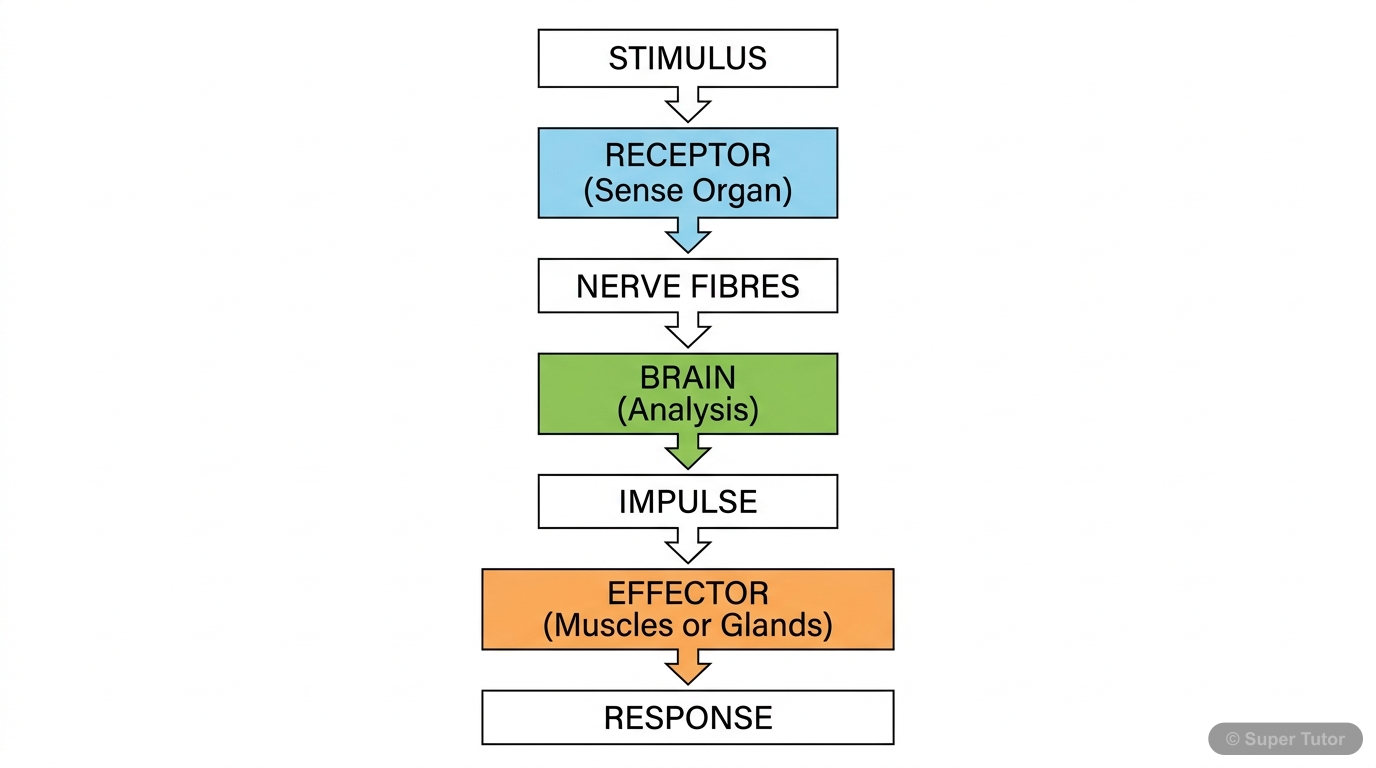
This is just one of 5+ visuals inside Super Tutor's Sense Organs chapter
Explore the full setOverview
Sense organs are specialized structures that help our body detect and respond to changes in our environment and within our body. They act as receptors that collect information about stimuli (changes) and send this information to the brain through nerves. The brain then processes this information and
Key Concepts
A stimulus is any change
A stimulus is any change in the environment or within the body that affects body function. When a receptor detects a stimulus, it sends information th
Receptors are classified based on location
Receptors are classified based on location (exteroceptors for external stimuli, interoceptors for internal stimuli) and type of stimulus detected: mec
The eye has three main layers
The eye has three main layers: fibrous coat (sclera and cornea), vascular coat (choroid, ciliary body, iris), and nervous coat (retina). The retina co
Common defects include myopia (nearsightedness corrected
Common defects include myopia (nearsightedness corrected by concave lens), hypermetropia (farsightedness corrected by convex lens), astigmatism (uneve
The ear has three parts
The ear has three parts: external ear (pinna, auditory canal, eardrum), middle ear (ear ossicles - malleus, incus, stapes), and internal ear (cochlea
Learning Objectives
- Understand the concept of stimulus, receptor, effector, and response
- Learn about different types of receptors and their classification
- Study the detailed structure and function of the human eye
- Understand common eye defects and their corrections
- Learn about the structure and function of the human ear
Frequently Asked Questions
What are the important topics in Sense Organs for ICSE Class 10 Biology?
How to score full marks in Sense Organs — ICSE Class 10 Biology?
Sources & Official References
Content is aligned to the official syllabus. Refer to the board website for the latest curriculum.
More resources for Sense Organs
Important Questions
Practice with board exam-style questions
Syllabus
What topics to cover
Revision Notes
Key points for last-minute revision
Study Plan
Step-by-step plan to ace this chapter
Flashcards
Quick-fire cards for active recall
Formula Sheet
All formulas in one place
Practice Quiz
Test yourself with a quick quiz
Concept Maps
See how topics connect visually
For serious students
Get the full Sense Organs chapter — for free.
Quizzes, flashcards, AI doubt-solver and a step-by-step study plan for ICSE Class 10 Biology.