The Second World War (1939-45)
ICSE · Class 10 · History & Civics
Summary of The Second World War (1939-45) for ICSE Class 10 History & Civics. Key concepts, important points, and chapter overview.
Interactive on Super Tutor
Studying The Second World War (1939-45)? Get the full interactive chapter.
Quizzes, flashcards, AI doubt-solver and a step-by-step study plan — built for chapter summary and more.
1,000+ Class 10 students started this chapter today
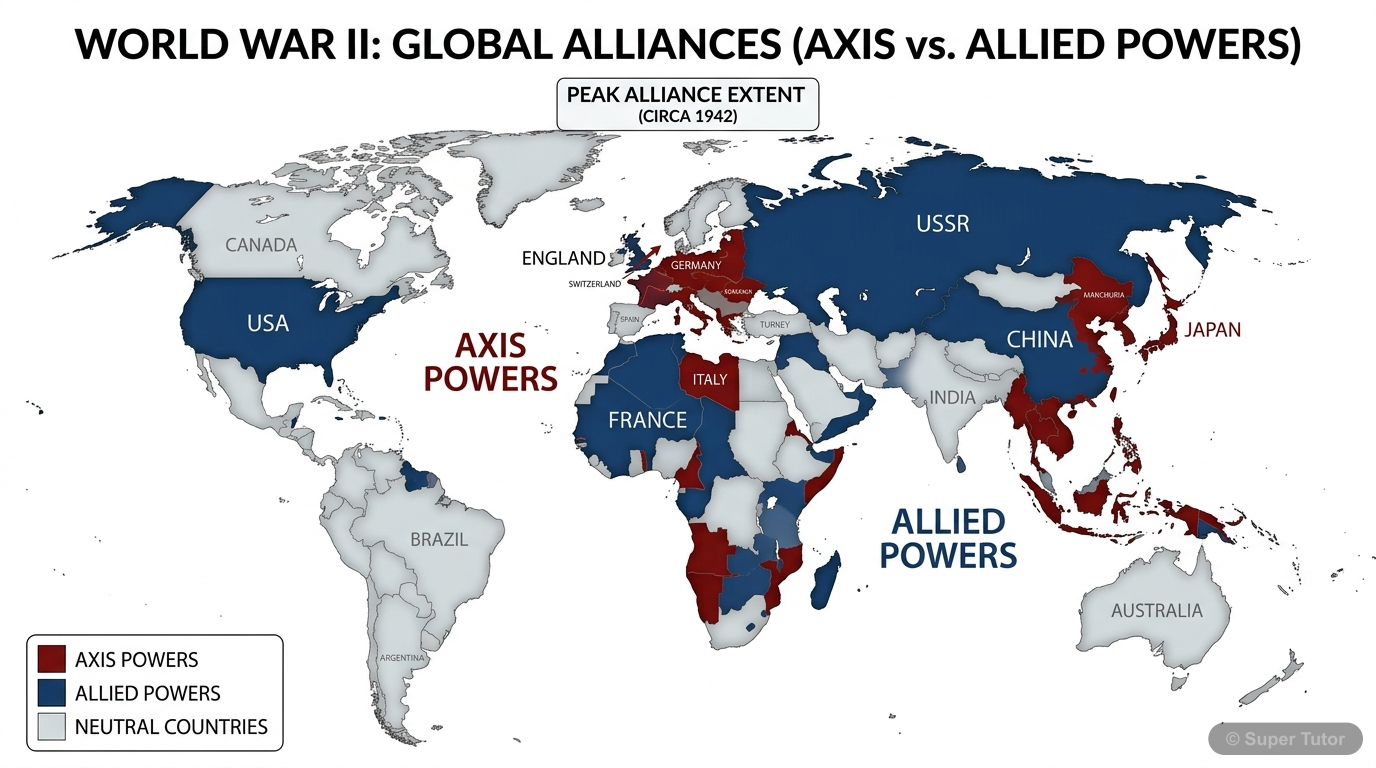
Super Tutor has 5+ illustrations like this for The Second World War (1939-45) alone — flashcards, concept maps, and step-by-step visuals.
See them allOverview
The Second World War (1939-45) was the most devastating global conflict in human history, involving over 80 nations and lasting six years. Unlike the First World War, this conflict was even more destructive and fundamentally changed the world order. The war began due to the failure of peace treaties
Key Concepts
The harsh terms imposed on Germany
The harsh terms imposed on Germany after WWI created resentment and desire for revenge. Germany lost territories, colonies, military power, and had to
Three aggressive dictatorships emerged
Three aggressive dictatorships emerged: Nazi Germany under Hitler, Fascist Italy under Mussolini, and militarist Japan under Emperor Hirohito. Each so
Britain and France initially tried
Britain and France initially tried to avoid war by giving in to Hitler's demands, hoping to satisfy his ambitions. The Munich Agreement (1938) allowed
Germany
Germany, Italy, and Japan formed a military alliance to support each other's expansionist goals. This divided the world into rival camps and made glob
Japan's surprise attack on the US
Japan's surprise attack on the US naval base at Pearl Harbor on December 7, 1941, killed 3,700 people and brought America fully into the war. This str
Learning Objectives
- Analyze the multiple causes that led to the outbreak of the Second World War
- Understand the rise of Nazism, Fascism, and militarism in Germany, Italy, and Japan
- Examine the major events and turning points of the war from 1939-1945
- Evaluate the consequences of the war on defeated and victorious nations
- Assess the emergence of Cold War tensions and bipolar world order
Frequently Asked Questions
What are the important topics in The Second World War (1939-45) for ICSE Class 10 History & Civics?
How to score full marks in The Second World War (1939-45) — ICSE Class 10 History & Civics?
Sources & Official References
Content is aligned to the official syllabus. Refer to the board website for the latest curriculum.
More resources for The Second World War (1939-45)
Important Questions
Practice with board exam-style questions
Syllabus
What topics to cover
Revision Notes
Key points for last-minute revision
Study Plan
Step-by-step plan to ace this chapter
Flashcards
Quick-fire cards for active recall
Formula Sheet
All formulas in one place
Practice Quiz
Test yourself with a quick quiz
Concept Maps
See how topics connect visually
For serious students
Get the full The Second World War (1939-45) chapter — for free.
Quizzes, flashcards, AI doubt-solver and a step-by-step study plan for ICSE Class 10 History & Civics.