Diseases Cause and Control
ICSE · Class 9 · Biology
Flashcards for Diseases Cause and Control — ICSE Class 9 Biology. Quick Q&A cards covering key concepts, definitions, and formulas.
Interactive on Super Tutor
Studying Diseases Cause and Control? Get the full interactive chapter.
Quizzes, flashcards, AI doubt-solver and a step-by-step study plan — built for flashcards and more.
1,000+ Class 9 students started this chapter today
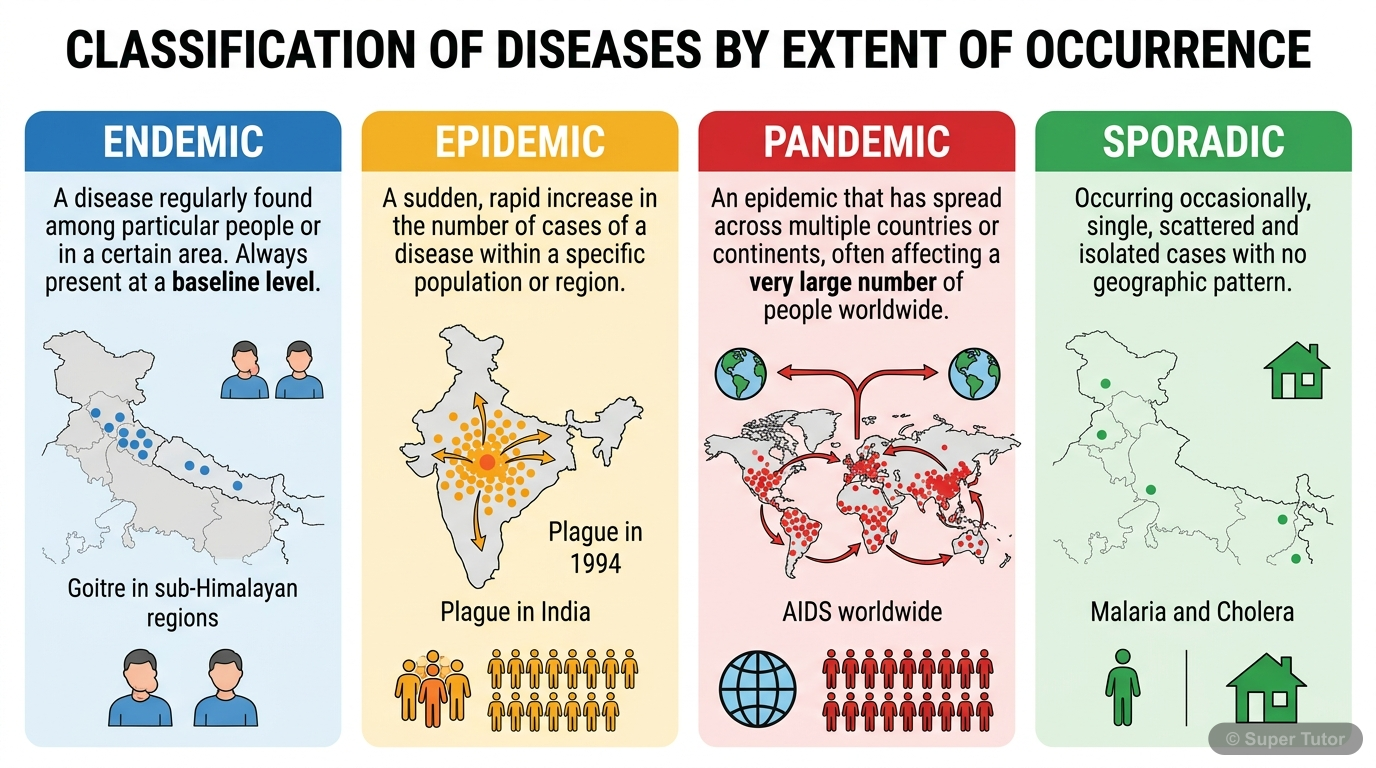
Learn better with visuals Super Tutor has hundreds of illustrations like this across every chapter — all free to try.
Get startedWhat is a disease?
Answer
Disease is a departure from normal health through structural or functional disorder of the body. It is a condition in which the normal functioning of the body is disturbed.
Define endemic disease with an example.
Answer
Endemic disease is found in a certain area only, attacking fewer number of people. Example: Yellow fever in certain African countries, goitre in sub-Himalayan regions.
What is the difference between epidemic and pandemic diseases?
Answer
Epidemic: Disease breaks out and spreads from place to place affecting large numbers of people at the same time (e.g., plague in India in 1994). Pandemic: Disease is widely distributed worldwide (e.g.
What is incubation period?
Answer
Incubation period is the period between the entry of germs and the appearance of the first symptoms of the disease. It varies from a few hours to several years depending on the disease.
Name the causative agent and transmission mode of cholera.
Answer
Causative agent: Vibrio cholerae (bacterium). Transmission: Through contaminated food and water (faeco-oral route), spread by flies that carry germs from infected faeces to food.
What are the main symptoms of cholera?
Answer
Main symptoms include vomiting, loose motions (diarrhoea), very little or no urination due to water shortage in body, and accumulation of poisonous urea in the body.
How can typhoid fever be prevented?
Answer
Prevention methods: Anti-typhoid vaccination (repeated annually), proper sanitation, control of flies, avoiding contaminated water and milk, and maintaining good hygiene.
What is the causative agent of tuberculosis and how is it transmitted?
Answer
Causative agent: Mycobacterium tuberculosis (rod-shaped bacterium). Transmission: Through sputum from infected persons, carried by air or dust particles.
+17 more flashcards available
Practice AllFrequently Asked Questions
What are the important topics in Diseases Cause and Control for ICSE Class 9 Biology?
How to score full marks in Diseases Cause and Control — ICSE Class 9 Biology?
How many flashcards are available for Diseases Cause and Control?
Sources & Official References
Content is aligned to the official syllabus. Refer to the board website for the latest curriculum.
More resources for Diseases Cause and Control
Important Questions
Practice with board exam-style questions
Syllabus
What topics to cover
Revision Notes
Key points for last-minute revision
Study Plan
Step-by-step plan to ace this chapter
Formula Sheet
All formulas in one place
Chapter Summary
Understand the chapter at a glance
Practice Quiz
Test yourself with a quick quiz
Concept Maps
See how topics connect visually
For serious students
Get the full Diseases Cause and Control chapter — for free.
Quizzes, flashcards, AI doubt-solver and a step-by-step study plan for ICSE Class 9 Biology.