Pollination and Fertilization
ICSE · Class 9 · Biology
Flashcards for Pollination and Fertilization — ICSE Class 9 Biology. Quick Q&A cards covering key concepts, definitions, and formulas.
Interactive on Super Tutor
Studying Pollination and Fertilization? Get the full interactive chapter.
Quizzes, flashcards, AI doubt-solver and a step-by-step study plan — built for flashcards and more.
1,000+ Class 9 students started this chapter today
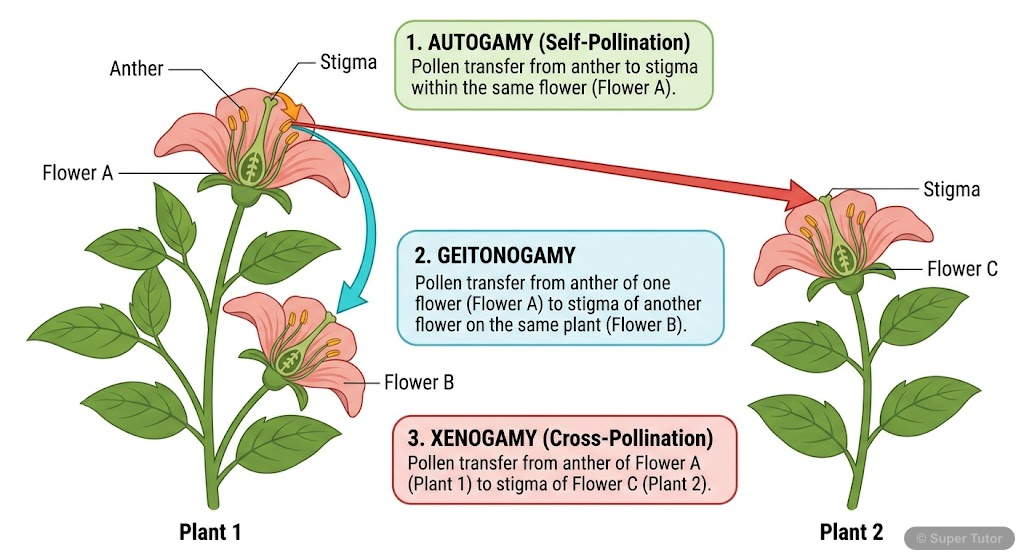
Learn better with visuals Super Tutor has hundreds of illustrations like this across every chapter — all free to try.
Get startedWhat is pollination?
Answer
Pollination is the process of transference of pollen grains from the anther to the stigma. It is the first step in plant reproduction that must occur before fruit and seed formation.
Name the three types of pollen transfer and define each.
Answer
1. Autogamy - pollen falls on stigma of same flower 2. Geitonogamy - pollen from another flower of same plant 3. Allogamy - pollen from flower of another plant of same species (cross-pollination)…
What is self-pollination?
Answer
Self-pollination is the transfer of pollen from anther to stigma of the same flower (autogamy) or to another flower of the same plant (geitonogamy). It can occur in bisexual flowers or unisexual flowe…
List 3 advantages of self-pollination.
Answer
1. Much surer process when stamens and carpels mature together 2. Parental characters are preserved indefinitely 3. No wastage of pollen - small quantity sufficient 4. Great economy - no need for larg…
What are the main disadvantages of self-pollination?
Answer
1. Continued self-pollination leads to weakening of variety/species 2. Seeds are poor quality, offspring less vigorous 3. Weaker/defective characters cannot be eliminated 4. Does not yield new varieti…
What is cross-pollination?
Answer
Cross-pollination is the transfer of pollen from anthers of flowers of one plant to the stigma of a flower of another plant of the same species. It requires external agents like wind, insects, or wate…
Compare advantages and disadvantages of cross-pollination.
Answer
Advantages: 1. Healthier offspring 2. Abundant, viable seeds 3. New varieties possible Disadvantages: 1. Not always certain - needs pollinating agents 2. Large quantity pollen needed - wastage 3. Unec…
What is dichogamy? Give examples of protandry and protogyny.
Answer
Dichogamy is different timing of maturation of androecium and gynoecium in bisexual flowers. Protandry (anthers mature first): bhindi, sweet pea, salvia, sunflower Protogyny (stigma matures first): cu…
+16 more flashcards available
Practice AllFrequently Asked Questions
What are the important topics in Pollination and Fertilization for ICSE Class 9 Biology?
How to score full marks in Pollination and Fertilization — ICSE Class 9 Biology?
How many flashcards are available for Pollination and Fertilization?
Sources & Official References
Content is aligned to the official syllabus. Refer to the board website for the latest curriculum.
More resources for Pollination and Fertilization
Important Questions
Practice with board exam-style questions
Syllabus
What topics to cover
Revision Notes
Key points for last-minute revision
Study Plan
Step-by-step plan to ace this chapter
Formula Sheet
All formulas in one place
Chapter Summary
Understand the chapter at a glance
Practice Quiz
Test yourself with a quick quiz
Concept Maps
See how topics connect visually
For serious students
Get the full Pollination and Fertilization chapter — for free.
Quizzes, flashcards, AI doubt-solver and a step-by-step study plan for ICSE Class 9 Biology.