Pollination and Fertilization
ICSE · Class 9 · Biology
Quick revision notes for Pollination and Fertilization — ICSE Class 9 Biology. Key concepts, formulas, and definitions for last-minute revision.
Interactive on Super Tutor
Studying Pollination and Fertilization? Get the full interactive chapter.
Quizzes, flashcards, AI doubt-solver and a step-by-step study plan — built for revision notes and more.
1,000+ Class 9 students started this chapter today
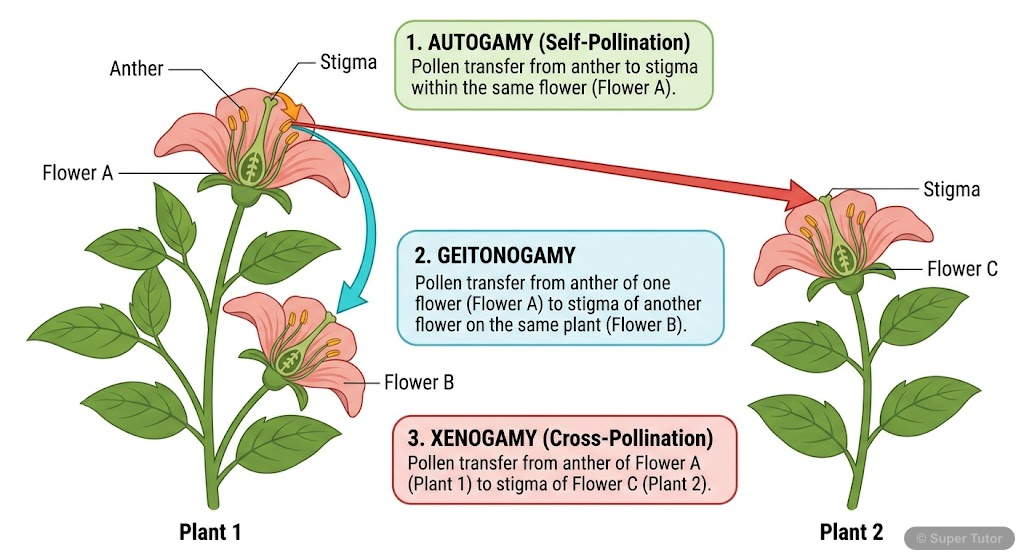
Learn better with visuals Super Tutor has hundreds of illustrations like this across every chapter — all free to try.
Get startedKey Topics to Revise
Pollination - Definition and Types
- Pollination is the transfer of pollen grains from anther to stigma
- Pollination must occur between plants of the same species only
- Nature ensures only same-species pollen germinates and grows further
Self-Pollination vs Cross-Pollination
- Self-pollination requires bisexual flowers or unisexual flowers on same plant
- For self-pollination, anthers and stigma must mature simultaneously
- Self-pollination advantages: surer process, preserves parental characters, economical (no wastage), no need for large/showy flowers
Nature's Mechanisms Favoring Cross-Pollination
- Unisexuality: Separate male and female flowers on different plants (dioecious) or same plant (monoecious)
- Dichogamy: Different maturation times of anthers and stigma
- Protandry: Anthers mature before stigma (e.g., sunflower, sweet pea)
Agents of Cross-Pollination and Flower Adaptations
- Main agents: Insects, wind, water, birds, animals
- Insect-pollinated flowers (entomophilous): Large, brightly colored, scented, nectar-producing, sticky pollen, flowers in clusters
- Wind-pollinated flowers (anemophilous): Small, dull colored, no scent/nectar, long hanging stamens, light dry pollen, feathery stigma
Get complete notes with diagrams and examples
Full NotesKey Concepts
Frequently Asked Questions
What are the important topics in Pollination and Fertilization for ICSE Class 9 Biology?
How to score full marks in Pollination and Fertilization — ICSE Class 9 Biology?
Sources & Official References
Content is aligned to the official syllabus. Refer to the board website for the latest curriculum.
More resources for Pollination and Fertilization
Important Questions
Practice with board exam-style questions
Syllabus
What topics to cover
Study Plan
Step-by-step plan to ace this chapter
Flashcards
Quick-fire cards for active recall
Formula Sheet
All formulas in one place
Chapter Summary
Understand the chapter at a glance
Practice Quiz
Test yourself with a quick quiz
Concept Maps
See how topics connect visually
For serious students
Get the full Pollination and Fertilization chapter — for free.
Quizzes, flashcards, AI doubt-solver and a step-by-step study plan for ICSE Class 9 Biology.