Pollination and Fertilization
ICSE · Class 9 · Biology
Complete topic list for Pollination and Fertilization in ICSE Class 9 Biology. Key concepts, sub-topics, and what to focus on for board exams.
Interactive on Super Tutor
Studying Pollination and Fertilization? Get the full interactive chapter.
Quizzes, flashcards, AI doubt-solver and a step-by-step study plan — built for syllabus and more.
1,000+ Class 9 students started this chapter today
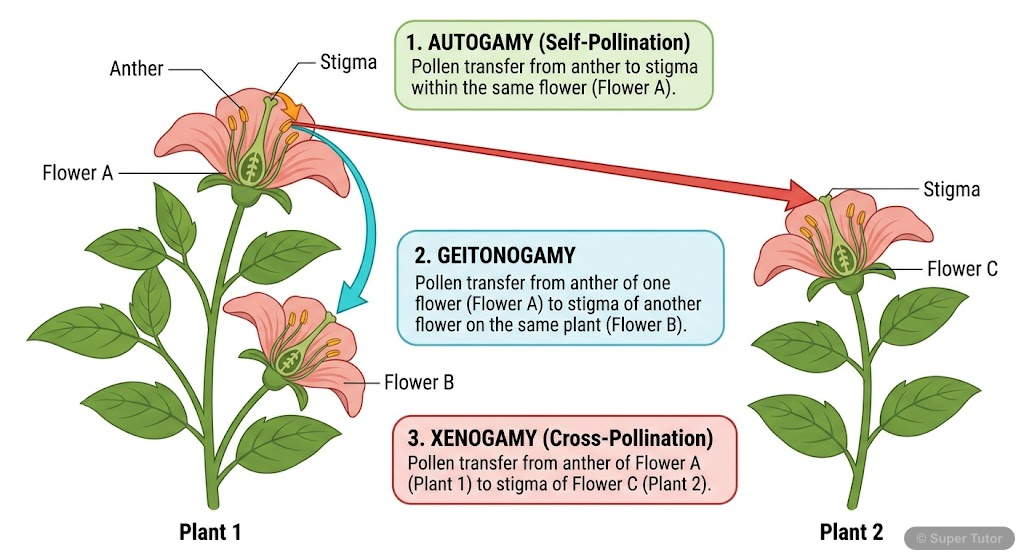
Learn better with visuals Super Tutor has hundreds of illustrations like this across every chapter — all free to try.
Get startedTopics in Pollination and Fertilization
Pollination - Definition and Types
- Pollination is the transfer of pollen grains from anther to stigma
- Pollination must occur between plants of the same species only
- Nature ensures only same-species pollen germinates and grows further
Self-Pollination vs Cross-Pollination
- Self-pollination requires bisexual flowers or unisexual flowers on same plant
- For self-pollination, anthers and stigma must mature simultaneously
- Self-pollination advantages: surer process, preserves parental characters, economical (no wastage), no need for large/showy flowers
Nature's Mechanisms Favoring Cross-Pollination
- Unisexuality: Separate male and female flowers on different plants (dioecious) or same plant (monoecious)
- Dichogamy: Different maturation times of anthers and stigma
- Protandry: Anthers mature before stigma (e.g., sunflower, sweet pea)
Agents of Cross-Pollination and Flower Adaptations
- Main agents: Insects, wind, water, birds, animals
- Insect-pollinated flowers (entomophilous): Large, brightly colored, scented, nectar-producing, sticky pollen, flowers in clusters
- Wind-pollinated flowers (anemophilous): Small, dull colored, no scent/nectar, long hanging stamens, light dry pollen, feathery stigma
Key Concepts
Frequently Asked Questions
What are the important topics in Pollination and Fertilization for ICSE Class 9 Biology?
How to score full marks in Pollination and Fertilization — ICSE Class 9 Biology?
Sources & Official References
Content is aligned to the official syllabus. Refer to the board website for the latest curriculum.
More resources for Pollination and Fertilization
Important Questions
Practice with board exam-style questions
Revision Notes
Key points for last-minute revision
Study Plan
Step-by-step plan to ace this chapter
Flashcards
Quick-fire cards for active recall
Formula Sheet
All formulas in one place
Chapter Summary
Understand the chapter at a glance
Practice Quiz
Test yourself with a quick quiz
Concept Maps
See how topics connect visually
For serious students
Get the full Pollination and Fertilization chapter — for free.
Quizzes, flashcards, AI doubt-solver and a step-by-step study plan for ICSE Class 9 Biology.