Atmospheric Pollution
ICSE · Class 9 · Chemistry
Flashcards for Atmospheric Pollution — ICSE Class 9 Chemistry. Quick Q&A cards covering key concepts, definitions, and formulas.
Interactive on Super Tutor
Studying Atmospheric Pollution? Get the full interactive chapter.
Quizzes, flashcards, AI doubt-solver and a step-by-step study plan — built for flashcards and more.
1,000+ Class 9 students started this chapter today
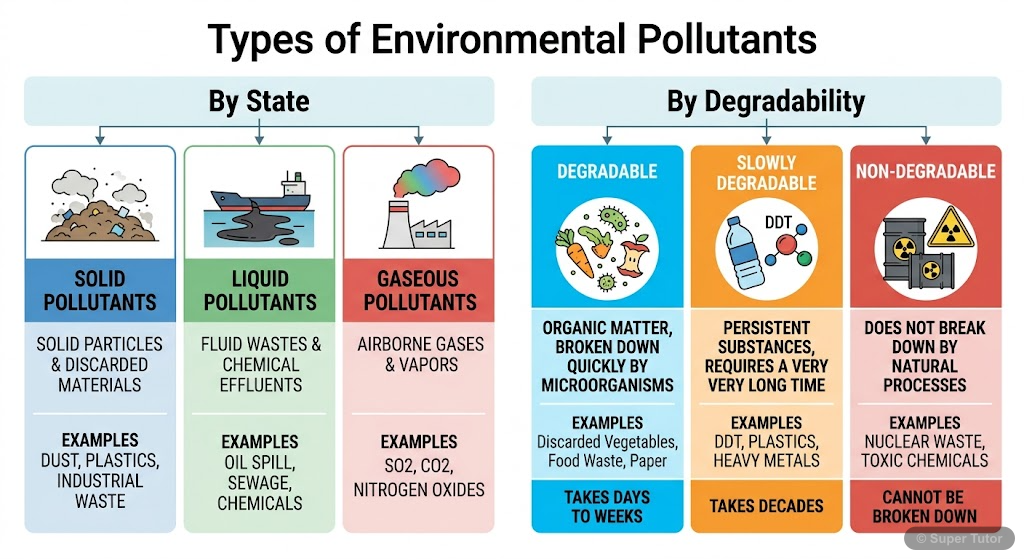
Super Tutor has 7+ illustrations like this for Atmospheric Pollution alone — flashcards, concept maps, and step-by-step visuals.
See them allWhat is environmental pollution?
Answer
Environmental pollution is the effect of undesirable changes in our surroundings that have harmful effects on plants, animals and human beings. It is caused by harmful substances called pollutants tha…
Name four natural sources of air pollutants.
Answer
1. Volcanoes (release CO, SO₂, H₂S, Cl) 2. Decaying vegetation (releases N₂O) 3. Forest fires (release CO) 4. Winds and dust storms (carry particulate matter)…
What is smog and how is it harmful?
Answer
Smog is a combination of smoke and fog containing oxides of nitrogen and sulphur, and partially-oxidized hydrocarbons. It is noxious and irritating, reduces visibility, causes respiratory troubles, an…
Write the equation for the formation of nitrogen dioxide from nitric oxide.
Answer
2NO + O₂(g) → 2NO₂(g) OR NO(g) + O₃(g) → NO₂(g) + O₂(g)…
Why is carbon monoxide extremely dangerous to humans?
Answer
Carbon monoxide combines with haemoglobin more than 200 times more strongly than oxygen, forming carboxyhaemoglobin. This reduces the oxygen-carrying capacity of blood, causing oxygen depletion in hea…
What is acid rain and what is its typical pH range?
Answer
Acid rain is precipitation (rain, snow, fog, dew) that is more acidic than normal water due to acids like HNO₃ and H₂SO₄. Normal rain pH is 5-6, while acid rain pH ranges from 3-5, sometimes as low as…
Write the equations showing formation of sulphuric acid from sulphur dioxide.
Answer
S + O₂ → SO₂ 2SO₂ + O₂ → 2SO₃ SO₃ + H₂O → H₂SO₄ OR 2SO₂ + O₂ + 2H₂O → 2H₂SO₄…
How does acid rain affect the Taj Mahal?
Answer
Acid rain causes extensive damage to building materials like marble and limestone. The reaction is: CaCO₃ + H₂SO₄ → CaSO₄ + CO₂ + H₂O. This makes the marble pitted and mechanically weak, threatening m…
+14 more flashcards available
Practice AllFrequently Asked Questions
What are the important topics in Atmospheric Pollution for ICSE Class 9 Chemistry?
How to score full marks in Atmospheric Pollution — ICSE Class 9 Chemistry?
How many flashcards are available for Atmospheric Pollution?
Sources & Official References
Content is aligned to the official syllabus. Refer to the board website for the latest curriculum.
More resources for Atmospheric Pollution
Important Questions
Practice with board exam-style questions
Syllabus
What topics to cover
Revision Notes
Key points for last-minute revision
Study Plan
Step-by-step plan to ace this chapter
Formula Sheet
All formulas in one place
Chapter Summary
Understand the chapter at a glance
Practice Quiz
Test yourself with a quick quiz
Concept Maps
See how topics connect visually
For serious students
Get the full Atmospheric Pollution chapter — for free.
Quizzes, flashcards, AI doubt-solver and a step-by-step study plan for ICSE Class 9 Chemistry.