Laws of Motion
ICSE · Class 9 · Physics
Flashcards for Laws of Motion — ICSE Class 9 Physics. Quick Q&A cards covering key concepts, definitions, and formulas.
Interactive on Super Tutor
Studying Laws of Motion? Get the full interactive chapter.
Quizzes, flashcards, AI doubt-solver and a step-by-step study plan — built for flashcards and more.
1,000+ Class 9 students started this chapter today
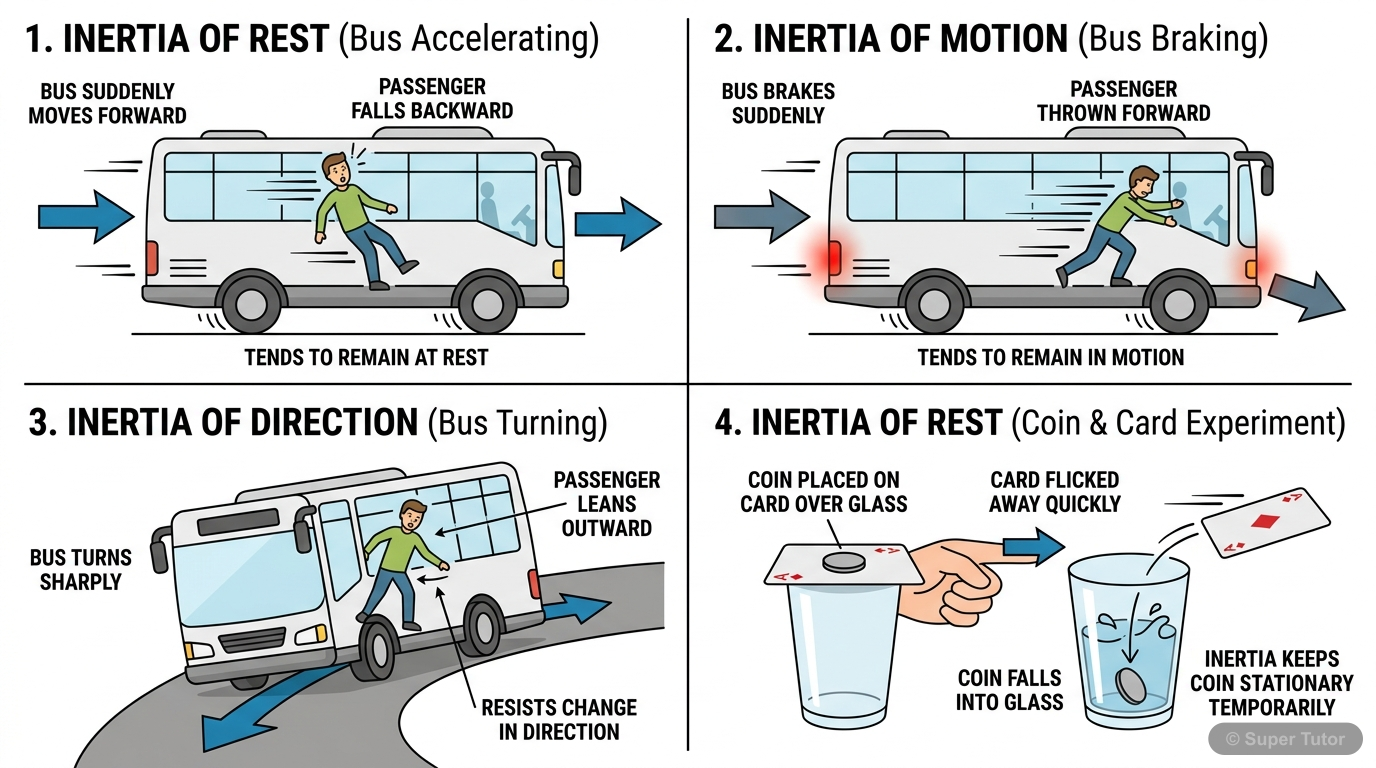
Super Tutor has 20+ illustrations like this for Laws of Motion alone — flashcards, concept maps, and step-by-step visuals.
See them allWhat is force? List its two main effects on a body.
Answer
Force is a physical cause that changes or tends to change either the size, shape, or state of rest or motion of a body. Two main effects: (1) It can change the state of rest or motion of the body (2) …
Distinguish between contact forces and non-contact forces with two examples each.
Answer
Contact forces: Applied by making physical contact. Examples: (1) Frictional force (2) Normal reaction force. Non-contact forces: Experienced without physical touch. Examples: (1) Gravitational force …
State Newton's First Law of Motion.
Answer
A body at rest remains at rest, and a body in motion continues to move with the same speed in the same direction, unless acted upon by an external force.
What is inertia? Name its two types with one example each.
Answer
Inertia is the property of a body to resist change in its state of rest or motion. Types: (1) Inertia of rest - a passenger falls backward when a train suddenly starts (2) Inertia of motion - a cyclis…
Why does a coin fall into a glass when a card beneath it is quickly flicked away?
Answer
When the card is flicked quickly, it moves away due to the applied force. However, the coin remains at its original position due to inertia of rest. As the card moves away, the coin falls into the gla…
Define linear momentum and write its formula with SI unit.
Answer
Linear momentum is the product of mass and velocity of a body. Formula: p = mv. SI unit: kg m s⁻¹ (kilogram meter per second)…
State Newton's Second Law of Motion in terms of momentum.
Answer
The rate of change of momentum of a body is directly proportional to the applied force and takes place in the direction of the force. Mathematically: F = Δp/Δt…
Derive the relation F = ma from Newton's Second Law.
Answer
From F = Δp/Δt = Δ(mv)/Δt. When mass is constant: F = m(Δv/Δt) = ma, where a is acceleration. This shows force equals mass times acceleration.
+16 more flashcards available
Practice AllFrequently Asked Questions
What are the important topics in Laws of Motion for ICSE Class 9 Physics?
How to score full marks in Laws of Motion — ICSE Class 9 Physics?
How many flashcards are available for Laws of Motion?
Sources & Official References
Content is aligned to the official syllabus. Refer to the board website for the latest curriculum.
More resources for Laws of Motion
Important Questions
Practice with board exam-style questions
Syllabus
What topics to cover
Revision Notes
Key points for last-minute revision
Study Plan
Step-by-step plan to ace this chapter
Formula Sheet
All formulas in one place
Chapter Summary
Understand the chapter at a glance
Practice Quiz
Test yourself with a quick quiz
Concept Maps
See how topics connect visually
For serious students
Get the full Laws of Motion chapter — for free.
Quizzes, flashcards, AI doubt-solver and a step-by-step study plan for ICSE Class 9 Physics.