Laws of Motion
ICSE · Class 9 · Physics
Complete topic list for Laws of Motion in ICSE Class 9 Physics. Key concepts, sub-topics, and what to focus on for board exams.
Interactive on Super Tutor
Studying Laws of Motion? Get the full interactive chapter.
Quizzes, flashcards, AI doubt-solver and a step-by-step study plan — built for syllabus and more.
1,000+ Class 9 students started this chapter today
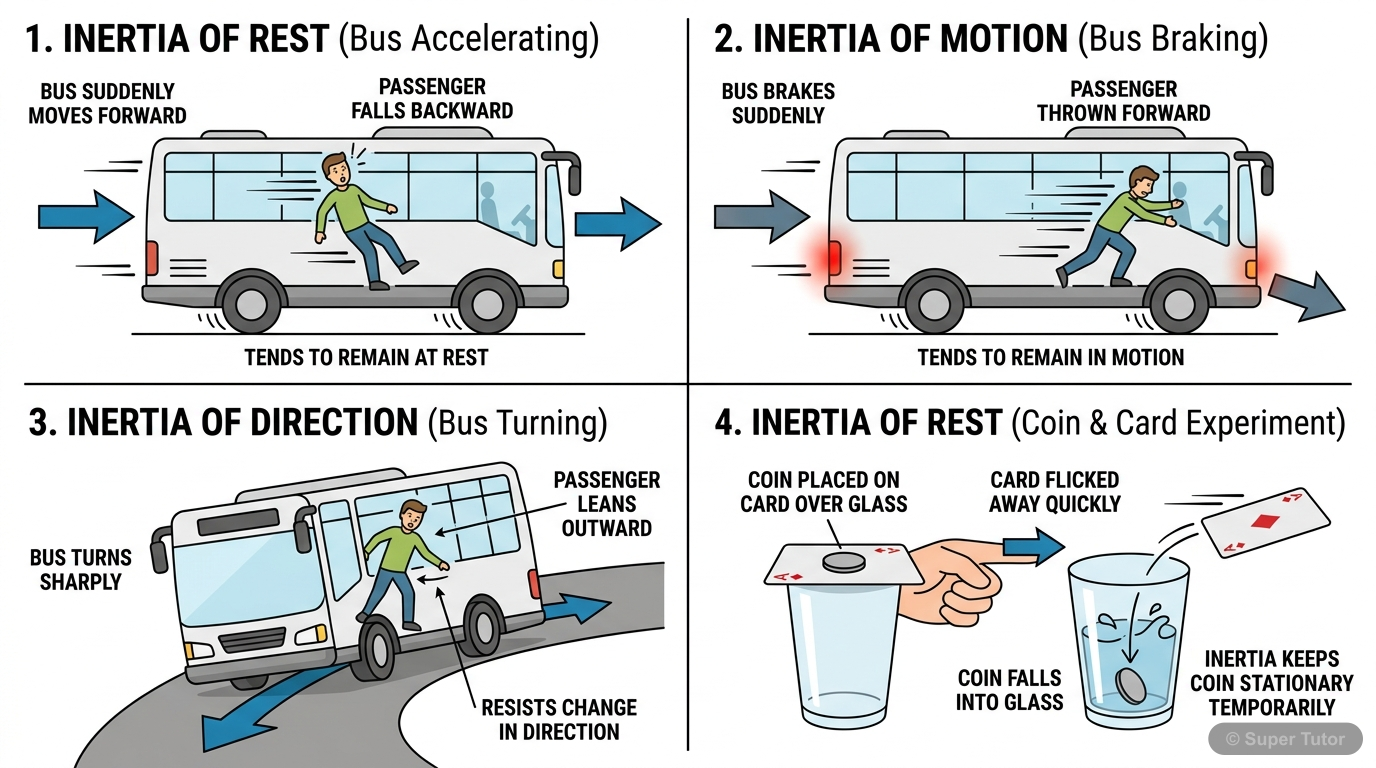
Super Tutor has 20+ illustrations like this for Laws of Motion alone — flashcards, concept maps, and step-by-step visuals.
See them allTopics in Laws of Motion
Contact and Non-Contact Forces
- Force is a physical cause that changes or tends to change the size, shape, or state of rest/motion of a body
- Contact forces require physical contact between objects (friction, normal reaction, tension, spring force, collision force)
- Non-contact forces act at a distance without physical contact (gravitational, electrostatic, magnetic)
Newton's First Law of Motion and Inertia
- A body at rest remains at rest, and a body in motion continues in motion with constant velocity unless acted upon by external force
- Inertia is the property of matter to resist change in state of rest or motion
- Mass is the measure of inertia - greater mass means greater inertia
Linear Momentum and Newton's Second Law
- Linear momentum p = mv (product of mass and velocity)
- Newton's second law: F = ma (when mass is constant)
- General form: F = dp/dt (rate of change of momentum)
Newton's Third Law of Motion
- To every action there is equal and opposite reaction
- Action and reaction forces are equal in magnitude, opposite in direction
- Action and reaction act on different bodies simultaneously
Key Concepts
Frequently Asked Questions
What are the important topics in Laws of Motion for ICSE Class 9 Physics?
How to score full marks in Laws of Motion — ICSE Class 9 Physics?
Sources & Official References
Content is aligned to the official syllabus. Refer to the board website for the latest curriculum.
More resources for Laws of Motion
Important Questions
Practice with board exam-style questions
Revision Notes
Key points for last-minute revision
Study Plan
Step-by-step plan to ace this chapter
Flashcards
Quick-fire cards for active recall
Formula Sheet
All formulas in one place
Chapter Summary
Understand the chapter at a glance
Practice Quiz
Test yourself with a quick quiz
Concept Maps
See how topics connect visually
For serious students
Get the full Laws of Motion chapter — for free.
Quizzes, flashcards, AI doubt-solver and a step-by-step study plan for ICSE Class 9 Physics.