The Human Eye and the Colourful World
Madhya Pradesh Board · Class 10 · Science
Summary of The Human Eye and the Colourful World for Madhya Pradesh Board Class 10 Science. Key concepts, important points, and chapter overview.
Interactive on Super Tutor
Studying The Human Eye and the Colourful World? Get the full interactive chapter.
Quizzes, flashcards, AI doubt-solver and a step-by-step study plan — built for chapter summary and more.
1,000+ Class 10 students started this chapter today
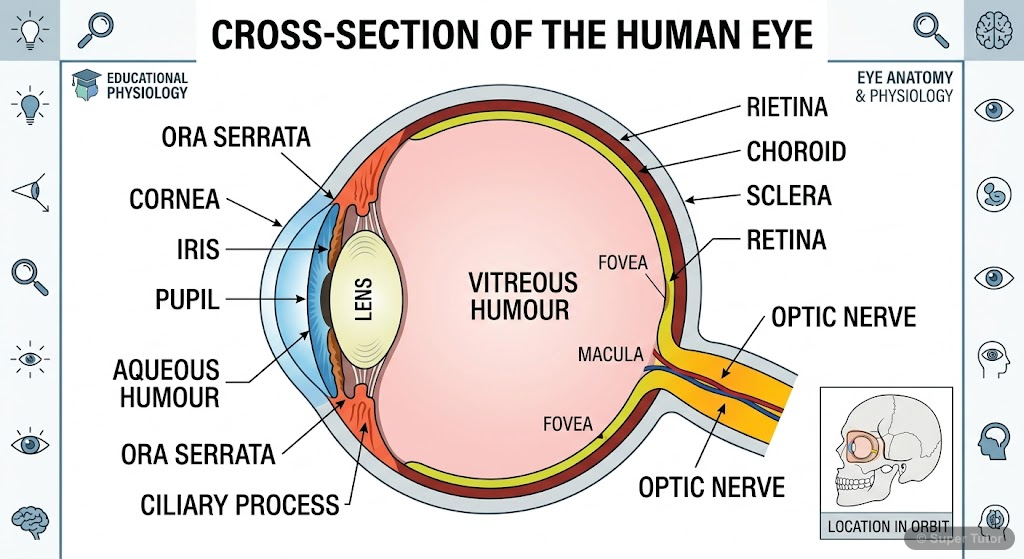
This is just one of 14+ visuals inside Super Tutor's The Human Eye and the Colourful World chapter
Explore the full setOverview
This chapter explores the fascinating world of vision and light phenomena. We learn about the human eye - our most precious sense organ that helps us see the beautiful, colourful world around us. The chapter connects the physics of light refraction and dispersion to explain how we see, why vision de
Key Concepts
The human eye works like
The human eye works like a camera with key parts including cornea (transparent front layer), iris (controls pupil size), crystalline lens (focuses lig
The ability of eye lens
The ability of eye lens to change its focal length by adjusting curvature through ciliary muscles. When muscles relax, lens becomes thin (longer focal
Myopia (near
Myopia (near-sightedness): Can see nearby objects clearly but not distant ones. Image forms in front of retina. Corrected with concave lens. Hypermetr
A triangular glass prism has inclined
A triangular glass prism has inclined surfaces causing light to bend at both entry and exit points. Unlike parallel-sided glass slab, prism causes dev
Splitting of white light into its
Splitting of white light into its component colours (VIBGYOR - Violet, Indigo, Blue, Green, Yellow, Orange, Red) when passing through a prism. Differe
Learning Objectives
- Understand the structure and functioning of the human eye as an optical instrument
- Learn about the power of accommodation and how the eye focuses on objects at different distances
- Identify common vision defects (myopia, hypermetropia, presbyopia) and their correction methods
- Explore refraction of light through prisms and understand the concept of deviation
- Understand dispersion of white light and formation of spectrum
Frequently Asked Questions
What are the important topics in The Human Eye and the Colourful World for Madhya Pradesh Board Class 10 Science?
How to score full marks in The Human Eye and the Colourful World — Madhya Pradesh Board Class 10 Science?
Sources & Official References
Content is aligned to the official syllabus. Refer to the board website for the latest curriculum.
More resources for The Human Eye and the Colourful World
Important Questions
Practice with board exam-style questions
Syllabus
What topics to cover
Revision Notes
Key points for last-minute revision
Study Plan
Step-by-step plan to ace this chapter
Flashcards
Quick-fire cards for active recall
Formula Sheet
All formulas in one place
Practice Quiz
Test yourself with a quick quiz
Concept Maps
See how topics connect visually
For serious students
Get the full The Human Eye and the Colourful World chapter — for free.
Quizzes, flashcards, AI doubt-solver and a step-by-step study plan for Madhya Pradesh Board Class 10 Science.