Minerals and Energy Resources
Madhya Pradesh Board · Class 10 · Social Science
Summary of Minerals and Energy Resources for Madhya Pradesh Board Class 10 Social Science. Key concepts, important points, and chapter overview.
Interactive on Super Tutor
Studying Minerals and Energy Resources? Get the full interactive chapter.
Quizzes, flashcards, AI doubt-solver and a step-by-step study plan — built for chapter summary and more.
1,000+ Class 10 students started this chapter today
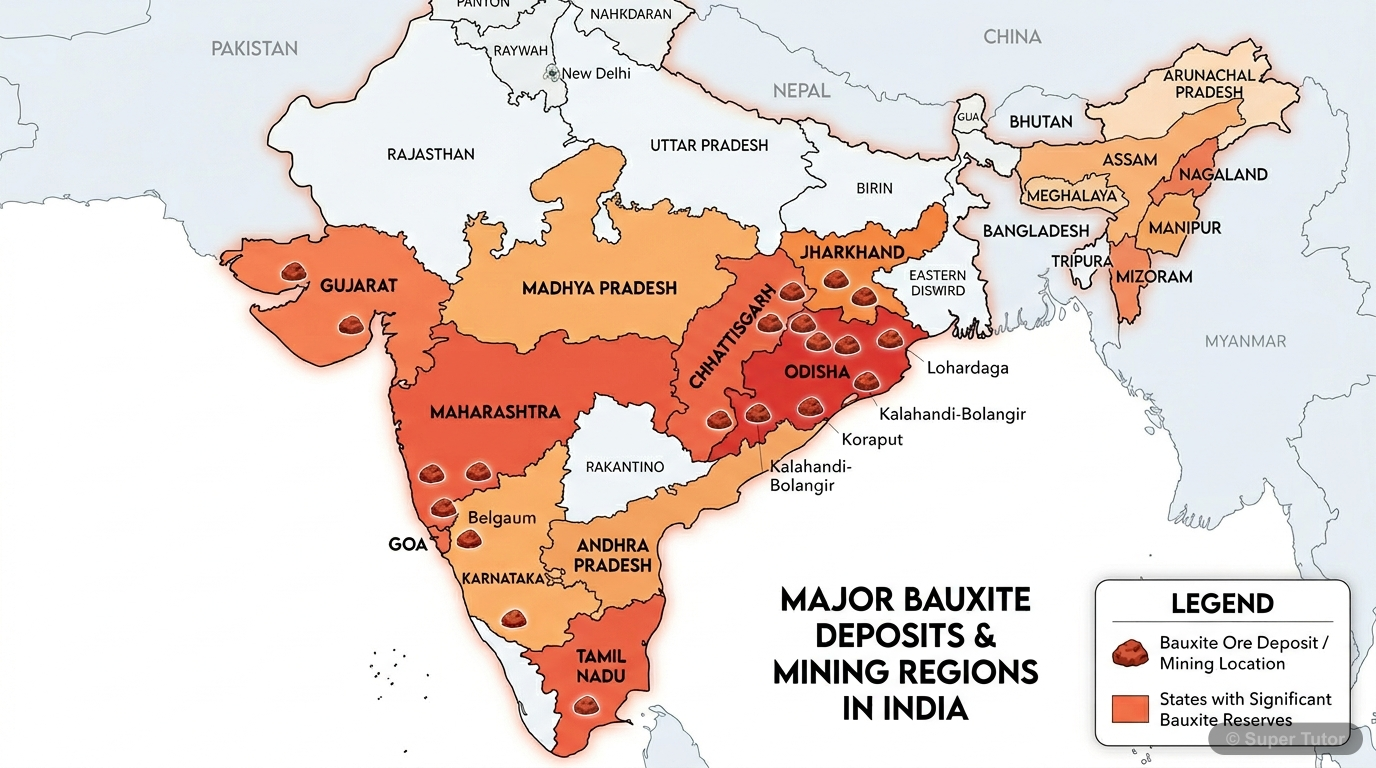
Learn better with visuals Super Tutor has hundreds of illustrations like this across every chapter — all free to try.
Get startedOverview
Minerals and energy resources are the foundation of modern civilization and economic development. From the tiny pin to towering buildings, from cooking food to running industries - everything depends on minerals extracted from Earth's crust. This chapter explores how minerals are formed, where they
Key Concepts
A mineral is a homogeneous
A mineral is a homogeneous, naturally occurring substance with a definable internal structure. Minerals form under specific physical and chemical cond
Minerals occur in five main forms
Minerals occur in five main forms: (1) In igneous/metamorphic rocks as veins and lodes (tin, copper, zinc), (2) In sedimentary rocks as beds/layers (c
Ferrous minerals contain iron and account
Ferrous minerals contain iron and account for 75% of metallic mineral production value. Iron ore (magnetite with 70% iron content, hematite with 50-60
These include copper
These include copper, bauxite, lead, zinc, and gold. India is deficient in copper reserves (main sources: Balaghat-MP, Khetri-Rajasthan, Singhbhum-Jha
Coal forms from compressed plant material
Coal forms from compressed plant material over millions of years. Types include: Peat (lowest grade), Lignite (low-grade brown coal), Bituminous (most
Learning Objectives
- Understand the definition and classification of minerals
- Learn about the mode of occurrence of minerals in different geological formations
- Identify the distribution of major minerals in India including iron ore, manganese, copper, bauxite, and mica
- Distinguish between ferrous, non-ferrous, and non-metallic minerals
- Explore conventional energy sources like coal, petroleum, natural gas, and electricity
Frequently Asked Questions
What are the important topics in Minerals and Energy Resources for Madhya Pradesh Board Class 10 Social Science?
How to score full marks in Minerals and Energy Resources — Madhya Pradesh Board Class 10 Social Science?
Sources & Official References
Content is aligned to the official syllabus. Refer to the board website for the latest curriculum.
More resources for Minerals and Energy Resources
Important Questions
Practice with board exam-style questions
Syllabus
What topics to cover
Revision Notes
Key points for last-minute revision
Study Plan
Step-by-step plan to ace this chapter
Flashcards
Quick-fire cards for active recall
Formula Sheet
All formulas in one place
Practice Quiz
Test yourself with a quick quiz
Concept Maps
See how topics connect visually
For serious students
Get the full Minerals and Energy Resources chapter — for free.
Quizzes, flashcards, AI doubt-solver and a step-by-step study plan for Madhya Pradesh Board Class 10 Social Science.