Power-sharing & Federalism
Madhya Pradesh Board · Class 10 · Social Science
Summary of Power-sharing & Federalism for Madhya Pradesh Board Class 10 Social Science. Key concepts, important points, and chapter overview.
Interactive on Super Tutor
Studying Power-sharing & Federalism? Get the full interactive chapter.
Quizzes, flashcards, AI doubt-solver and a step-by-step study plan — built for chapter summary and more.
1,000+ Class 10 students started this chapter today
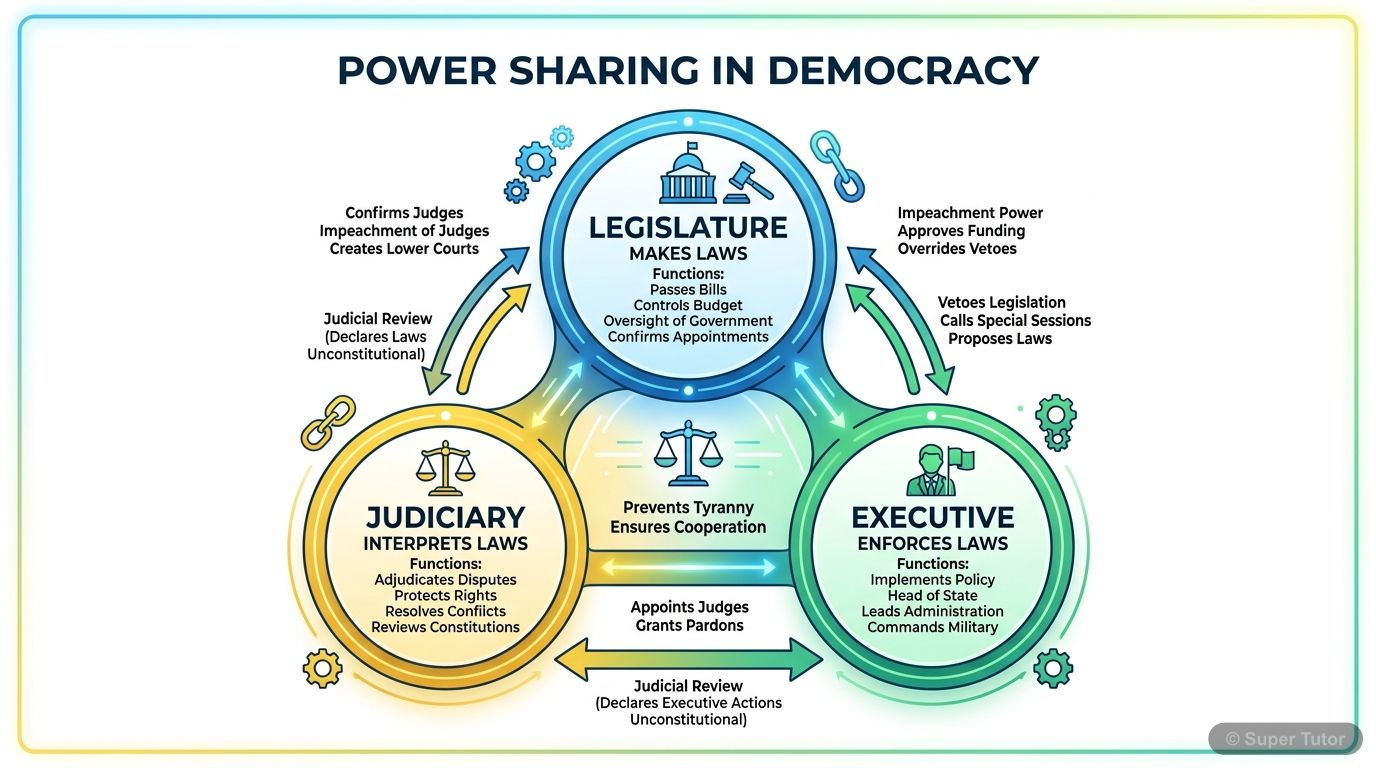
Learn better with visuals Super Tutor has hundreds of illustrations like this across every chapter — all free to try.
Get startedOverview
Power-sharing is a fundamental principle of democracy that ensures no single group or individual holds all the power. This chapter explores how different countries handle power distribution among various communities, regions, and institutions. Through the contrasting examples of Belgium and Sri Lank
Key Concepts
An arrangement where power is distributed
An arrangement where power is distributed among different organs of government, levels of government, social groups, and political parties rather than
A belief system where the majority
A belief system where the majority community rules the country according to its wishes, often disregarding the needs and interests of minority communi
A policy approach that recognizes
A policy approach that recognizes and respects the existence of different communities and their interests. Belgium successfully implemented accommodat
Power sharing among different organs
Power sharing among different organs of government at the same level - legislature, executive, and judiciary. This creates a system of checks and bala
Power sharing between different levels
Power sharing between different levels of government - central/federal government, state/provincial governments, and local governments like municipali
Learning Objectives
- Understand the concept and importance of power-sharing in democracy
- Analyze the different approaches to power-sharing through Belgium and Sri Lanka case studies
- Distinguish between prudential and moral reasons for power-sharing
- Identify various forms of power-sharing arrangements in democratic governments
- Evaluate the consequences of majoritarianism versus accommodation policies
Frequently Asked Questions
What are the important topics in Power-sharing & Federalism for Madhya Pradesh Board Class 10 Social Science?
How to score full marks in Power-sharing & Federalism — Madhya Pradesh Board Class 10 Social Science?
Sources & Official References
Content is aligned to the official syllabus. Refer to the board website for the latest curriculum.
More resources for Power-sharing & Federalism
Important Questions
Practice with board exam-style questions
Syllabus
What topics to cover
Revision Notes
Key points for last-minute revision
Study Plan
Step-by-step plan to ace this chapter
Flashcards
Quick-fire cards for active recall
Formula Sheet
All formulas in one place
Practice Quiz
Test yourself with a quick quiz
Concept Maps
See how topics connect visually
For serious students
Get the full Power-sharing & Federalism chapter — for free.
Quizzes, flashcards, AI doubt-solver and a step-by-step study plan for Madhya Pradesh Board Class 10 Social Science.