Organisms and Populations
Madhya Pradesh Board · Class 12 · Biology
Quick revision notes for Organisms and Populations — Madhya Pradesh Board Class 12 Biology. Key concepts, formulas, and definitions for last-minute revision.
Interactive on Super Tutor
Studying Organisms and Populations? Get the full interactive chapter.
Quizzes, flashcards, AI doubt-solver and a step-by-step study plan — built for revision notes and more.
1,000+ Class 12 students started this chapter today
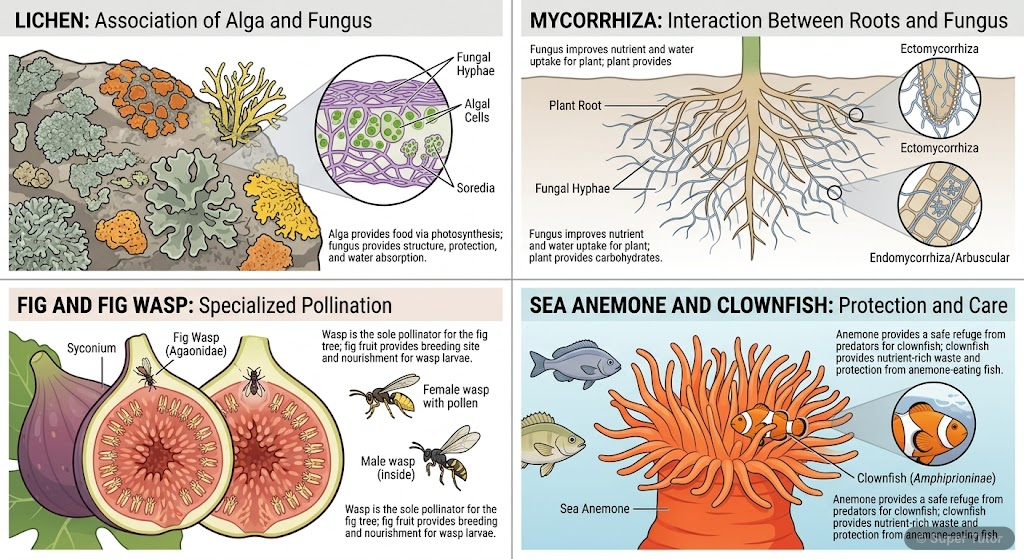
Learn better with visuals Super Tutor has hundreds of illustrations like this across every chapter — all free to try.
Get startedKey Topics to Revise
Population Attributes
- A population is a group of individuals of the same species living in a defined geographical area, sharing resources and potentially interbreeding
- Population attributes include birth rate, death rate, sex ratio, and age distribution - attributes that individual organisms do not possess
- Birth rate = Number of births per unit time per individual (calculated as births/initial population)
Population Growth
- Population size changes due to four basic processes: Natality (births), Mortality (deaths), Immigration (individuals entering), Emigration (individuals leaving)
- Population change equation: Nt+1 = Nt + [(B + I) - (D + E)]
- Two main growth patterns: Exponential growth (J-shaped curve) and Logistic growth (S-shaped curve)
Life History Variations
- Populations evolve to maximize reproductive fitness (Darwinian fitness) under specific selection pressures
- Organisms show different reproductive strategies: breed once (semelparous) vs. breed multiple times (iteroparous)
- Trade-off between number and size of offspring: many small offspring vs. few large offspring
Population Interactions
- Six types of interspecific interactions based on effects on both species: Mutualism (++), Competition (--), Predation (+-), Parasitism (+-), Commensalism (+0), Amensalism (-0)
- No natural habitat is inhabited by a single species - all organisms interact
- Predation transfers energy between trophic levels and controls prey populations
Get complete notes with diagrams and examples
Full NotesKey Concepts
Frequently Asked Questions
What are the important topics in Organisms and Populations for Madhya Pradesh Board Class 12 Biology?
How to score full marks in Organisms and Populations — Madhya Pradesh Board Class 12 Biology?
Sources & Official References
Content is aligned to the official syllabus. Refer to the board website for the latest curriculum.
More resources for Organisms and Populations
Important Questions
Practice with board exam-style questions
Syllabus
What topics to cover
Study Plan
Step-by-step plan to ace this chapter
Flashcards
Quick-fire cards for active recall
Formula Sheet
All formulas in one place
Chapter Summary
Understand the chapter at a glance
Practice Quiz
Test yourself with a quick quiz
Concept Maps
See how topics connect visually
For serious students
Get the full Organisms and Populations chapter — for free.
Quizzes, flashcards, AI doubt-solver and a step-by-step study plan for Madhya Pradesh Board Class 12 Biology.