Money and Banking
Madhya Pradesh Board · Class 12 · Economics
Summary of Money and Banking for Madhya Pradesh Board Class 12 Economics. Key concepts, important points, and chapter overview.
Interactive on Super Tutor
Studying Money and Banking? Get the full interactive chapter.
Quizzes, flashcards, AI doubt-solver and a step-by-step study plan — built for chapter summary and more.
1,000+ Class 12 students started this chapter today
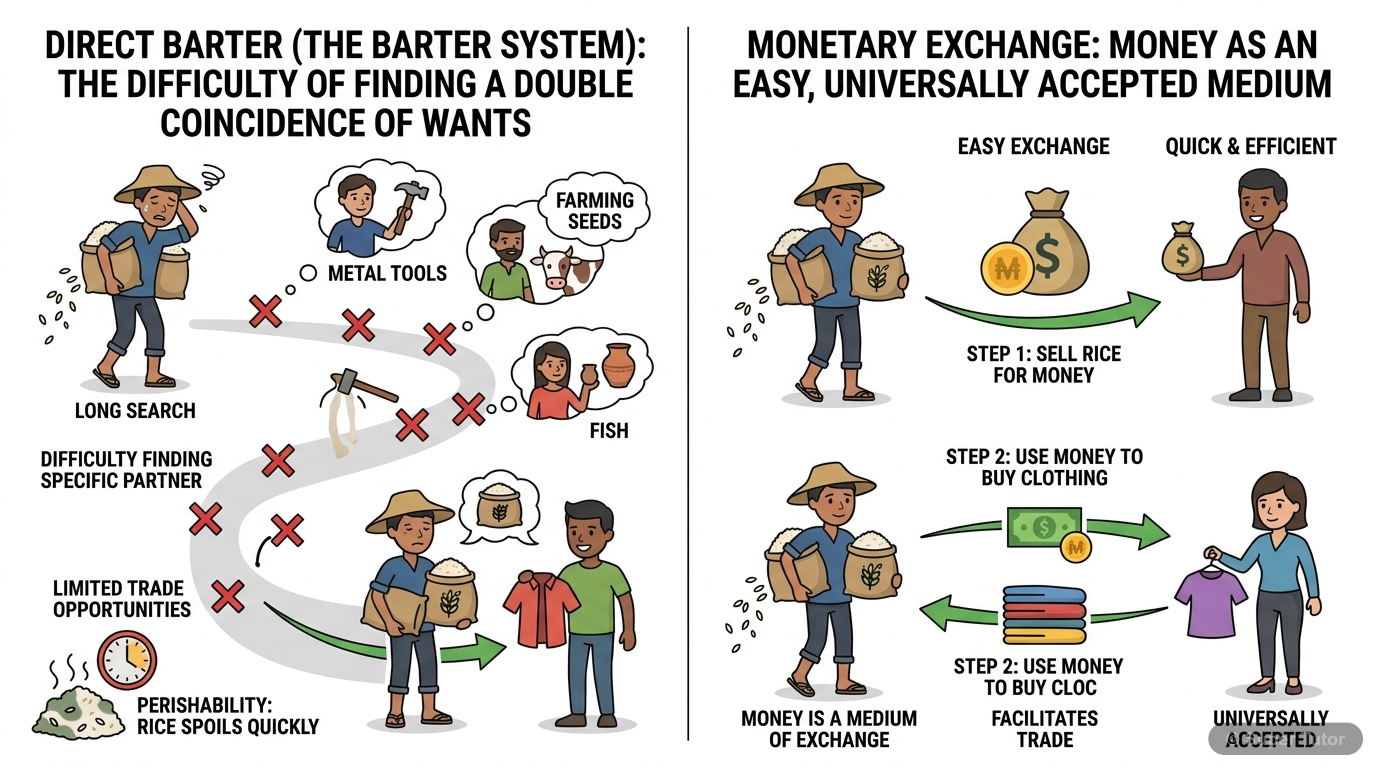
This is just one of 12+ visuals inside Super Tutor's Money and Banking chapter
Explore the full setOverview
Money and Banking is a fundamental chapter in macroeconomics that explores how money functions in an economy and how the banking system creates and controls money supply. This chapter explains the evolution from barter systems to modern monetary systems, the crucial role of the Reserve Bank of India
Key Concepts
Barter system involves direct exchange
Barter system involves direct exchange of goods without using money. It requires double coincidence of wants - both parties must want what the other h
Money serves four main functions
Money serves four main functions: (1) Medium of Exchange - facilitates transactions without barter, (2) Unit of Account - provides a common measure of
People demand money for two main
People demand money for two main motives: Transaction Motive (to conduct daily transactions - higher income leads to higher money demand) and Speculat
Money supply includes currency (notes
Money supply includes currency (notes and coins) and bank deposits. RBI measures it through M1 (Currency + Demand Deposits), M2 (M1 + Post Office Savi
RBI is India's central bank established
RBI is India's central bank established in 1935. Its key functions include: issuing currency, controlling money supply, acting as banker to government
Learning Objectives
- Understand the concept of money and its evolution from barter system
- Analyze the various functions of money in a modern economy
- Examine the demand for money and factors affecting it
- Study the money supply process and its components
- Understand the role of Reserve Bank of India (RBI) as the central bank
Frequently Asked Questions
What are the important topics in Money and Banking for Madhya Pradesh Board Class 12 Economics?
How to score full marks in Money and Banking — Madhya Pradesh Board Class 12 Economics?
Sources & Official References
Content is aligned to the official syllabus. Refer to the board website for the latest curriculum.
More resources for Money and Banking
Important Questions
Practice with board exam-style questions
Syllabus
What topics to cover
Revision Notes
Key points for last-minute revision
Study Plan
Step-by-step plan to ace this chapter
Flashcards
Quick-fire cards for active recall
Formula Sheet
All formulas in one place
Practice Quiz
Test yourself with a quick quiz
Concept Maps
See how topics connect visually
For serious students
Get the full Money and Banking chapter — for free.
Quizzes, flashcards, AI doubt-solver and a step-by-step study plan for Madhya Pradesh Board Class 12 Economics.