Market Equilibrium
Madhya Pradesh Board · Class 12 · Economics
Flashcards for Market Equilibrium — Madhya Pradesh Board Class 12 Economics. Quick Q&A cards covering key concepts, definitions, and formulas.
Interactive on Super Tutor
Studying Market Equilibrium? Get the full interactive chapter.
Quizzes, flashcards, AI doubt-solver and a step-by-step study plan — built for flashcards and more.
1,000+ Class 12 students started this chapter today
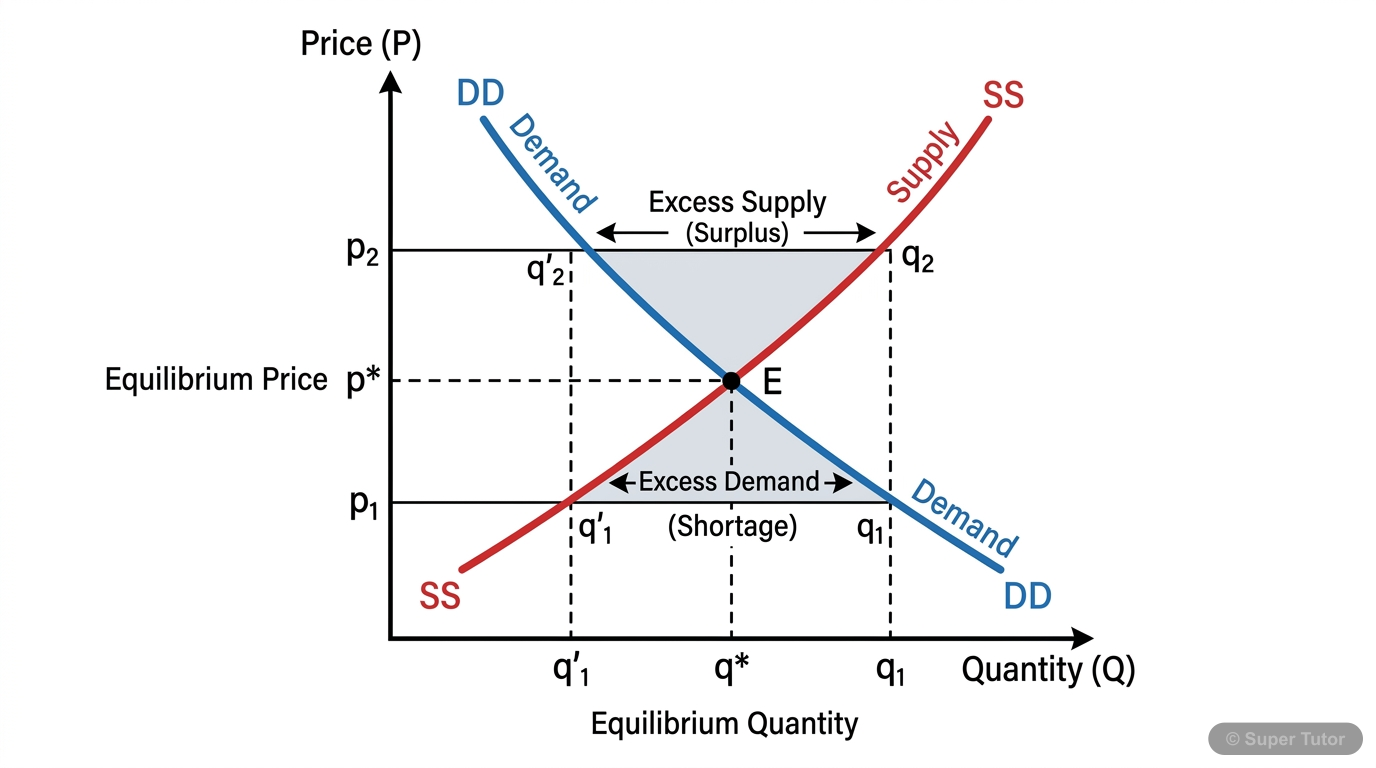
Super Tutor has 10+ illustrations like this for Market Equilibrium alone — flashcards, concept maps, and step-by-step visuals.
See them allWhat is market equilibrium?
Answer
Market equilibrium is a situation where the plans of all consumers and firms in the market match and the market clears. In equilibrium, aggregate quantity that firms wish to sell equals the quantity t…
Define excess demand with an example.
Answer
Excess demand occurs when market demand exceeds market supply at a given price. For example, if at ₹25 per kg, consumers want to buy 175 kg of wheat but suppliers only offer 125 kg, there is excess de…
Define excess supply and explain its effect on price.
Answer
Excess supply occurs when market supply exceeds market demand at a given price. For example, if at ₹45 per kg, suppliers want to sell 200 kg of wheat but consumers only demand 155 kg, there is excess …
Calculate equilibrium price and quantity: Demand: qD = 200 - 5p, Supply: qS = 50 + 2p
Answer
At equilibrium: qD = qS 200 - 5p = 50 + 2p 200 - 50 = 2p + 5p 150 = 7p p* = ₹21.43 (approx) Substituting back: q* = 200 - 5(21.43) = 92.85 units (approx) Equilibrium price = ₹21.43, Equilibrium quan…
What is the 'Invisible Hand' in market equilibrium?
Answer
The 'Invisible Hand' is a concept from Adam Smith that describes the automatic price adjustment mechanism in perfectly competitive markets. It raises prices when there is excess demand and lowers pric…
What happens to equilibrium when demand curve shifts rightward?
Answer
When demand curve shifts rightward (with supply unchanged): - At original price, excess demand occurs - Price tends to rise - New equilibrium has HIGHER price and HIGHER quantity - Both price and quan…
What happens to equilibrium when supply curve shifts leftward?
Answer
When supply curve shifts leftward (with demand unchanged): - At original price, excess demand occurs - Price tends to rise - New equilibrium has HIGHER price and LOWER quantity - Price and quantity ch…
Define Marginal Revenue Product of Labour (MRPL).
Answer
MRPL = MR × MPL, where MR is Marginal Revenue and MPL is Marginal Product of Labour. For a perfectly competitive firm, MR = Price, so MRPL = Price × MPL = Value of Marginal Product of Labour (VMPL). A…
+14 more flashcards available
Practice AllFrequently Asked Questions
What are the important topics in Market Equilibrium for Madhya Pradesh Board Class 12 Economics?
How to score full marks in Market Equilibrium — Madhya Pradesh Board Class 12 Economics?
How many flashcards are available for Market Equilibrium?
Sources & Official References
Content is aligned to the official syllabus. Refer to the board website for the latest curriculum.
More resources for Market Equilibrium
Important Questions
Practice with board exam-style questions
Syllabus
What topics to cover
Revision Notes
Key points for last-minute revision
Study Plan
Step-by-step plan to ace this chapter
Formula Sheet
All formulas in one place
Chapter Summary
Understand the chapter at a glance
Practice Quiz
Test yourself with a quick quiz
Concept Maps
See how topics connect visually
For serious students
Get the full Market Equilibrium chapter — for free.
Quizzes, flashcards, AI doubt-solver and a step-by-step study plan for Madhya Pradesh Board Class 12 Economics.