Mineral and Energy Resources
Madhya Pradesh Board · Class 12 · Geography
Summary of Mineral and Energy Resources for Madhya Pradesh Board Class 12 Geography. Key concepts, important points, and chapter overview.
Interactive on Super Tutor
Studying Mineral and Energy Resources? Get the full interactive chapter.
Quizzes, flashcards, AI doubt-solver and a step-by-step study plan — built for chapter summary and more.
1,000+ Class 12 students started this chapter today
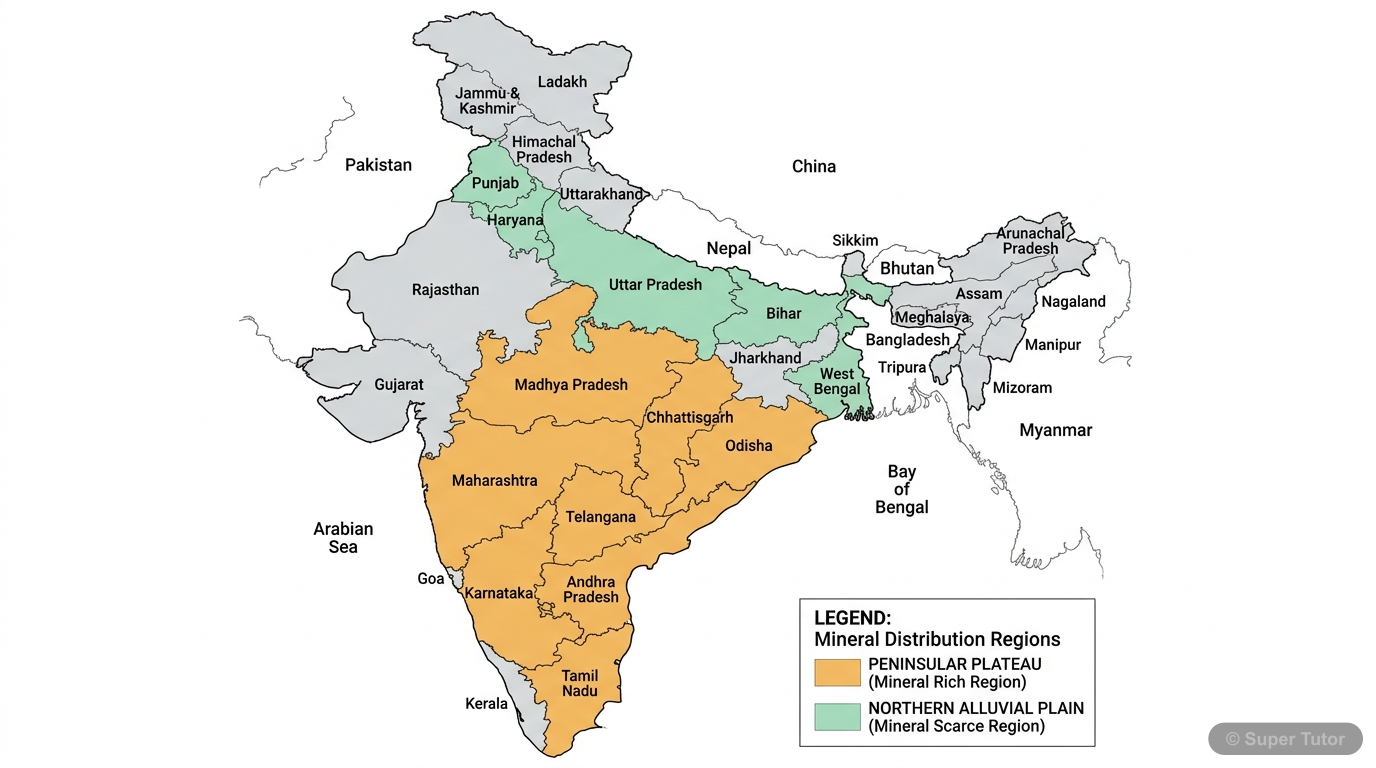
Super Tutor has 17+ illustrations like this for Mineral and Energy Resources alone — flashcards, concept maps, and step-by-step visuals.
See them allOverview
India is blessed with a rich variety of mineral resources due to its diverse geological structure. These minerals form the backbone of India's industrial development and economic growth. This chapter explores the distribution, types, and significance of various mineral and energy resources found acr
Key Concepts
Minerals are classified into two main
Minerals are classified into two main categories: Metallic minerals (ferrous like iron ore, manganese; non-ferrous like copper, bauxite) and Non-metal
Minerals have three key characteristics
Minerals have three key characteristics: uneven spatial distribution, inverse relationship between quality and quantity (high-quality minerals are fou
India's minerals are concentrated in three
India's minerals are concentrated in three major belts: North-Eastern Belt (Chhotanagpur plateau - iron ore, coal, manganese), South-Western Belt (Kar
Iron ore (mainly hematite and magnetite)
Iron ore (mainly hematite and magnetite) is found abundantly in Odisha, Jharkhand, Karnataka, and Goa. Manganese, essential for steel production, is c
Bauxite (aluminum ore) is found mainly
Bauxite (aluminum ore) is found mainly in Odisha, Gujarat, and Jharkhand. Copper occurs in Jharkhand, Madhya Pradesh, and Rajasthan. India has limited
Learning Objectives
- Understand the classification and characteristics of mineral resources in India
- Analyze the spatial distribution of major minerals across different geological regions
- Examine the location and importance of ferrous and non-ferrous minerals
- Study the distribution and significance of energy resources including coal, petroleum, and natural gas
- Explore conventional and non-conventional energy sources and their potential
Frequently Asked Questions
What are the important topics in Mineral and Energy Resources for Madhya Pradesh Board Class 12 Geography?
How to score full marks in Mineral and Energy Resources — Madhya Pradesh Board Class 12 Geography?
Sources & Official References
Content is aligned to the official syllabus. Refer to the board website for the latest curriculum.
More resources for Mineral and Energy Resources
Important Questions
Practice with board exam-style questions
Syllabus
What topics to cover
Revision Notes
Key points for last-minute revision
Study Plan
Step-by-step plan to ace this chapter
Flashcards
Quick-fire cards for active recall
Formula Sheet
All formulas in one place
Practice Quiz
Test yourself with a quick quiz
Concept Maps
See how topics connect visually
For serious students
Get the full Mineral and Energy Resources chapter — for free.
Quizzes, flashcards, AI doubt-solver and a step-by-step study plan for Madhya Pradesh Board Class 12 Geography.