Planning and Sustainable Development in Indian Context
Madhya Pradesh Board · Class 12 · Geography
Flashcards for Planning and Sustainable Development in Indian Context — Madhya Pradesh Board Class 12 Geography. Quick Q&A cards covering key concepts, definitions, and formulas.
Interactive on Super Tutor
Studying Planning and Sustainable Development in Indian Context? Get the full interactive chapter.
Quizzes, flashcards, AI doubt-solver and a step-by-step study plan — built for flashcards and more.
1,000+ Class 12 students started this chapter today
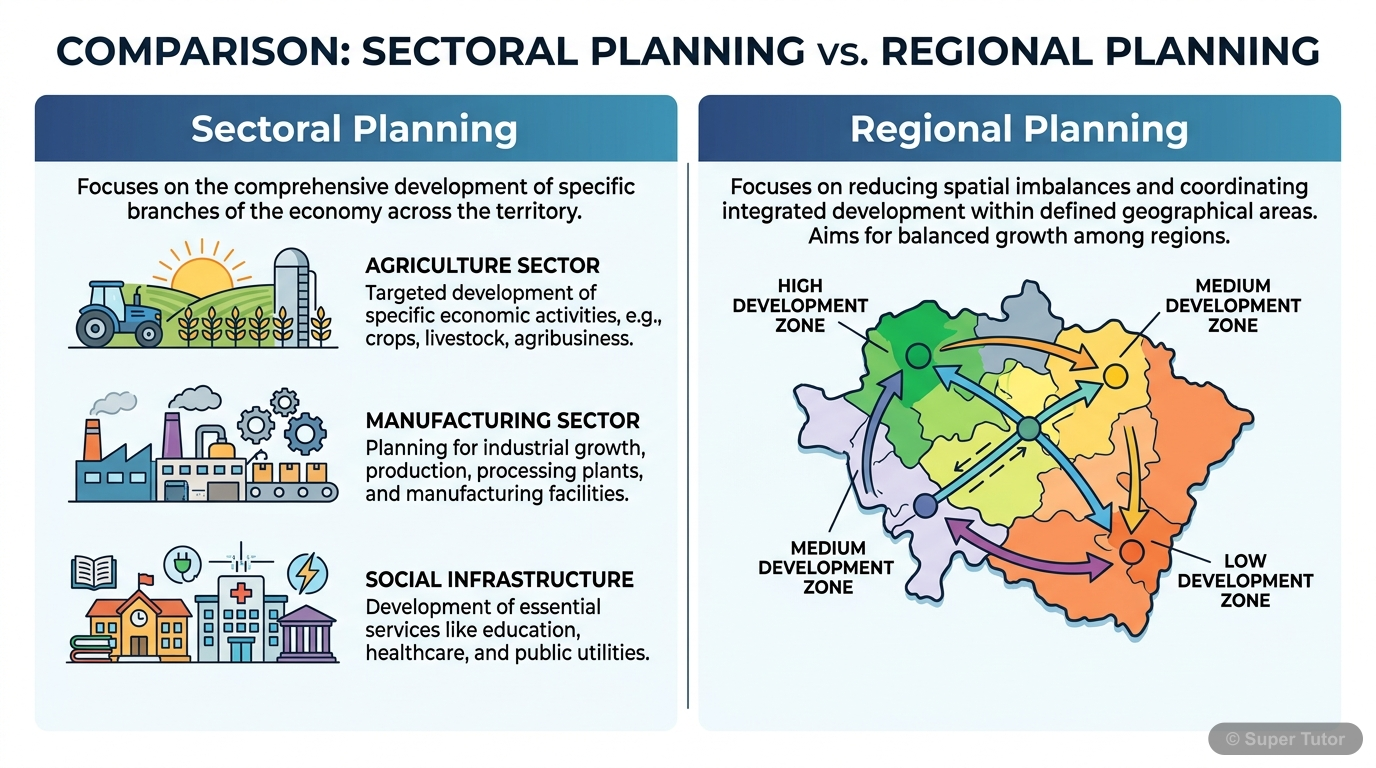
Learn better with visuals Super Tutor has hundreds of illustrations like this across every chapter — all free to try.
Get startedWhat is economic planning and how does it differ from traditional hit-and-miss methods?
Answer
Economic planning is a systematic process of thinking, formulating schemes or programmes, and implementing actions to achieve specific economic development goals. Unlike traditional hit-and-miss metho…
When was NITI Aayog formed and what replaced it?
Answer
NITI Aayog was formed on 1 January 2015, replacing the Planning Commission. It was established with the objective of involving states in economic policy-making and providing strategic and technical ad…
What are the two main approaches to planning? Explain each.
Answer
The two main approaches to planning are: 1. Sectoral Planning: Formulation and implementation of schemes aimed at developing various sectors like agriculture, irrigation, manufacturing, power, transpo…
Why was the 'target area' and 'target group' approach introduced in Indian planning?
Answer
After one-and-a-half decades of planning experience, it was realized that regional imbalances in economic development were getting accentuated. To arrest the increase in regional and social disparitie…
Name four target area development programmes in India.
Answer
Four target area development programmes are: 1. Command Area Development Programme 2. Drought Prone Area Development Programme 3. Desert Development Programme 4. Hill Area Development Programme…
What are SFDA and MFDA? When were they introduced?
Answer
SFDA stands for Small Farmers Development Agency and MFDA stands for Marginal Farmers Development Agency. These are examples of target group programmes designed to support small and marginal farmers w…
Which Five Year Plan initiated Hill Area Development Programmes and what was the criteria for backward hill areas?
Answer
Hill Area Development Programmes were initiated during the Fifth Five Year Plan. The National Committee on Development of Backward Areas (1981) recommended that all hill areas having height above 600 …
What were the main objectives of Hill Area Development Programmes?
Answer
The programmes aimed at harnessing indigenous resources of hill areas through development of: 1. Horticulture and plantation 2. Agriculture 3. Animal husbandry and poultry 4. Forestry 5. Small-scale a…
+17 more flashcards available
Practice AllFrequently Asked Questions
What are the important topics in Planning and Sustainable Development in Indian Context for Madhya Pradesh Board Class 12 Geography?
How to score full marks in Planning and Sustainable Development in Indian Context — Madhya Pradesh Board Class 12 Geography?
How many flashcards are available for Planning and Sustainable Development in Indian Context?
Sources & Official References
Content is aligned to the official syllabus. Refer to the board website for the latest curriculum.
More resources for Planning and Sustainable Development in Indian Context
Important Questions
Practice with board exam-style questions
Syllabus
What topics to cover
Revision Notes
Key points for last-minute revision
Study Plan
Step-by-step plan to ace this chapter
Formula Sheet
All formulas in one place
Chapter Summary
Understand the chapter at a glance
Practice Quiz
Test yourself with a quick quiz
Concept Maps
See how topics connect visually
For serious students
Get the full Planning and Sustainable Development in Indian Context chapter — for free.
Quizzes, flashcards, AI doubt-solver and a step-by-step study plan for Madhya Pradesh Board Class 12 Geography.