Colonialism and the Countryside: Exploring Official Archives
Madhya Pradesh Board · Class 12 · History
Summary of Colonialism and the Countryside: Exploring Official Archives for Madhya Pradesh Board Class 12 History. Key concepts, important points, and chapter overview.
Interactive on Super Tutor
Studying Colonialism and the Countryside: Exploring Official Archives? Get the full interactive chapter.
Quizzes, flashcards, AI doubt-solver and a step-by-step study plan — built for chapter summary and more.
1,000+ Class 12 students started this chapter today
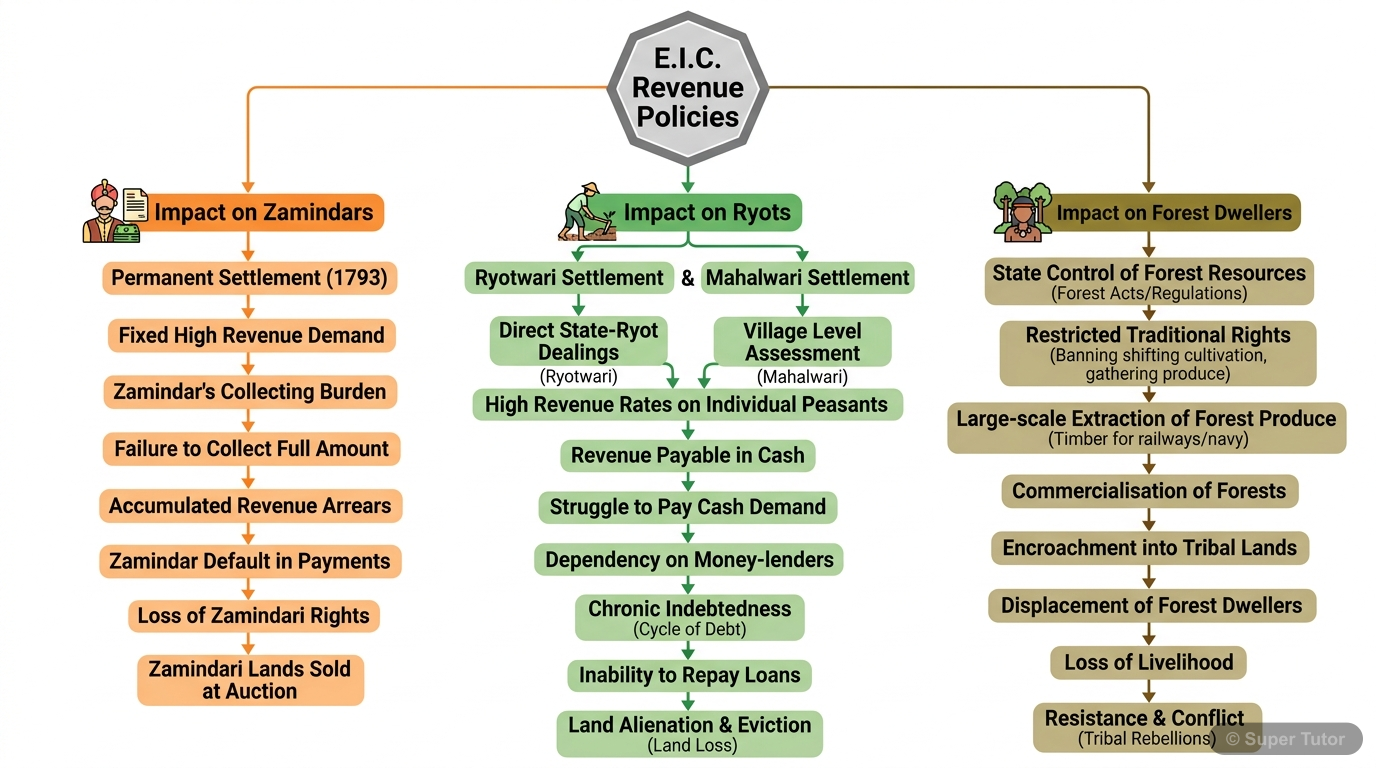
This is just one of 17+ visuals inside Super Tutor's Colonialism and the Countryside: Exploring Official Archives chapter
Explore the full setOverview
This chapter examines how colonial rule transformed rural India, focusing on three main regions: Bengal's zamindari system, the Rajmahal hills with Paharias and Santhals, and the Bombay Deccan. It explores how the East India Company established its authority in the countryside, implemented revenue p
Key Concepts
Introduced by Lord Cornwallis in Bengal
Introduced by Lord Cornwallis in Bengal, this system fixed land revenue demand permanently. Zamindars were made revenue collectors who had to pay a fi
Under this system
Under this system, zamindars were classified as revenue collectors rather than landowners. They controlled multiple villages (sometimes 400) and colle
Rich peasants in Bengal who acquired
Rich peasants in Bengal who acquired large landholdings (sometimes thousands of acres) and controlled local trade and moneylending. They used sharecro
Paharias were hill folk practicing shifting
Paharias were hill folk practicing shifting cultivation and forest-based economy. Santhals were settled agriculturists whom the British encouraged to
Introduced in Bombay Deccan
Introduced in Bombay Deccan, this system settled revenue directly with individual cultivators (ryots). Unlike the Permanent Settlement, revenue rates
Learning Objectives
- Understand how colonial rule impacted rural communities in different regions of India
- Analyze the Permanent Settlement system in Bengal and its consequences
- Examine the transformation of tribal communities like Paharias and Santhals
- Study the ryotwari system in the Bombay Deccan and peasant revolts
- Learn to critically analyze official colonial archives and their limitations
Frequently Asked Questions
What are the important topics in Colonialism and the Countryside: Exploring Official Archives for Madhya Pradesh Board Class 12 History?
How to score full marks in Colonialism and the Countryside: Exploring Official Archives — Madhya Pradesh Board Class 12 History?
Sources & Official References
Content is aligned to the official syllabus. Refer to the board website for the latest curriculum.
More resources for Colonialism and the Countryside: Exploring Official Archives
Important Questions
Practice with board exam-style questions
Syllabus
What topics to cover
Revision Notes
Key points for last-minute revision
Study Plan
Step-by-step plan to ace this chapter
Flashcards
Quick-fire cards for active recall
Formula Sheet
All formulas in one place
Practice Quiz
Test yourself with a quick quiz
Concept Maps
See how topics connect visually
For serious students
Get the full Colonialism and the Countryside: Exploring Official Archives chapter — for free.
Quizzes, flashcards, AI doubt-solver and a step-by-step study plan for Madhya Pradesh Board Class 12 History.