India’s external relations
Madhya Pradesh Board · Class 12 · Political Science
Flashcards for India’s external relations — Madhya Pradesh Board Class 12 Political Science. Quick Q&A cards covering key concepts, definitions, and formulas.
Interactive on Super Tutor
Studying India’s external relations? Get the full interactive chapter.
Quizzes, flashcards, AI doubt-solver and a step-by-step study plan — built for flashcards and more.
1,000+ Class 12 students started this chapter today
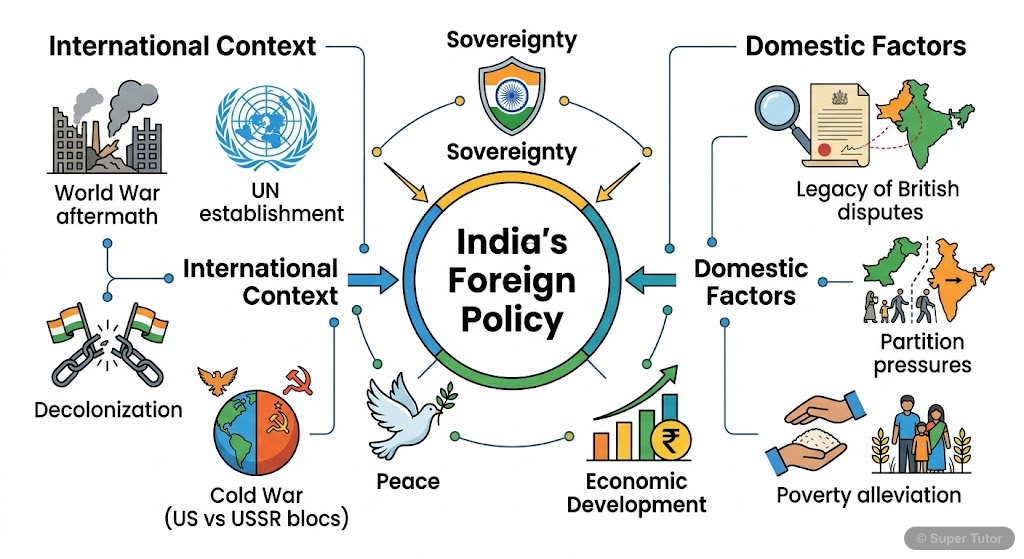
Super Tutor has 7+ illustrations like this for India’s external relations alone — flashcards, concept maps, and step-by-step visuals.
See them allWhat are the three major objectives of Nehru's foreign policy?
Answer
1. Preserve the hard-earned sovereignty 2. Protect territorial integrity 3. Promote rapid economic development Nehru aimed to achieve these objectives through the strategy of non-alignment.
Define Non-Alignment Movement (NAM) and its significance for India.
Answer
Non-Alignment Movement was a policy of staying away from military alliances led by the US and Soviet Union during the Cold War. India advocated this as an ideal foreign policy approach to maintain ind…
What are the Five Principles of Peaceful Coexistence (Panchsheel)?
Answer
Panchsheel was jointly announced by Indian PM Nehru and Chinese Premier Zhou Enlai on April 29, 1954. The five principles promote: 1. Mutual respect for territorial integrity 2. Non-aggression 3. Non-…
What was the Bandung Conference of 1955 and its importance?
Answer
The Bandung Conference was an Afro-Asian conference held in Indonesia in 1955. It marked the zenith of India's engagement with newly independent Asian and African nations. The conference later led to …
Explain the main causes of the 1962 Sino-Indian War.
Answer
Two main causes: 1. Tibet Issue: China annexed Tibet in 1950, removing a historical buffer. India grew uneasy about suppression of Tibetan culture and granted asylum to Dalai Lama in 1959. 2. Border D…
What were the consequences of the 1962 China War for India?
Answer
1. Damaged India's image at home and abroad 2. India had to seek military assistance from US and Britain 3. Created sense of national humiliation but strengthened nationalism 4. Defence Minister V.K.
What was the Kashmir conflict and how did it affect India-Pakistan relations?
Answer
The Kashmir conflict started immediately after partition in 1947 as a dispute over the accession of Jammu and Kashmir. A proxy war broke out between Indian and Pakistani armies, which was then referre…
Describe the 1965 Indo-Pakistan War and its outcome.
Answer
Started in April 1965 with Pakistani attacks in Rann of Kutch, followed by bigger offensive in Kashmir in August-September. PM Lal Bahadur Shastri ordered counter-offensive on Punjab border, and India…
+12 more flashcards available
Practice AllFrequently Asked Questions
What are the important topics in India’s external relations for Madhya Pradesh Board Class 12 Political Science?
How to score full marks in India’s external relations — Madhya Pradesh Board Class 12 Political Science?
How many flashcards are available for India’s external relations?
Sources & Official References
Content is aligned to the official syllabus. Refer to the board website for the latest curriculum.
More resources for India’s external relations
Important Questions
Practice with board exam-style questions
Syllabus
What topics to cover
Revision Notes
Key points for last-minute revision
Study Plan
Step-by-step plan to ace this chapter
Formula Sheet
All formulas in one place
Chapter Summary
Understand the chapter at a glance
Practice Quiz
Test yourself with a quick quiz
Concept Maps
See how topics connect visually
For serious students
Get the full India’s external relations chapter — for free.
Quizzes, flashcards, AI doubt-solver and a step-by-step study plan for Madhya Pradesh Board Class 12 Political Science.