India’s external relations
Madhya Pradesh Board · Class 12 · Political Science
Quick revision notes for India’s external relations — Madhya Pradesh Board Class 12 Political Science. Key concepts, formulas, and definitions for last-minute revision.
Interactive on Super Tutor
Studying India’s external relations? Get the full interactive chapter.
Quizzes, flashcards, AI doubt-solver and a step-by-step study plan — built for revision notes and more.
1,000+ Class 12 students started this chapter today
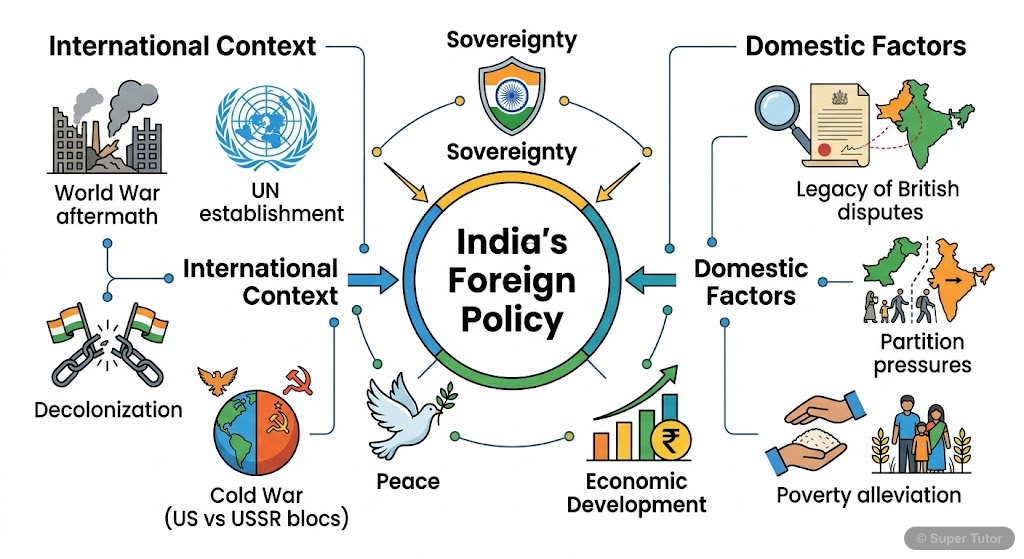
Super Tutor has 7+ illustrations like this for India’s external relations alone — flashcards, concept maps, and step-by-step visuals.
See them allKey Topics to Revise
Constitutional Foundations and Early Context
- Article 51 of Indian Constitution lays down Directive Principles for international relations
- Four key principles: (a) Promote international peace and security (b) Maintain just and honorable relations (c) Foster respect for international law (d) Encourage settlement of disputes by arbitration
- India gained independence during the beginning of Cold War (1947)
Nehru's Foreign Policy and Non-Alignment
- Jawaharlal Nehru was Prime Minister and Foreign Minister (1946-1964)
- Three major objectives: preserve sovereignty, protect territorial integrity, promote economic development
- Non-alignment strategy: avoid military alliances with either US or USSR blocs
Asian Relations and Bandung Conference
- India convened Asian Relations Conference in March 1947 (before independence)
- Supported Indonesia's freedom struggle from Dutch colonialism (1949)
- Strongly opposed racism and apartheid in South Africa
India-China Relations and Panchsheel
- India was among first countries to recognize Communist China (1949)
- Initially very friendly relations between Nehru and Chinese leaders
- Panchsheel (Five Principles of Peaceful Coexistence) announced on April 29, 1954
Get complete notes with diagrams and examples
Full NotesKey Concepts
Frequently Asked Questions
What are the important topics in India’s external relations for Madhya Pradesh Board Class 12 Political Science?
How to score full marks in India’s external relations — Madhya Pradesh Board Class 12 Political Science?
Sources & Official References
Content is aligned to the official syllabus. Refer to the board website for the latest curriculum.
More resources for India’s external relations
Important Questions
Practice with board exam-style questions
Syllabus
What topics to cover
Study Plan
Step-by-step plan to ace this chapter
Flashcards
Quick-fire cards for active recall
Formula Sheet
All formulas in one place
Chapter Summary
Understand the chapter at a glance
Practice Quiz
Test yourself with a quick quiz
Concept Maps
See how topics connect visually
For serious students
Get the full India’s external relations chapter — for free.
Quizzes, flashcards, AI doubt-solver and a step-by-step study plan for Madhya Pradesh Board Class 12 Political Science.