Attitude and Social Cognition
Madhya Pradesh Board · Class 12 · Psychology
Summary of Attitude and Social Cognition for Madhya Pradesh Board Class 12 Psychology. Key concepts, important points, and chapter overview.
Interactive on Super Tutor
Studying Attitude and Social Cognition? Get the full interactive chapter.
Quizzes, flashcards, AI doubt-solver and a step-by-step study plan — built for chapter summary and more.
1,000+ Class 12 students started this chapter today
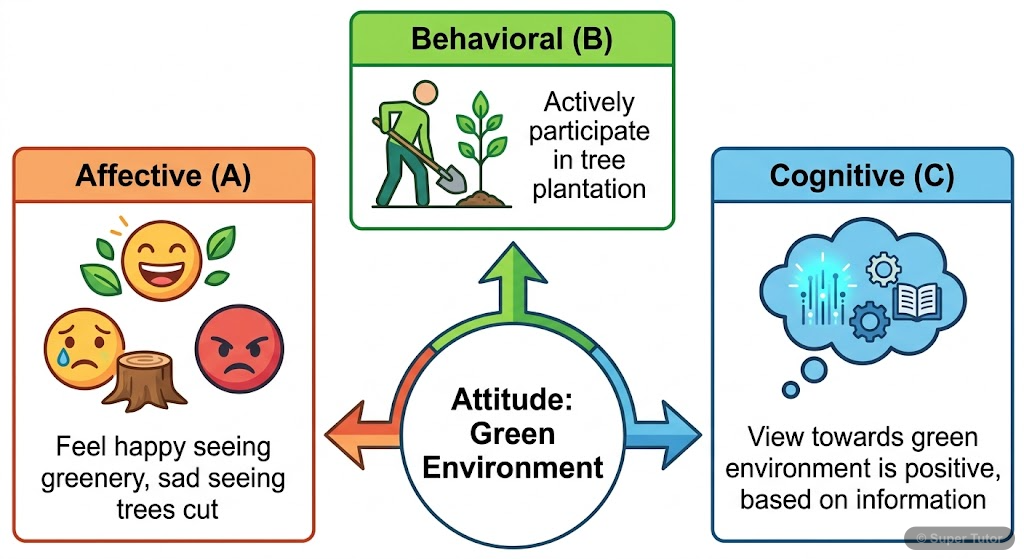
This is just one of 11+ visuals inside Super Tutor's Attitude and Social Cognition chapter
Explore the full setOverview
Social psychology examines how individual behavior is influenced by others and the social environment. This chapter explores attitudes - our ways of thinking about specific topics and people - and how they form, change, and influence our behavior. Understanding attitudes is crucial as they shape our
Key Concepts
Attitudes are states of mind containing
Attitudes are states of mind containing thoughts, emotions, and behavioral tendencies toward specific topics (attitude objects). They consist of three
Attitudes have four key properties
Attitudes have four key properties: Valence (positive, negative, or neutral direction), Extremeness (how strong the attitude is), Simplicity or Comple
Attitudes develop through learning processes including
Attitudes develop through learning processes including: association with positive/negative experiences, rewards and punishments, observing others (mod
Three major theories explain attitude change
Three major theories explain attitude change: Balance Theory (P-O-X triangle seeking consistency), Cognitive Dissonance (reducing inconsistency betwee
Attitudes don't always predict behavior
Attitudes don't always predict behavior. Consistency occurs when attitudes are strong and central, the person is aware of their attitude, there's no e
Learning Objectives
- Understand what attitudes are and their key components
- Learn how attitudes are formed through various processes
- Explore the mechanisms of attitude change
- Analyze the relationship between attitudes and behavior
- Examine prejudice and discrimination as special cases of attitudes
Frequently Asked Questions
What are the important topics in Attitude and Social Cognition for Madhya Pradesh Board Class 12 Psychology?
How to score full marks in Attitude and Social Cognition — Madhya Pradesh Board Class 12 Psychology?
Sources & Official References
Content is aligned to the official syllabus. Refer to the board website for the latest curriculum.
More resources for Attitude and Social Cognition
Important Questions
Practice with board exam-style questions
Syllabus
What topics to cover
Revision Notes
Key points for last-minute revision
Study Plan
Step-by-step plan to ace this chapter
Flashcards
Quick-fire cards for active recall
Formula Sheet
All formulas in one place
Practice Quiz
Test yourself with a quick quiz
Concept Maps
See how topics connect visually
For serious students
Get the full Attitude and Social Cognition chapter — for free.
Quizzes, flashcards, AI doubt-solver and a step-by-step study plan for Madhya Pradesh Board Class 12 Psychology.