Social Influence and Group Processes
Madhya Pradesh Board · Class 12 · Psychology
Quick revision notes for Social Influence and Group Processes — Madhya Pradesh Board Class 12 Psychology. Key concepts, formulas, and definitions for last-minute revision.
Interactive on Super Tutor
Studying Social Influence and Group Processes? Get the full interactive chapter.
Quizzes, flashcards, AI doubt-solver and a step-by-step study plan — built for revision notes and more.
1,000+ Class 12 students started this chapter today
This is just one of 9+ visuals inside Super Tutor's Social Influence and Group Processes chapter
Explore the full setKey Topics to Revise
Nature and Formation of Groups
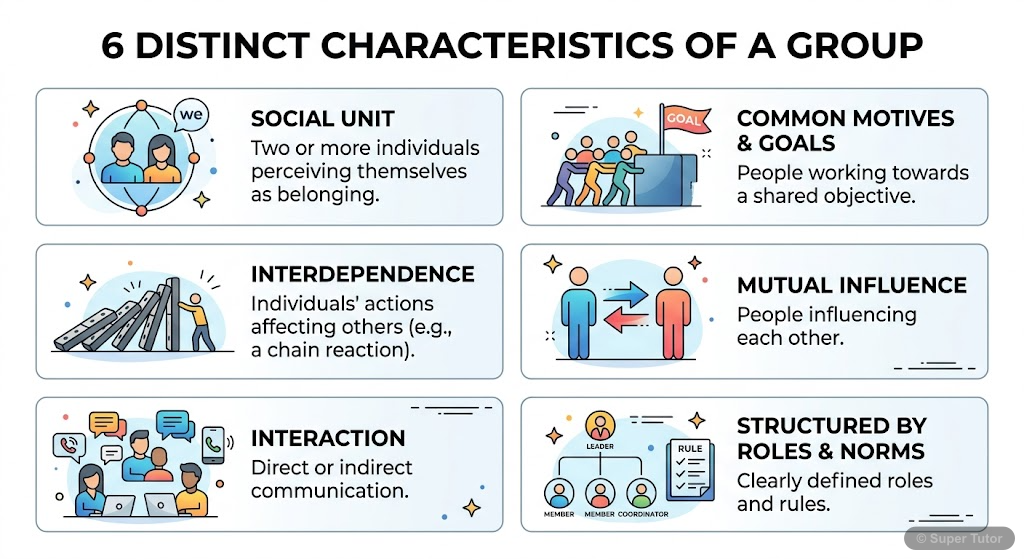
- A group is an organized system of two or more individuals who interact, are interdependent, have common motives, defined roles, and shared norms
- Key characteristics: social unit with identity, common goals, interdependence, mutual influence, structured interactions, and established norms
- Groups differ from crowds (no structure, temporary), audiences (passive, specific purpose), and mobs (impulsive, homogeneous behavior)
Stages of Group Formation and Structure
- Tuckman's five stages: Forming (uncertainty, getting acquainted), Storming (conflict over goals and leadership), Norming (developing group identity and norms), Performing (working toward goals), Adjou
- Not all groups follow stages systematically - some skip stages or move back and forth
- Four elements of group structure: Roles (expected behaviors), Norms (behavioral standards), Status (relative social position), Cohesiveness (togetherness and mutual attraction)
Types of Groups
- Primary vs Secondary Groups: Primary are pre-existing (family, caste), face-to-face, close emotional bonds, less permeable boundaries. Secondary are chosen (political parties), impersonal, indirect re
- Formal vs Informal Groups: Formal have explicit rules and defined roles (organizations, universities). Informal have close relationships, no formal rules (friend circles)
- Ingroup vs Outgroup: Ingroup is 'we' (own group), viewed favorably with positive traits. Outgroup is 'they' (other groups), often viewed negatively
Group Influence on Individual Behavior
- Social Facilitation: Presence of others enhances performance on well-learned tasks but impairs performance on difficult/new tasks due to increased arousal
- Social Loafing: Reduction in individual effort when working collectively, especially when individual contributions cannot be identified
- Causes of social loafing: reduced responsibility, lack of individual evaluation, no comparison with other groups, poor coordination, weak group identity
Get complete notes with diagrams and examples
Full NotesKey Concepts
Frequently Asked Questions
What are the important topics in Social Influence and Group Processes for Madhya Pradesh Board Class 12 Psychology?
How to score full marks in Social Influence and Group Processes — Madhya Pradesh Board Class 12 Psychology?
Sources & Official References
Content is aligned to the official syllabus. Refer to the board website for the latest curriculum.
More resources for Social Influence and Group Processes
Important Questions
Practice with board exam-style questions
Syllabus
What topics to cover
Study Plan
Step-by-step plan to ace this chapter
Flashcards
Quick-fire cards for active recall
Formula Sheet
All formulas in one place
Chapter Summary
Understand the chapter at a glance
Practice Quiz
Test yourself with a quick quiz
Concept Maps
See how topics connect visually
For serious students
Get the full Social Influence and Group Processes chapter — for free.
Quizzes, flashcards, AI doubt-solver and a step-by-step study plan for Madhya Pradesh Board Class 12 Psychology.