Social Institutions: Continuity and Change
Madhya Pradesh Board · Class 12 · Sociology
Summary of Social Institutions: Continuity and Change for Madhya Pradesh Board Class 12 Sociology. Key concepts, important points, and chapter overview.
Interactive on Super Tutor
Studying Social Institutions: Continuity and Change? Get the full interactive chapter.
Quizzes, flashcards, AI doubt-solver and a step-by-step study plan — built for chapter summary and more.
1,000+ Class 12 students started this chapter today
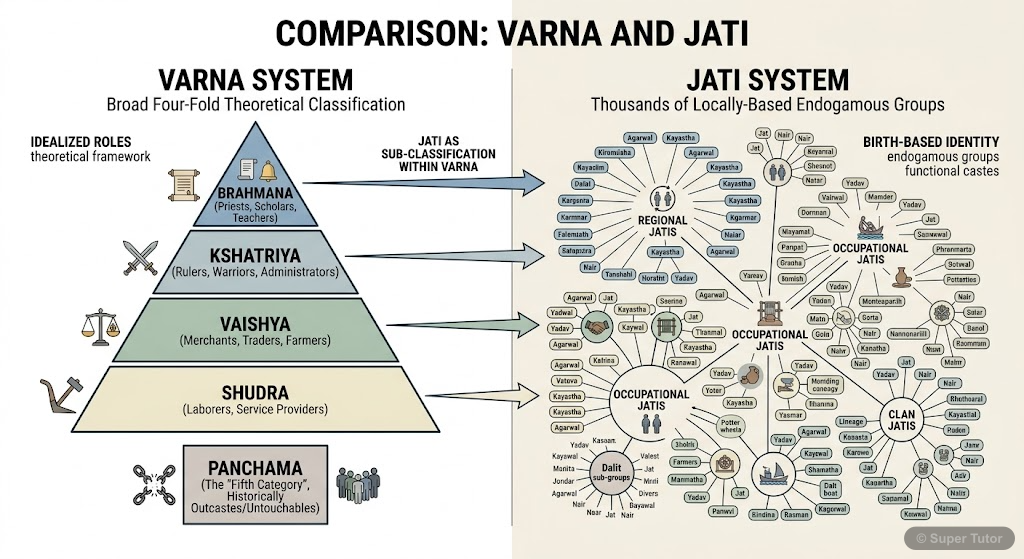
Learn better with visuals Super Tutor has hundreds of illustrations like this across every chapter — all free to try.
Get startedOverview
This chapter explores three fundamental social institutions that form the backbone of Indian society: caste, tribe, and family. These institutions have evolved significantly over time, adapting to colonial influences, modernization, and contemporary changes while maintaining certain traditional elem
Key Concepts
An ancient social institution unique
An ancient social institution unique to the Indian subcontinent, involving hierarchical division of society. It includes two main aspects: Varna (four
A concept coined by M
A concept coined by M.N. Srinivas referring to the process by which lower or middle castes adopt the ritual, domestic, and social practices of higher
Term used by M
Term used by M.N. Srinivas to describe intermediate castes that gained economic and political power through land reforms after Independence. Examples
Indigenous communities comprising about 8
Indigenous communities comprising about 8.6% of India's population, primarily concentrated in 'middle India' and northeastern states. Traditionally de
The basic social unit that can
The basic social unit that can be nuclear (one set of parents and children) or extended/joint (multiple couples and generations). Indian families show
Learning Objectives
- Understand the evolution and contemporary relevance of the caste system in India
- Analyze the characteristics and challenges faced by tribal communities
- Examine the changing structure and dynamics of family systems in India
- Evaluate the impact of modernization and colonialism on traditional social institutions
- Assess the role of these institutions in contemporary Indian society and politics
Frequently Asked Questions
What are the important topics in Social Institutions: Continuity and Change for Madhya Pradesh Board Class 12 Sociology?
How to score full marks in Social Institutions: Continuity and Change — Madhya Pradesh Board Class 12 Sociology?
Sources & Official References
Content is aligned to the official syllabus. Refer to the board website for the latest curriculum.
More resources for Social Institutions: Continuity and Change
Important Questions
Practice with board exam-style questions
Syllabus
What topics to cover
Revision Notes
Key points for last-minute revision
Study Plan
Step-by-step plan to ace this chapter
Flashcards
Quick-fire cards for active recall
Formula Sheet
All formulas in one place
Practice Quiz
Test yourself with a quick quiz
Concept Maps
See how topics connect visually
For serious students
Get the full Social Institutions: Continuity and Change chapter — for free.
Quizzes, flashcards, AI doubt-solver and a step-by-step study plan for Madhya Pradesh Board Class 12 Sociology.